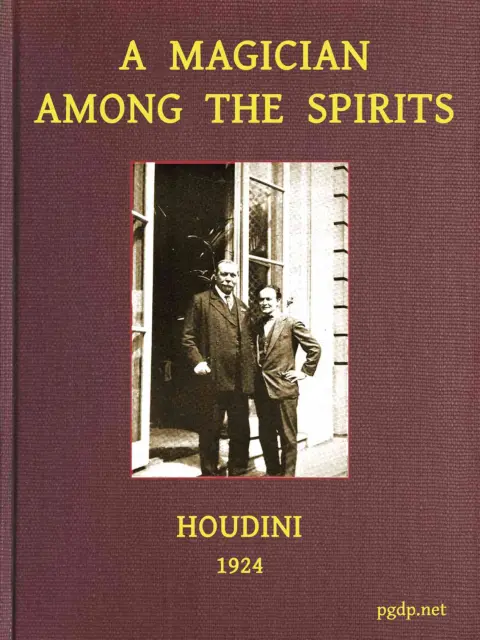
A Magician Among the Spirits
Harry Houdini
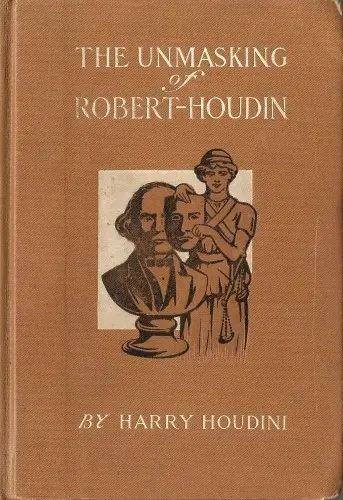
THE CLASSIC COLLECTION · 1908
"The Unmasking of Robert-Houdin" by Harry Houdini is a historical account written in the early 20th century. The book examines the life and legacy of Jean-Eugène Robert-Houdin, who is often hailed as the father of modern magic. Houdini sets out to challenge the romanticized image of Robert-Houdin by revealing what he believes to be historical inaccuracies in Robert-Houdin's own writings, asserting that many of the magician's claims of originality were actually borrowed from lesser-known predecessors. At the start of the work, Houdini introduces his deep admiration for Robert-Houdin, explaining how the famous magician's "Memoirs" inspired him to pursue his own career in magic. However, his extensive research into Robert-Houdin's life leads to disillusionment. He details his investigations, which uncovered numerous instances where Robert-Houdin allegedly took credit for inventions and tricks crafted by other magicians prior to his time. Houdini emphasizes his commitment to revising the historical narrative of magic to acknowledge those who truly contributed to the craft, thereby setting the stage for a critical reassessment of Robert-Houdin's legacy.
Introduction adapted from the source catalogue; source summaries may be automatically generated.
Free to read · English · 53,395 words · No account needed
MAKE TIME FOR A GOOD BOOK
On by default. Untick to stop anonymous reading totals. Each page counts after 10 seconds in view. How this works.
Anonymous counting is on unless you have switched it off.
I am reproducing herewith a number of programmes describing the effect of the trick and proving that it was no novelty when Robert-Houdin "invented" it. In fact the trick was so common that only the supreme egotism of the man can explain his having introduced it into the pages of his book as an original trick. The mysterious clock worked by the counterweight, which has been described, is credited as having been the invention of Johann Nep. Hofzinser.
In an advertisement, published in the London Post of May 23d, 1778, included in my collection, this announcement, among others of much interest, will be found:
"PART II.--Breslaw will exhibit many of his newly invented deceptions with a grand apparatus and experiments and particularly the Magic Clock, Sympathetic Bell, and Pyramidical Glasses in a manner entirely new."
In 1781, while showing at Greenwood's Rooms, Haymarket, London, Breslaw heavily advertised, "Particularly an experiment on a newly invented mechanical clock will be displayed, under the direction of Sieur Castinia, just arrived from Naples, the like never attempted before in this metropolis."
There is every reason to believe that Katterfelto, the greatest of bombastic conjurers, used the electrical clock in his performances, as he made a feature of the various late discoveries, and in his programme of 1782 he advertises "feats and experiments in Magnetical, Electrical, Optical, Chymical, Philosophical, Mathematical, etc., etc." Among implements and instruments or articles mentioned I found Watches, Caskets, Dice, Cards, Mechanical Clocks, Pyramidical Glasses, etc., etc.
Gyngell, Sr., the celebrated Bartholomew Fair conjurer, whose career started about 1788, had on his early programmes, "A Pedestal Clock, so singularly constructed that it is obedient to the word of command." On the same programme (Catherine Street Theatre, London, February 15th, 1816) I find "The Russian Inn," "The Confectioner's Shop," and "The Automaton Rope Vaulter." This programme is reproduced in full in Chapter IV.
Without devoting further space to Robert-Houdin's absurd claim to having invented this clock, we will proceed to discuss his claims to the automaton rope walker, which he called a trapeze performer.
The Trapeze Automaton
Though "Diavolo Antonio" or "Le Voltigeur Trapeze" was not a simple trick, but a cleverly constructed automaton, worked by a concealed confederate, it was a common feature on programmes long before Robert-Houdin claimed it as his invention. Yet with the daring of one who believes that all proof has been destroyed, he announces on page 312 of the American edition of his "Memoirs" that he invented "The Trapeze Performer" for his season of 1848. In the illustrated appendix of his French edition he states that the figure made its first appearance at his Paris theatre, October 1st, 1849. He thus describes the automaton:
Your reading position is saved on this browser. Take it to another device with a library code. Reading pages adapt to text, rather than matching a printed edition.
Harry Houdini
BEHIND THE BOOK
This eBook is for the use of anyone anywhere in the United States and most other parts of the world at no cost and with almost no restrictions whatsoever. You may copy it, give it away or re-use it under the terms of the Project Gutenberg License included with this eBook or online at www.gutenberg.org. If you are not located in the United States, you will have to check the laws of the country where you are located before using this eBook. Read the source licence.
The original source file, including credits and licence, is retained by this library. Request an original-format copy at no charge. Please include the book title and Project Gutenberg identifier #42723.
KEEP YOUR CURIOSITY GOING
Cécile Tormay

Moritz Busch
John L. Ransom
Frances Wright
Cécile Tormay

Mabel Potter Daggett