The well of loneliness
Radclyffe Hall
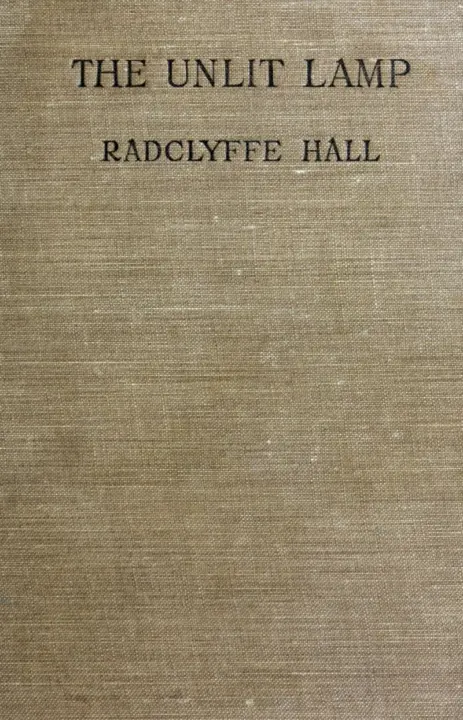
THE CLASSIC COLLECTION · 1924
"The Unlit Lamp" by Radclyffe Hall is a novel written in the early 20th century. The story revolves around the lives of the Ogden family, particularly focusing on the relationship between the parents, Colonel and Mrs. Ogden, and their daughters, Joan and Milly. It depicts the challenges and dynamics within the family, exploring themes of authority, aspirations, and societal expectations. The opening of "The Unlit Lamp" introduces Colonel Ogden, who is characterized by his strictness and overbearing nature, as he scrutinizes household expenses while reflecting on his life in a military context. His wife, Mrs. Ogden, appears weary and is portrayed as a dutiful yet anxious figure, struggling to balance her husband's demands and her sensitivity to her daughters' needs. The two daughters offer contrasting personalities: Milly is depicted as charming and carefree, while Joan stands out as an introspective and strong-minded child, often confronting issues of fairness and justice within their home life. This initial section sets the tone for the conflicts and emotional currents that will define the family's narrative.
Introduction adapted from the source catalogue; source summaries may be automatically generated.
Free to read · English · 112,002 words · No account needed
MAKE TIME FOR A GOOD BOOK
On by default. Untick to stop anonymous reading totals. Each page counts after 10 seconds in view. How this works.
Anonymous counting is on unless you have switched it off.
She was thinking of her now as she tried to eat. Richard, more freckled and blunt-faced than ever, talked and joked in a kind of desperation; it seemed to him that something must be seriously wrong with Joan. Mrs. Benson's keen eyes watched the girl attentively, and what she saw mystified her. She took Elizabeth into the drawing-room after lunch, having first ordered Richard and Joan into the garden. When she and Elizabeth were alone together she began at once.
"What on earth's the matter with Joan, Elizabeth?"
"I don't know--why? Do you think she looks ill?"
"Don't you?"
"Yes."
"I was quite shocked to-day. I always feel interested in that child, and I should be dreadfully anxious if she belonged to me."
"Well, she's at a difficult age, you know."
"Oh, my dear, it's more than that; have you been letting her work too
hard?"
"Oh!" said Elizabeth violently, "I'm sick to death of being asked that; of course she works too hard, but it isn't that, it's----"
"Yes?" queried Mrs. Benson.
"It's--oh! I don't know, Mrs. Benson, I can't put it into words, but it's an awful responsibility, somehow; I can't tell you how it worries me." Her voice shook.
Mrs. Benson patted her hand reassuringly. "Whatever it is, it's got on your nerves too, Elizabeth."
Elizabeth looked at her a little startled. Yes, it had got on her nerves, it was horribly on her nerves and had been for weeks. She longed to talk frankly and explain to this kind, commonplace woman the complicated situation as she saw it, to ask her advice. She began: "Joan's got something on her mind----" Then stopped.
"But of course she has," said Mrs. Benson.
"And she's growing--mentally, I mean. Oh, and physically too----"
"They all do that, Elizabeth."
"Yes, but--I don't understand it; at least, yes, I do understand it,
only I can't see my way."
"Your way?"
"Yes, my way with Joan."
"Can't you try to rouse her? She seems to me to be getting very morbid."
"No, she's not--at least not in the way you mean. Don't think I'm mad, but Joan gives me such a queer feeling. I feel as though she'd been fighting, fighting, fighting to get out, to be herself, and that now she's not fighting any more, she's too tired."
"But, my dear child, what is it all about?"
"I think I know, in fact I'm sure I do, and yet I can't help her. I want her to go away from here some day, I want her to have a life of her own. Can't you see how it is? She's so much her mother's favourite--they adore each other."
Your reading position is saved on this browser. Take it to another device with a library code. Reading pages adapt to text, rather than matching a printed edition.
BEHIND THE BOOK
This eBook is for the use of anyone anywhere in the United States and most other parts of the world at no cost and with almost no restrictions whatsoever. You may copy it, give it away or re-use it under the terms of the Project Gutenberg License included with this eBook or online at www.gutenberg.org. If you are not located in the United States, you will have to check the laws of the country where you are located before using this eBook. Read the source licence.
The original source file, including credits and licence, is retained by this library. Request an original-format copy at no charge. Please include the book title and Project Gutenberg identifier #69137.
KEEP YOUR CURIOSITY GOING
Coulson Kernahan

Maurice Baring
Frances Wright
Cécile Tormay

Frederic Jesup Stimson

W. H. P. (William Henry Pope) Jarvis