The well of loneliness
Radclyffe Hall
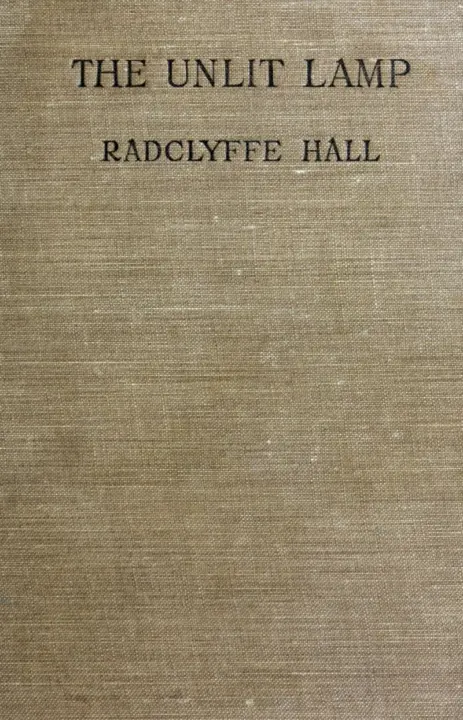
THE CLASSIC COLLECTION · 1924
"The Unlit Lamp" by Radclyffe Hall is a novel written in the early 20th century. The story revolves around the lives of the Ogden family, particularly focusing on the relationship between the parents, Colonel and Mrs. Ogden, and their daughters, Joan and Milly. It depicts the challenges and dynamics within the family, exploring themes of authority, aspirations, and societal expectations. The opening of "The Unlit Lamp" introduces Colonel Ogden, who is characterized by his strictness and overbearing nature, as he scrutinizes household expenses while reflecting on his life in a military context. His wife, Mrs. Ogden, appears weary and is portrayed as a dutiful yet anxious figure, struggling to balance her husband's demands and her sensitivity to her daughters' needs. The two daughters offer contrasting personalities: Milly is depicted as charming and carefree, while Joan stands out as an introspective and strong-minded child, often confronting issues of fairness and justice within their home life. This initial section sets the tone for the conflicts and emotional currents that will define the family's narrative.
Introduction adapted from the source catalogue; source summaries may be automatically generated.
Free to read · English · 112,002 words · No account needed
MAKE TIME FOR A GOOD BOOK
On by default. Untick to stop anonymous reading totals. Each page counts after 10 seconds in view. How this works.
Anonymous counting is on unless you have switched it off.
They stared at each other in silence for a moment, and then: "Oh, Joan!"
"Richard!"
They clasped hands and laughed, then they clasped hands all over again and laughed again too, but with tears in their eyes.
Presently he said: "After all these years, Joan, and to meet in a place
like this!"
"Yes, it's a long time, isn't it!"
"It's a lifetime," he replied gravely.
They went out on to the veranda. "Mother's going to bed," she told him. "I can stay out here for twenty minutes."
"Why only twenty minutes, Joan?"
"Because I must go and read to her when she's undressed; she's still rather sleepless after the journey."
He was silent. Then he said: "Well, tell me all about it, please; I want
to hear everything."
She smiled at the familiar words. "That won't take twenty minutes; I can say it in less than two."
"Then say it," he commanded.
"I was bottled, after all," she told him with mock solemnity, but her
voice shook a little.
He took her hand and pressed it very gently. "I know that, my dear."
She said: "You stopped writing rather suddenly, I thought. Why was
that?"
He hesitated. "Well, you know, after Elizabeth's marriage and your decision to throw up the sponge--you remember you wrote to me of your decision, don't you?---- Well, after that I did write occasionally, for a year or two, but then it all seemed so hopeless, and I realized that you didn't mean to marry me, so I thought it best to let you go. I had my work, Joan, and I tried to wipe you out; you were a disturbing element."
She nodded. She could understand his not having wanted a distraction in the days when he was making his career, she could even understand his having dropped her; what interest could he have had in so disappointing a life as hers? "And you, on the other hand, have made good?" she queried, continuing her own train of thought.
He sighed. "Oh, yes, I suppose so; I'm considered a very successful man,
I believe."
It came to her as a shock that she ought to know something about this very successful man, and that the mere fact that she knew nothing showed how completely she had dropped away from all her old interests.
"Don't be angry, Richard," she said apologetically. "But please tell me what you do. Did you specialize in nerves after all?"
He shook his head. "No, Joan, I specialized in brain; I'm a surgeon, my
dear."
"A great one, Richard?"
"Oh, I don't know; I'm fairly useful, I think."
Your reading position is saved on this browser. Take it to another device with a library code. Reading pages adapt to text, rather than matching a printed edition.
BEHIND THE BOOK
This eBook is for the use of anyone anywhere in the United States and most other parts of the world at no cost and with almost no restrictions whatsoever. You may copy it, give it away or re-use it under the terms of the Project Gutenberg License included with this eBook or online at www.gutenberg.org. If you are not located in the United States, you will have to check the laws of the country where you are located before using this eBook. Read the source licence.
The original source file, including credits and licence, is retained by this library. Request an original-format copy at no charge. Please include the book title and Project Gutenberg identifier #69137.
KEEP YOUR CURIOSITY GOING
Coulson Kernahan

Maurice Baring
Frances Wright
Cécile Tormay

Frederic Jesup Stimson

W. H. P. (William Henry Pope) Jarvis