The well of loneliness
Radclyffe Hall
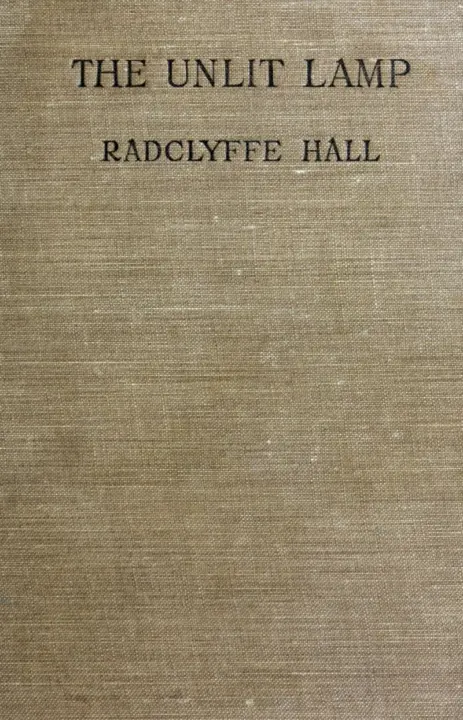
THE CLASSIC COLLECTION · 1924
"The Unlit Lamp" by Radclyffe Hall is a novel written in the early 20th century. The story revolves around the lives of the Ogden family, particularly focusing on the relationship between the parents, Colonel and Mrs. Ogden, and their daughters, Joan and Milly. It depicts the challenges and dynamics within the family, exploring themes of authority, aspirations, and societal expectations. The opening of "The Unlit Lamp" introduces Colonel Ogden, who is characterized by his strictness and overbearing nature, as he scrutinizes household expenses while reflecting on his life in a military context. His wife, Mrs. Ogden, appears weary and is portrayed as a dutiful yet anxious figure, struggling to balance her husband's demands and her sensitivity to her daughters' needs. The two daughters offer contrasting personalities: Milly is depicted as charming and carefree, while Joan stands out as an introspective and strong-minded child, often confronting issues of fairness and justice within their home life. This initial section sets the tone for the conflicts and emotional currents that will define the family's narrative.
Introduction adapted from the source catalogue; source summaries may be automatically generated.
Free to read · English · 112,002 words · No account needed
MAKE TIME FOR A GOOD BOOK
On by default. Untick to stop anonymous reading totals. Each page counts after 10 seconds in view. How this works.
Anonymous counting is on unless you have switched it off.
"Where's the medicine bag?" Joan asked anxiously.
Mrs. Ogden shook her head. "I don't know; hasn't it been got out? I suppose it's in the cupboard under the stairs."
They routed out the bag from its dusty lair and began to sort bottles. "Joan, you must not go on taking that bromo-seltzer after what Major Boyle told us."
"Of course I shall go on taking it; it's perfectly harmless."
"It's very far from harmless. Major Boyle says that he knows for a
fact----"
"I don't care a rap what Major Boyle thinks he knows," Joan interrupted impatiently. "It's the only thing that does my head the least good, and I'm going to take it."
"Well, I do wish you wouldn't; I'm sure it's very dangerous."
"Oh, Mother, do leave me alone; I'm not a child, I can quite well look
after myself."
They squabbled for a little while over the bromo-seltzer, while the bag grew gradually full to bursting. At last it was closed, but not without an effort.
"Good gracious, here's the bird-seed left out!" Mrs. Ogden exclaimed, producing a good-sized cocoa tin from the washstand cupboard. "And now what's to be done?"
"It must go in a trunk," said Joan firmly.
"But suppose it upsets?"
"Oh, it won't."
"Well, I don't know; it might."
"Then put it in the hold-all; it will be all right there."
"I can't understand why it can't go in the medicine bag; it always has at other times," said Mrs. Ogden discontentedly. "And it's Bobbie's special mixture; I can only get it at one place."
"Bobbie won't die, Mother, if he has to live for three weeks on Hyde's or Spratt's or something; there's lots of seed at the grocers at Lynton, I've often seen it."
But Mrs. Ogden persisted. "We must find room in the bag for it, my
dear."
"I will not unpack the whole of that bag for any bird," said Joan untruthfully; if there had been the least necessity she would not only have unpacked the bag but the entire luggage for Bobbie's sake.
They got off at last, and were actually in the Barnstaple train; bags,
wraps, bird-cage and all.
Mrs. Ogden sighed contentedly. "The worst of the journey's over," she declared. "It's that change in London I always dread."
Joan leant back in her corner and tried to sleep, but a flutter from the cage at her side roused her. She bent down and half uncovered Bobbie, who hopped to the bars and nibbled her finger.
"There, there, my pet," she murmured softly.
Bobbie burst into a loud song. "He likes the noise of the train," smiled Mrs. Ogden, nodding her head.
Your reading position is saved on this browser. Take it to another device with a library code. Reading pages adapt to text, rather than matching a printed edition.
BEHIND THE BOOK
This eBook is for the use of anyone anywhere in the United States and most other parts of the world at no cost and with almost no restrictions whatsoever. You may copy it, give it away or re-use it under the terms of the Project Gutenberg License included with this eBook or online at www.gutenberg.org. If you are not located in the United States, you will have to check the laws of the country where you are located before using this eBook. Read the source licence.
The original source file, including credits and licence, is retained by this library. Request an original-format copy at no charge. Please include the book title and Project Gutenberg identifier #69137.
KEEP YOUR CURIOSITY GOING
Coulson Kernahan

Maurice Baring
Frances Wright
Cécile Tormay

Frederic Jesup Stimson

W. H. P. (William Henry Pope) Jarvis