
Coal and the coal mines
Homer Greene

THE CLASSIC COLLECTION · 1917
"The Unhallowed Harvest" by Homer Greene is a social commentary novel written in the early 20th century. The story centers around the Reverend Robert Bruce Farrar, who finds himself embroiled in a court case involving a working-class family, the Bradleys, after the husband suffers a life-altering injury at work. Through the lens of this legal struggle, the narrative explores themes of social justice, inequality, and the human condition. At the start of the novel, the Reverend Farrar attends a courtroom trial where a negligence case is being decided against the Malleson Manufacturing Company. He is particularly interested in the case due to the human elements involved, namely the struggles of the injured worker, John Bradley, and the emotional turmoil faced by his wife, Mary. As the court proceedings unfold, it becomes clear that while the law is being upheld, a greater moral injustice may be at play, as the ruling favors the corporation despite its negligence. Mary Bradley’s fierce determination to fight for her husband’s dignity and their family's rights highlights the stark divide between the wealthy and the working class, setting the stage for further developments in their lives and in the socio-economic landscape of the time.
Introduction adapted from the source catalogue; source summaries may be automatically generated.
Free to read · English · 121,322 words · No account needed
MAKE TIME FOR A GOOD BOOK
On by default. Untick to stop anonymous reading totals. Each page counts after 10 seconds in view. How this works.
Anonymous counting is on unless you have switched it off.
Then Barry, with a sense of duty well performed, resumed activity with his fork. But Judge Bosworth’s face had grown redder, the rector’s lips were tightly set, as if in an effort to prevent the escape from them of inadvertent words, and Ruth, fearful of the upsetting of her plans for a harmonious dinner, was nervously tapping the damask cloth with a shapely finger. Miss Chichester, seeing that Barry had unwittingly gotten himself into trouble, felt that it was her instant duty to help him out of it.
“Oh, but Barry’s going to give Mrs. Bradley some money anyway, now that her husband’s dead. Aren’t you, Barry? I call that very generous.”
“Yes,” replied Barry, “if she’ll take it. Something as a gift, you know. Purely as a gift. No obligation connected with it at all.”
“A small sum as an honorarium, I suppose, Barry,” said Mr. Tracy, with
a twinkle in his eye.
“Exactly!” replied Barry, “an honorarium.” The word sounded good to him. He meant to stow it away in his memory, for use on some other occasion.
“But what if she won’t accept it?” asked Mrs. Tracy. “That kind of people are so very independent.”
“Barry intends to keep calling on her and urging her, periodically, until she does accept it. Don’t you, Barry?” inquired Westgate. Mr. Tracy and Westgate never seemed able to let escape them a good opportunity of having a little quiet amusement at Barry’s expense.
“Why,” replied Barry, “it might take one or two more visits to induce her to be reasonable about it, I don’t know.”
“Well,” said Miss Chichester, “if she doesn’t take it the second time it’s offered to her, she should never have another chance. Barry can’t afford to be perpetually chasing after ungrateful people to force money on them. Can you, Barry?”
“But what if Barry enjoys the chase?” asked Westgate.
Then the vice-president of the Malleson Manufacturing Company awoke to a dim consciousness of the fact that he was being made the subject of gentle raillery.
“Oh, now, look here, Phil,” he said, “the woman’s handsome and all that, you know; but really, belonging, as she does, to the laboring class, it’s not to be presumed that she would drive so conservative a man as I am suddenly daft.”
“She hasn’t driven you suddenly daft, Barry,” replied Westgate. “I’m sure that no one who has known you for any length of time would accuse her of having done that.”
“Philip,” remonstrated Ruth, “behave yourself!”
Your reading position is saved on this browser. Take it to another device with a library code. Reading pages adapt to text, rather than matching a printed edition.
Homer Greene

Homer Greene
Homer Greene
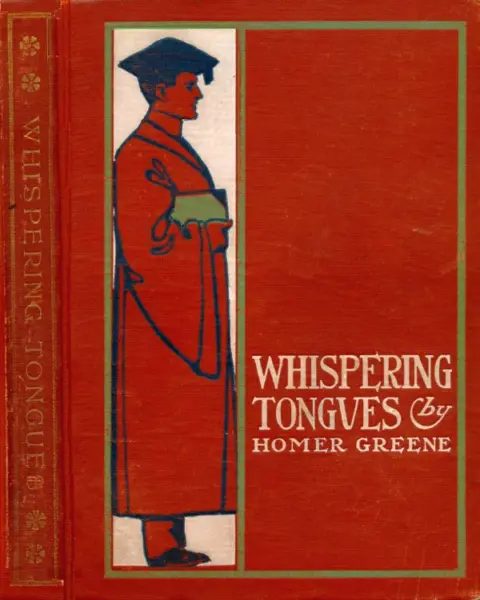
Homer Greene
BEHIND THE BOOK
This eBook is for the use of anyone anywhere in the United States and most other parts of the world at no cost and with almost no restrictions whatsoever. You may copy it, give it away or re-use it under the terms of the Project Gutenberg License included with this eBook or online at www.gutenberg.org. If you are not located in the United States, you will have to check the laws of the country where you are located before using this eBook. Read the source licence.
The original source file, including credits and licence, is retained by this library. Request an original-format copy at no charge. Please include the book title and Project Gutenberg identifier #70967.
KEEP YOUR CURIOSITY GOING
Coulson Kernahan

Maurice Baring
Frances Wright
Cécile Tormay

Frederic Jesup Stimson

W. H. P. (William Henry Pope) Jarvis