THE CLASSIC COLLECTION✦An outlaw’s diary: the CommuneCLASSIC FREE BOOKS
An outlaw’s diary: the Commune
Cécile Tormay
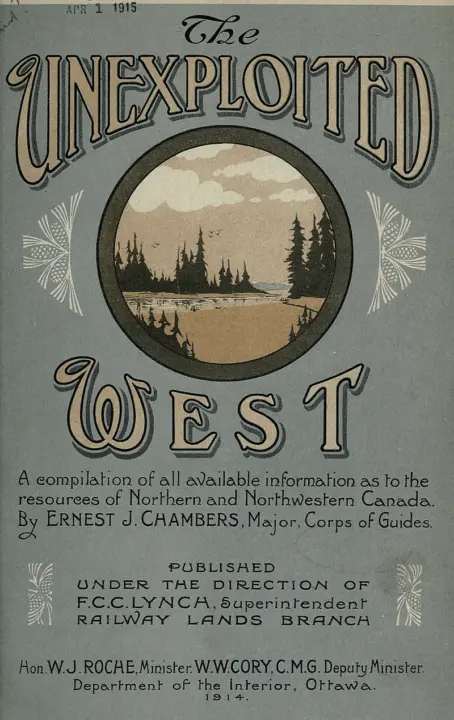
THE CLASSIC COLLECTION · 1914
"The Unexploited West" by Major Ernest J. Chambers is a compilation of research focused on the natural resources of northern Canada's unexploited regions, written in the early 20th century. The book aims to consolidate and present the accumulated knowledge regarding the area's climate, agricultural potential, timber, minerals, and fauna to stimulate interest and exploration in these overlooked territories. The opening of the work serves as a preface, contextualizing the book's purpose and highlighting the increasing immigration and exploration pressures in Canada, particularly westward. Chambers informs the reader about the previous misconceptions regarding the vast land north of the “Fertile Belt,” once deemed sterile and inhospitable, but now reassessed due to valuable exploratory findings. He notes the historical research efforts and public demand for information, emphasizing the newfound recognition of the area’s economic potential, along with the publication's systematic arrangement of findings regarding the climate, soil, and resources of this enticing yet largely unknown frontier.
Introduction adapted from the source catalogue; source summaries may be automatically generated.
Free to read · English · 194,188 words · No account needed
MAKE TIME FOR A GOOD BOOK
On by default. Untick to stop anonymous reading totals. Each page counts after 10 seconds in view. How this works.
Anonymous counting is on unless you have switched it off.
Ogilvie, William, D.L.S., exploratory trips of, in 1884 and in 1888, 18
report on agricultural possibilities in the Athabaska basin, 134
on soil and climate in Peace river country, 149-154
on waterpower on Athabaska river, 177
on waterpower on Slave river, 177
on wood buffalo in northern Alberta, 196, 197
on fish in lake Athabaska, 204
on Mackenzie basin, 234
much forest between Great Slave lake and Fort Simpson, 267
dense forest around Fort Nelson, 269
on timber on lower Mackenzie, 272
on deposits of economic minerals in Mackenzie valley, 284
on fish of the Mackenzie, 300
Oil springs of Athabaska region, 19
Oil throughout Mackenzie valley, 282
Oliver, Hon. Frank, trip of, made in 1910, 27 his opinion of the agricultural possibilities of the country between Edmonton and the Mackenzie, 141 evidence before the Senate Committee as to agricultural possibilities in Peace river country, 162 opinion of timber in Athabaska country, 177
O’Sullivan, Owen, C.E., on the west coast of James bay, 57 testimony before the Senate Committee of 1907, 57, 58 1906 report, 73, 74 further evidence before the Senate Committee of 1907, 74
Owl and Churchill rivers, timber in the country between, 76, 77
Pallister, Captain John, report of, 2, 3
Parliamentary inquiry, an early, 8, 9
Parliamentary inquiries of recent date, 16, 27
Pas and Cross lake, timber of the district between, 78, 79
Pas and Clearwater lake, Mr. McLaggan’s description of the waters between,
92
Patrol of the country between Great Slave lake and Hudson bay by Inspector E. A. Pelletier of the Royal Northwest Mounted Police, 23, 24
Peace river district, 131
river and tributaries, 143-144
climatic conditions, 149
settlements, 170, 171
transportation and industries, 171, 172
climate exceptionally healthy, 174
timber, 177-179
gold found in the bars in river, 180
iron, 181
timber, etc., 261, 262
fine balsam poplar, 268
woodland caribou, 291
feathered game, 294
arctic grayling, 296
Peat deposits in the area north of lake Winnipeg, 84
Pelletier, Inspector E. A., patrol of, of the country between Great Slave lake and Hudson bay, 23, 24
Petitot, Rev. Father, O.M.I., of Fort Good Hope, evidence of, before Senate Committee of 1888, 283
Petroleum, indications of, in the tar sands found along Athabaska river,
188
borings for, in Athabaska region, 189-194
all over Athabaska district, 282
Pike, Mr. Warburton, explorations of, of Great Slave lake district, 19 description of the climate in Peace river country, in his book, 173, 174
Pine (Banksian), 67
Mr. Preble’s report, 268
Point Separation and country surrounding is well wooded, 273, 274
Polar bear, the, 356
Poplar, Balsam, Rough-barked poplar, Cotton Tree, Balm of Gilead, etc., 65
aspen or white poplar, 122
balsam or black, 122
around Athabaska, Slave and Peace rivers, 268
Potatoes grown as far north as Nelson House, 56
fifty miles north of Pas, 56
at Split lake, 58
Prairie land around Fort Nelson, 269
Prairie River settlement, 171
Your reading position is saved on this browser. Take it to another device with a library code. Reading pages adapt to text, rather than matching a printed edition.
BEHIND THE BOOK
This eBook is for the use of anyone anywhere in the United States and most other parts of the world at no cost and with almost no restrictions whatsoever. You may copy it, give it away or re-use it under the terms of the Project Gutenberg License included with this eBook or online at www.gutenberg.org. If you are not located in the United States, you will have to check the laws of the country where you are located before using this eBook. Read the source licence.
The original source file, including credits and licence, is retained by this library. Request an original-format copy at no charge. Please include the book title and Project Gutenberg identifier #49245.
KEEP YOUR CURIOSITY GOING
Cécile Tormay

Moritz Busch
John L. Ransom
Frances Wright
Cécile Tormay

Mabel Potter Daggett