THE CLASSIC COLLECTION✦An outlaw’s diary: the CommuneCLASSIC FREE BOOKS
An outlaw’s diary: the Commune
Cécile Tormay
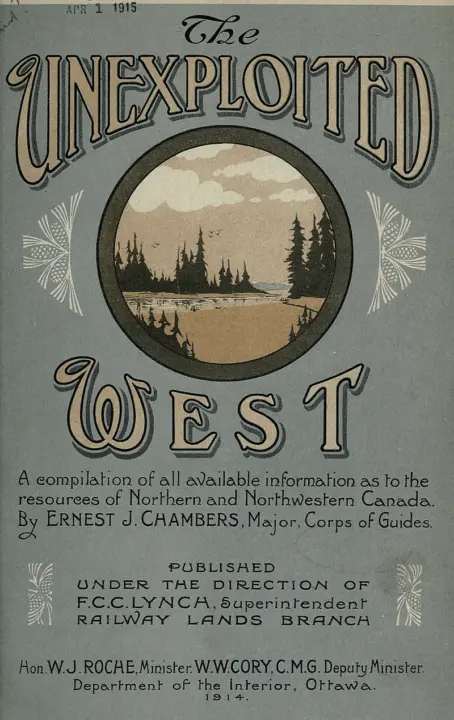
THE CLASSIC COLLECTION · 1914
"The Unexploited West" by Major Ernest J. Chambers is a compilation of research focused on the natural resources of northern Canada's unexploited regions, written in the early 20th century. The book aims to consolidate and present the accumulated knowledge regarding the area's climate, agricultural potential, timber, minerals, and fauna to stimulate interest and exploration in these overlooked territories. The opening of the work serves as a preface, contextualizing the book's purpose and highlighting the increasing immigration and exploration pressures in Canada, particularly westward. Chambers informs the reader about the previous misconceptions regarding the vast land north of the “Fertile Belt,” once deemed sterile and inhospitable, but now reassessed due to valuable exploratory findings. He notes the historical research efforts and public demand for information, emphasizing the newfound recognition of the area’s economic potential, along with the publication's systematic arrangement of findings regarding the climate, soil, and resources of this enticing yet largely unknown frontier.
Introduction adapted from the source catalogue; source summaries may be automatically generated.
Free to read · English · 194,188 words · No account needed
MAKE TIME FOR A GOOD BOOK
On by default. Untick to stop anonymous reading totals. Each page counts after 10 seconds in view. How this works.
Anonymous counting is on unless you have switched it off.
Mair, Mr. Charles, evidence of, on agricultural resources of Peace river
district, 170
climate of same, 174
timber in same, 179
Mackenzie, Mr. Alexander, trips of exploration of, 11 overlooking the Clearwater from Methye portage, 117 country north of the Mackenzie after leaving Slave lake, 267
Mackenzie river region, area comprised in, 29
agricultural possibilities, arable land and topography, 208
extent of watershed of, 209
table of distances, 210
navigation, 210
open season on Mackenzie river, 213
tributaries of Mackenzie, 214
ramparts of cañon of Mackenzie, 216
the “Grand View”, 217
cattle, 219
reindeer, 221
cereals, 221
root crops, 221
Professor Macoun’s testimony, 227
stock-raising, 228
R. G. McConnell, 229
William Ogilvie, 234
timber, 261, 262
muskeg and rocky areas, 261
fine balsam poplar, 268
waterpower, 271
timber, 274
coal, 281
salt springs, 281
salt, 282
iron, 283
fish and game, 288
caribou, 292
feathered game, 294
fish, 295
Macleod, Sergt. R. W., report of, on country between Fort Vermilion and
Hay river, 139-140
on buffalo in the country between Fort Vermilion and the mouth of Hay
river in Great Slave lake, 203
reports of his patrols in 1909 and 1910 from Fort Vermilion to Hay
river, 205-206
Macleod, Mr. Malcolm, before Senate Committee of 1888, 274, 275
Macoun, Professor John, report of, on the Northwest Territories, 16 and Doctor Selwyn, expedition of, 17 reference of, to northern portion of Saskatchewan as an agricultural country in his book “Manitoba and the Great Northwest”, 98 opinion of the agricultural possibilities of Peace river country as stated in his book “Manitoba and the Great Northwest”, 146-147 evidence before the Senate Committee of 1888 as to the character of the Peace river country, 147-149 evidence before the Senate Committee of 1888 as to the timber in Athabaska country, 175 evidence before the Senate Committee of 1888 as to fish in the north, 204 on Mackenzie basin, 228
Manasan falls, 51
Marble found on Marble island in Hudson bay and also at Churchill, 87
McConnell, R. G., B.A., explorations of, 18, 19
report on agricultural possibilities of Peace river country, 154-155
evidence before the Senate Committee of 1907 on agricultural
possibilities in Peace river country, 155-156
report on gold in northern Alberta, 180
on iron in Peace region, 181
on minerals in northern Alberta, 182, 183, 185
on petroleum in the tar sands, 188-189
opinion of the natural gas along the Athabaska river, 193-194
report on Mackenzie basin, 229
on the Mackenzie, 265
from Fort Providence along Beaver river to lake Bis-tcho, 267-268
timber about Fort Simpson, 268
timber along Liard river, 269, 270
jackpine grows as far north as Fort Good Hope, 271
timber below Fort Good Hope, 271, 272
tar springs about Great Slave lake, 281
indications of oil throughout Mackenzie valley, 282
fish in Great Slave lake district, 297
McDonald, Chief Factor A., report of, on minerals of Cree river, 126
McDougall, The Reverend Doctor John, opinion of, of the region to the
south of Split lake, 37
Your reading position is saved on this browser. Take it to another device with a library code. Reading pages adapt to text, rather than matching a printed edition.
BEHIND THE BOOK
This eBook is for the use of anyone anywhere in the United States and most other parts of the world at no cost and with almost no restrictions whatsoever. You may copy it, give it away or re-use it under the terms of the Project Gutenberg License included with this eBook or online at www.gutenberg.org. If you are not located in the United States, you will have to check the laws of the country where you are located before using this eBook. Read the source licence.
The original source file, including credits and licence, is retained by this library. Request an original-format copy at no charge. Please include the book title and Project Gutenberg identifier #49245.
KEEP YOUR CURIOSITY GOING
Cécile Tormay

Moritz Busch
John L. Ransom
Frances Wright
Cécile Tormay

Mabel Potter Daggett