THE CLASSIC COLLECTION✦An outlaw’s diary: the CommuneCLASSIC FREE BOOKS
An outlaw’s diary: the Commune
Cécile Tormay
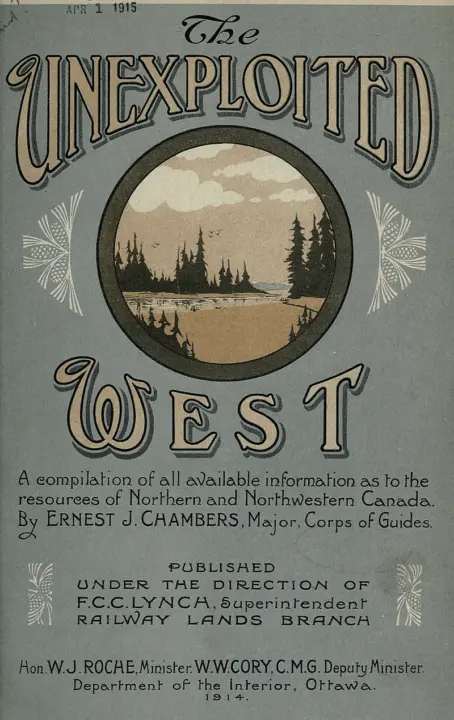
THE CLASSIC COLLECTION · 1914
"The Unexploited West" by Major Ernest J. Chambers is a compilation of research focused on the natural resources of northern Canada's unexploited regions, written in the early 20th century. The book aims to consolidate and present the accumulated knowledge regarding the area's climate, agricultural potential, timber, minerals, and fauna to stimulate interest and exploration in these overlooked territories. The opening of the work serves as a preface, contextualizing the book's purpose and highlighting the increasing immigration and exploration pressures in Canada, particularly westward. Chambers informs the reader about the previous misconceptions regarding the vast land north of the “Fertile Belt,” once deemed sterile and inhospitable, but now reassessed due to valuable exploratory findings. He notes the historical research efforts and public demand for information, emphasizing the newfound recognition of the area’s economic potential, along with the publication's systematic arrangement of findings regarding the climate, soil, and resources of this enticing yet largely unknown frontier.
Introduction adapted from the source catalogue; source summaries may be automatically generated.
Free to read · English · 194,188 words · No account needed
MAKE TIME FOR A GOOD BOOK
On by default. Untick to stop anonymous reading totals. Each page counts after 10 seconds in view. How this works.
Anonymous counting is on unless you have switched it off.
Evidence of Bishop Clut before Senate Committee of 1888, 269
Evidence of Mr. von Hamerstein, before the Senate Committee of 1907, 286
Evidence of Ex-Judge MacLeod, before the Senate Committee of 1888, 291
Evidence of Mr. W. F. Bredin, before the Senate Committee of 1907, 299
Extracts from Mr. Robson’s book “An Account of Six Years’ Residence in Hudson’s Bay”, published in 1752, 34, 35, 36
Extract from Mr. Ed. Umfreville’s volume “Eleven Years in the Service of the Hudson’s Bay Company and Four Years in the Canada Fur Trade”, published in 1790, 36
Extract from the writings of the Reverend John Semmens, 36, 37
Extract from Mr. J. A. J. McKenna’s report on the Hudson bay route, 37
Extract from Doctor Robert Bell’s report of his exploratory trip in 1886 of the country in lake St. Joseph section, 38
Extract from the Annual Report, Department of the Interior, 1885; what Mr. Fawcett says of his descent of the Wenassago to Lac Seul, 38, 39
Extract from Mr. John Armstrong’s report of the preliminary survey in 1908-9 for the proposed railway to Hudson bay, 60
Extracts from the report of the engineer in charge of the boring operations at Pelican river, Mr. A. W. Fraser, 190-192
Fathers of Confederation, the, 1
Favourable lake, 39
vegetation around, 67
sturgeon, 90
“Fertile Belt”, the, 1
Fir trees (splendid) near Great Slave lake, and in the country east to
Slave river, 265
Fish in Sturgeon lake, 88
in Keewatin area, 88
in lake St. Joseph, 88
in Hudson bay, 89
in James bay, 89
and game in region explored by Mr. J. B. Tyrrell in 1896, 90
in Winisk and Attawapiskat rivers, 91
in region lying west of Hudson bay, 91-92
in the area south of Cross lake, 92
in the waters between Pas and Clearwater lake, 92
between Churchill and Pas, 92-93
staple food of inhabitants of country north of the Saskatchewan, 127
in the lakes and streams in the country between Churchill river and lake
Athabaska, 129
in Torch river, 129
in Saskatchewan river, 129
in Reindeer lake, 129
in Methye lake, 129
in the north in general, 203-204
in Big Buffalo river, 205
and game of Mackenzie region, 288
of the Mackenzie country, 295
in Athabaska river and Great Slave lake, 297
of Mackenzie river, reported on by Mr. Wm. Ogilvie, 300
in the “Barren Lands”, 357
the arctic salmon, 358
in the Dubawnt and the Kazan, 359
in the Thelon, 360
Flour manufactured at Fort Vermilion, 169-170
Footprint lake, 51, 52
Fort Enterprise, description of country surrounding, 267
Fort Franklin, 13
trees a hundred and thirty years old, 275
country is well wooded, 276
Fort Good Hope, 217
fine tamarack, 268
fine jackpine according to Mr. McConnell’s report of 1888, 271
tar springs reported by Mr. McConnell, 282
Fort Liard, 221, 226, 233, 241
Fort Norman, 215, 238
fine tamarack, 268
fine spruce, 270
soil, 283
Fort Providence, bitumen near, 285
Fort Nelson is all prairie land, 269
Fort Rae and surrounding country, canoe birch at, 266
Fort Resolution, 240
deer, 293, 294
Fort St. John, agriculture at, 150
Your reading position is saved on this browser. Take it to another device with a library code. Reading pages adapt to text, rather than matching a printed edition.
BEHIND THE BOOK
This eBook is for the use of anyone anywhere in the United States and most other parts of the world at no cost and with almost no restrictions whatsoever. You may copy it, give it away or re-use it under the terms of the Project Gutenberg License included with this eBook or online at www.gutenberg.org. If you are not located in the United States, you will have to check the laws of the country where you are located before using this eBook. Read the source licence.
The original source file, including credits and licence, is retained by this library. Request an original-format copy at no charge. Please include the book title and Project Gutenberg identifier #49245.
KEEP YOUR CURIOSITY GOING
Cécile Tormay

Moritz Busch
John L. Ransom
Frances Wright
Cécile Tormay

Mabel Potter Daggett