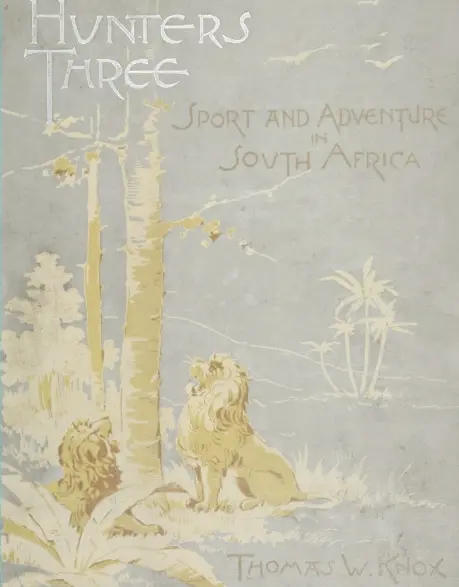
Hunters three: Sport and adventure in South Africa
Thomas Wallace Knox
THE CLASSIC COLLECTION · 1877
"The Underground World: A Mirror of Life Below the Surface" by Thomas Wallace Knox is a non-fiction work written in the late 19th century. The book explores various aspects of underground life, including mining, caves, and tunnels, providing vivid descriptions of both the natural formations and human activities that take place below the earth’s surface. Knox aims to unveil the mysteries and adventures associated with this hidden world, highlighting the challenges and dangers faced by miners and those who thrive in these subterranean environments." The beginning of "The Underground World" sets the stage for an in-depth exploration of life beneath the earth. It opens with a discussion on human curiosity about different ways of living and how much of existence occurs out of sight, emphasizing the rich resources found underground. The author reflects on the lifestyle of miners—experiencing constant darkness, potential hazards, and the isolation of their work. Knox shares anecdotes, including an account of a novice miner's reaction to descending into a shaft, which illustrates the mixture of wonder and trepidation that accompanies such subterranean explorations. This introduction ultimately establishes the book's intention to weave together fact and anecdote, creating a compelling narrative about the underground world.
Introduction adapted from the source catalogue; source summaries may be automatically generated.
Free to read · English · 311,687 words · No account needed
MAKE TIME FOR A GOOD BOOK
On by default. Untick to stop anonymous reading totals. Each page counts after 10 seconds in view. How this works.
Anonymous counting is on unless you have switched it off.
I am indebted for much of my information concerning the Black Hills to Mr. H. N. Maguire, who has made a careful examination of the country. He is very enthusiastic about its future prospects, and in summing up the resources of the region, he says:
“I may be over-sanguine, but I believe all those vast regions drained by the southern tributaries of the Yellowstone, or the major portion of them, comprise the richest mineral fields on the continent—gold, silver, copper, iron, and coal; and perhaps platinum, quicksilver, and other metals. They have all the other natural elements of imperial wealth and expansion: good soil, illimitable pasturage, health-giving climate, and a temperature delightful in summer, and very endurable in winter. Now that the Indians are about whipped into submission, I have no doubt emigration will pour thither in unprecedented numbers, soon resulting in an unbroken chain of industries, from the corn fields of Dakota to the stock ranges of the Yellowstone. The farmer and miner will sustain each other, while both will need and will be able to generously remunerate the artisan and tradesman. Honest industry in every field can not fail to be crowned with success.”
When perusing the estimates of the gold-yield of the Black Hills, we come to the conclusion that the total yield has been, for the year 1876, about $2,000,000.
[Sidenote: YIELD OF GOLD-PRODUCING COUNTRIES.]
Let us compare this with the yield of the other gold-producing
countries:
California produced in 1848 (estimated), $3,826,230 In 1849 (returns manifested), 4,921,250 In 1850 (returns manifested), 27,676,346
These are the first three years of the California gold fever. It is difficult, at this late date, to calculate the exact amount of gold kept in the hands of miners, as specimens, and as a circulating medium, during the first year (1848), but suppose we place the amount at $173,770 (which is a liberal estimate), we have then $4,000,000 as the yield of gold in 1848. Taking into account all the amounts which usually escape the official returns, and also the amounts buried by the miners until their return to the states, the most liberal estimates of these, added to the official returns, can hardly place the yield of gold from this state in 1848 over $10,000,000.
Nevada produced from her placer mines from 1849, the year of the discovery, to 1859, when they ceased working them, both years inclusive, only $400,000. This was produced, however, mostly by Chinese miners, of whom there were only about 200 in the mines. It will be remembered, also, that the placers of Nevada were never very remunerative, and that they decreased in the amount of yield as we approach the final year, 1859.
Oregon, in 1866, only produced, $2,000,000 Montana, with an area of 146,689 square miles, produced, in 1862, from her placers, 300,000 In 1863, 8,000,000
Your reading position is saved on this browser. Take it to another device with a library code. Reading pages adapt to text, rather than matching a printed edition.
Thomas Wallace Knox
Thomas Wallace Knox

Thomas Wallace Knox
Thomas Wallace Knox
BEHIND THE BOOK
This eBook is for the use of anyone anywhere in the United States and most other parts of the world at no cost and with almost no restrictions whatsoever. You may copy it, give it away or re-use it under the terms of the Project Gutenberg License included with this eBook or online at www.gutenberg.org. If you are not located in the United States, you will have to check the laws of the country where you are located before using this eBook. Read the source licence.
The original source file, including credits and licence, is retained by this library. Request an original-format copy at no charge. Please include the book title and Project Gutenberg identifier #57441.
KEEP YOUR CURIOSITY GOING
Cécile Tormay

Moritz Busch
John L. Ransom
Frances Wright
Cécile Tormay

Mabel Potter Daggett