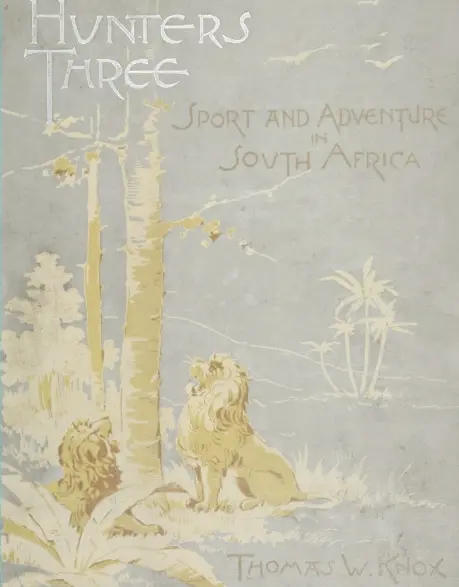
Hunters three: Sport and adventure in South Africa
Thomas Wallace Knox
THE CLASSIC COLLECTION · 1877
"The Underground World: A Mirror of Life Below the Surface" by Thomas Wallace Knox is a non-fiction work written in the late 19th century. The book explores various aspects of underground life, including mining, caves, and tunnels, providing vivid descriptions of both the natural formations and human activities that take place below the earth’s surface. Knox aims to unveil the mysteries and adventures associated with this hidden world, highlighting the challenges and dangers faced by miners and those who thrive in these subterranean environments." The beginning of "The Underground World" sets the stage for an in-depth exploration of life beneath the earth. It opens with a discussion on human curiosity about different ways of living and how much of existence occurs out of sight, emphasizing the rich resources found underground. The author reflects on the lifestyle of miners—experiencing constant darkness, potential hazards, and the isolation of their work. Knox shares anecdotes, including an account of a novice miner's reaction to descending into a shaft, which illustrates the mixture of wonder and trepidation that accompanies such subterranean explorations. This introduction ultimately establishes the book's intention to weave together fact and anecdote, creating a compelling narrative about the underground world.
Introduction adapted from the source catalogue; source summaries may be automatically generated.
Free to read · English · 311,687 words · No account needed
MAKE TIME FOR A GOOD BOOK
On by default. Untick to stop anonymous reading totals. Each page counts after 10 seconds in view. How this works.
Anonymous counting is on unless you have switched it off.
“One spring day, a tent-maker who lived by us, had placed a large and light frame tent upon the edge of the road, without fastening it in any way to the ground. He was warned not to leave it so exposed, but it being a calm day, the advice was neglected. About an hour after, he was inside, busy decorating its walls with red tape, when a sudden and violent whirlwind swept off the claims in all its dusty majesty, and careering down the road, encountered the unfortunate tent. A moment more, it rose in the air like a balloon, the astounded tent-maker vainly hanging to its ribs, until, seeing it was bound to go up, he dropped out, like an apple from a tree. Up it went, whirling with frightful velocity, and pursuing the course of the road, until it knocked fiercely against the gable of a neighboring canteen. In went the roof, while out came the inmates, amidst the smash of bottles and the running of brandy. On and on, and round and round, went the tent, until, espying a jaunty little canvas house which defied wind and rain, in a fit of jealousy it went into it, and, with a grand smash, both lay in ribbons on the ground, while the disgusted tent-maker settled a bill for two ruined houses, instead of being paid for erecting one.
“During the summer months, rain-storms, with heavy thunder and lightning, are frequent. They generally approach with a violent breeze, sharp lightning, and loud thunder. The clouds are all in motion, crossing and meeting each other, while along the face of the nimbus, or storm-cloud, is a heavy gray pall of vapor. This is much lower than the rain-cloud, and when close to the earth, portends a fearful storm. The gathering blackness, increased by clouds of dust, the zigzag lightning, the hoarse, reverberating sound of the thunder, and the moaning wind, all strike the spectator with awe. He gazes around him out on the distant plain, where all is dreary and somber; at the immense gray mounds of the claims, deserted, and looking ghostly and unearthly against their pitchy background—and the storm is upon us. Some ominous rain-drops strike the tent, a flash of lightning blinds, a peal of thunder stuns, and the gates of heaven open. The war of the tempest drowns all other sound, the tent shakes and trembles beneath the blast, while rivers of water course down the street, cutting great gullies in the road, and quickly undermining any protective earth-work the digger has placed around him. Soon the canvas begins to leak, and the inmates of the tent stand in dripping silence, listening to the war of the elements. One night, our Caffres were drowned out by one of these heavy storms. They generally slept in a large, circular fire-place of three feet deep, just sufficient to keep the cold from them, and thus were snugly ensconced when it began to rain. Above the fire-place was a hollow which drained into it. As this drainage was very unpleasant, and often, in heavy rains, flooded out the fire, we built a dam against it as a protection. On the night in question, it rained so fast the hollow was soon a sheet of water, which pressed with such force against the dam that it gave way. In an instant, the fire-place was full to overflowing, and the Caffres, thus rudely awakened, gave one mighty yell as the waters covered them. Aroused by the noise, I peeped forth as they were struggling out, their black heads showing around the edge of the fire-place like those of so many hippopotami. After getting out, and giving some hearty shakes, they commenced fishing up their bed-clothes from the treacherous flood. Long before sunrise, next morning, they were at the tent door, calling loudly for ‘soupies,’ or what we denominate ‘eye-openers,’ and certainly their condition, after what they had gone through, demanded relief.”
Your reading position is saved on this browser. Take it to another device with a library code. Reading pages adapt to text, rather than matching a printed edition.
Thomas Wallace Knox
Thomas Wallace Knox
Thomas Wallace Knox
Thomas Wallace Knox
BEHIND THE BOOK
This eBook is for the use of anyone anywhere in the United States and most other parts of the world at no cost and with almost no restrictions whatsoever. You may copy it, give it away or re-use it under the terms of the Project Gutenberg License included with this eBook or online at www.gutenberg.org. If you are not located in the United States, you will have to check the laws of the country where you are located before using this eBook. Read the source licence.
The original source file, including credits and licence, is retained by this library. Request an original-format copy at no charge. Please include the book title and Project Gutenberg identifier #57441.
KEEP YOUR CURIOSITY GOING
Cécile Tormay

Moritz Busch
John L. Ransom
Frances Wright
Cécile Tormay

Mabel Potter Daggett