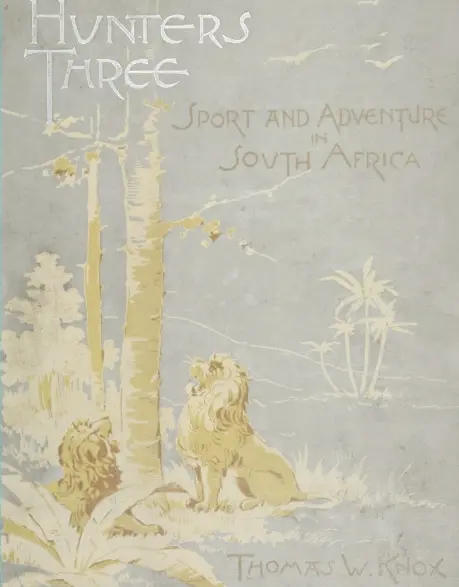
Hunters three: Sport and adventure in South Africa
Thomas Wallace Knox
THE CLASSIC COLLECTION · 1877
"The Underground World: A Mirror of Life Below the Surface" by Thomas Wallace Knox is a non-fiction work written in the late 19th century. The book explores various aspects of underground life, including mining, caves, and tunnels, providing vivid descriptions of both the natural formations and human activities that take place below the earth’s surface. Knox aims to unveil the mysteries and adventures associated with this hidden world, highlighting the challenges and dangers faced by miners and those who thrive in these subterranean environments." The beginning of "The Underground World" sets the stage for an in-depth exploration of life beneath the earth. It opens with a discussion on human curiosity about different ways of living and how much of existence occurs out of sight, emphasizing the rich resources found underground. The author reflects on the lifestyle of miners—experiencing constant darkness, potential hazards, and the isolation of their work. Knox shares anecdotes, including an account of a novice miner's reaction to descending into a shaft, which illustrates the mixture of wonder and trepidation that accompanies such subterranean explorations. This introduction ultimately establishes the book's intention to weave together fact and anecdote, creating a compelling narrative about the underground world.
Introduction adapted from the source catalogue; source summaries may be automatically generated.
Free to read · English · 311,687 words · No account needed
MAKE TIME FOR A GOOD BOOK
On by default. Untick to stop anonymous reading totals. Each page counts after 10 seconds in view. How this works.
Anonymous counting is on unless you have switched it off.
[Sidenote: WONDERFUL GEMS.]
“At the head of one of the bodies was found a large and heavy golden helmet, but it had been much crushed, and had become nearly flat under the ponderous weight which pressed upon it. In its present state, it is difficult to describe it. On its forepart, the openings for the eyes and mouth, as also a protuberance ornamented with small stars, are distinctly visible, as also on the top of the helmet, the tube for the crest. The back part is beautifully ornamented with an imitation of the hair. The face of the same body was covered with one of the golden masks which we frequently met with. It seems to have been the custom with the ancient Greeks, to cover the faces of their beloved dead, with masks of gold which exactly represent the outline of the features; probably they did so to preserve the face. We find this custom back in the wooden masks of the Egyptian mummies. The breast and sides were covered by a one-foot eight-inch long, and one-foot broad, thick plate of gold, which was no doubt intended to represent the coat of mail. There were further found one hundred leaves of gold, either of circular or of cross-like form, with impressed ornamentation, consisting either of spiral lines, or of circles. Further, three very heavy golden breast-pins, of which the one is five and one-half, the other five, and the third four and one-half inches long. The last is crowned with a ram, the two others with an ornament in shape of a helmet, and the heads of all the three breast-pins are perforated, probably to put in a flower. There were further found two masterly ornamental objects of massive gold in the form of crosses; also a large golden vase weighing one and seven-eighths kilogrammes: it has two handles, a large foot, and ornamented with three upper and two lower parallel lines, between which is a row of fourteen stars; further, a large golden vase with one handle, and an ornamentation representing seven beautiful flowers; another golden vase with two handles; further, a splendid little golden œhœ, or wine can, with an ornamentation of spiral lines. Further, six golden drinking cups, one of which is a drinking cup with two handles, on each of which is a pigeon, each of the two handles being joined to the foot by two separate golden blades. This goblet reminds us of Nestor’s goblet, which was also ornamented with pigeons (see ‘Iliad,’ XI, 632, 635). One of the other goblets is ornamented with parallel flutings. There were further found two small golden vessels; also, eight silver vases, three of which are admirably conserved; one of the other has its bottom and the mouth of bronze; below its bottom were found one hundred of the aforesaid golden buttons. I further found, in this tomb, thirteen large bronze vessels. This kind of vessel was in high esteem in the heroic age, and we see them continually mentioned by Homer as prizes in the games. I suppose that to each hero were given in the grave the goblets and other objects which were dear to him in his lifetime, having been won by him in the games, or having been given to him by his host as a pledge of hospitality and friendship. There was also found a large quantity of small perforated amber balls of necklaces, and a bronze or copper fork with three teeth, which had probably served on the funeral pyres. There were further found thirty-five arrow heads of obsidian. Nothing could give a better idea of the great antiquity of these tombs than these stone arrow-heads, for the ‘Iliad’ seems to know only arrow-heads of bronze (e.g., ‘Iliad,’ XIII, 650 and 662). Probably there had also been deposited bows and quivers in the tomb, but they would have been of wood, and would have rotted away. To my greatest regret, among thousands of gold ornaments, there is not even a single sign resembling writing, and it therefore appears certain that the sepulchres belong to an epoch which preceded the introduction of the Phœnician alphabet. Had the latter been known, the Mycenæan goldsmiths, whose continual efforts appear to have been directed to the invention of a new ornamentation, would have been very ambitious to show the novelty of the alphabet. A second proof of the immense antiquity of these tombs, is the entire absence of any vestige of either iron or glass, or of any pottery made on the potter’s wheel. But the hand-made pottery had reached a high degree of perfection, such as has never been attained here in later times by the pottery made on the wheel.”
Your reading position is saved on this browser. Take it to another device with a library code. Reading pages adapt to text, rather than matching a printed edition.
Thomas Wallace Knox
Thomas Wallace Knox
Thomas Wallace Knox
Thomas Wallace Knox
BEHIND THE BOOK
This eBook is for the use of anyone anywhere in the United States and most other parts of the world at no cost and with almost no restrictions whatsoever. You may copy it, give it away or re-use it under the terms of the Project Gutenberg License included with this eBook or online at www.gutenberg.org. If you are not located in the United States, you will have to check the laws of the country where you are located before using this eBook. Read the source licence.
The original source file, including credits and licence, is retained by this library. Request an original-format copy at no charge. Please include the book title and Project Gutenberg identifier #57441.
KEEP YOUR CURIOSITY GOING
Cécile Tormay

Moritz Busch
John L. Ransom
Frances Wright
Cécile Tormay

Mabel Potter Daggett