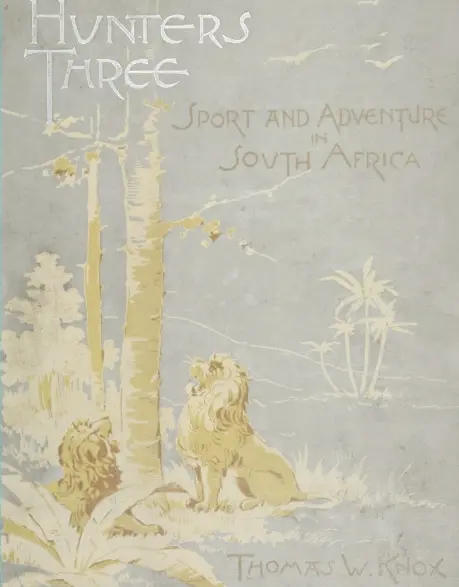
Hunters three: Sport and adventure in South Africa
Thomas Wallace Knox
THE CLASSIC COLLECTION · 1877
"The Underground World: A Mirror of Life Below the Surface" by Thomas Wallace Knox is a non-fiction work written in the late 19th century. The book explores various aspects of underground life, including mining, caves, and tunnels, providing vivid descriptions of both the natural formations and human activities that take place below the earth’s surface. Knox aims to unveil the mysteries and adventures associated with this hidden world, highlighting the challenges and dangers faced by miners and those who thrive in these subterranean environments." The beginning of "The Underground World" sets the stage for an in-depth exploration of life beneath the earth. It opens with a discussion on human curiosity about different ways of living and how much of existence occurs out of sight, emphasizing the rich resources found underground. The author reflects on the lifestyle of miners—experiencing constant darkness, potential hazards, and the isolation of their work. Knox shares anecdotes, including an account of a novice miner's reaction to descending into a shaft, which illustrates the mixture of wonder and trepidation that accompanies such subterranean explorations. This introduction ultimately establishes the book's intention to weave together fact and anecdote, creating a compelling narrative about the underground world.
Introduction adapted from the source catalogue; source summaries may be automatically generated.
Free to read · English · 311,687 words · No account needed
MAKE TIME FOR A GOOD BOOK
On by default. Untick to stop anonymous reading totals. Each page counts after 10 seconds in view. How this works.
Anonymous counting is on unless you have switched it off.
[Sidenote: LIST OF BONANZAS.]
The following list of the bonanzas of the Comstock will be interesting to all who are watching the marvelous history of that mammoth vein:
1. Ophir and Mexican.—Discovered on the surface, and extended 500 feet in depth. Average width of ore, 15 feet; cubical contents, 112,000 tons; approximate value of ore, $22,000,000.
2. Gould & Curry.—Extended from the surface to the depth of 500 feet. Average width of ore, 15 feet; length along the vein, 500 feet; cubical contents, 190,000 tons; value of ore, $37,500,000.
3. Savage.—This was a continuation of the Curry bonanza, but not so rich. The ore continued down in the Savage claim to the very bottom of that mine, which is now 2,300 feet below the outcroppings.
4. Hale & Norcross bonanza.—This body was struck at a depth of 450 feet. It averaged 10 feet in width, was about 200 feet long, and stretched down to the 1,200 foot level. Cubical contents, 75,000 tons; value, $5,500,000.
5. Chollar Potosi bonanza.—struck at a depth of 500 feet; width of the vein worked, 100 feet; has extended with but few interruptions down to the present bottom of the mine, which is over 1,700 feet. Cubical contents, 1,500,000 tons; value, $24,000,000.
6. Gold Hill bonanza.—This body extended from the surface to a depth of 500 feet, and for 300 feet on the vein. Contents, 300,000 tons; value, $10,000,000.
7. Yellow Jacket bonanza.—Discovered on the surface, and extended downward for over 700 feet. The ore on this body was quite poor, and never yielded much profit. Its total production was about $5,000,000.
8. Kentucky bonanza.—300 feet long, 20 feet wide, and 400 feet deep. This ore was very rich. Contents, 100,000 tons; value, $10,000,000.
9. Crown Point and Belcher bonanza.—Discovered on the 1,400 foot level, and extended downward for 600 feet. Is still producing in the Belcher. Contents, 1,500,000 tons; value, $50,000,000.
10. Consolidated Virginia and California bonanza.—This last and greatest ore body which the lode has yet developed, was found by drifting eastward from the 1,500 foot level into what was supposed to be the last country rock. The bonanza lies above and below this, and is believed to contain $140,000,000. It extends for about 700 feet along the vein, is 600 feet in height, and nearly 100 feet in width. Up to the present date, it has yielded over $30,000,000, though discovered less than two years ago, and is now producing at the rate of $120,000 per day.
The Comstock now furnishes employment for over 2,000 miners. Its daily output of ore is nearly 2,000 tons, and its yield, for the year 1877, will approach $50,000,000. One-half of this (or, more correctly, about forty-two per cent.) is gold, and the balance silver. When the amount of ore now in sight is taken out, the lode will have produced in all something over $300,000,000 in precious metals.
Your reading position is saved on this browser. Take it to another device with a library code. Reading pages adapt to text, rather than matching a printed edition.
Thomas Wallace Knox
Thomas Wallace Knox
Thomas Wallace Knox
Thomas Wallace Knox
BEHIND THE BOOK
This eBook is for the use of anyone anywhere in the United States and most other parts of the world at no cost and with almost no restrictions whatsoever. You may copy it, give it away or re-use it under the terms of the Project Gutenberg License included with this eBook or online at www.gutenberg.org. If you are not located in the United States, you will have to check the laws of the country where you are located before using this eBook. Read the source licence.
The original source file, including credits and licence, is retained by this library. Request an original-format copy at no charge. Please include the book title and Project Gutenberg identifier #57441.
KEEP YOUR CURIOSITY GOING
Cécile Tormay

Moritz Busch
John L. Ransom
Frances Wright
Cécile Tormay

Mabel Potter Daggett