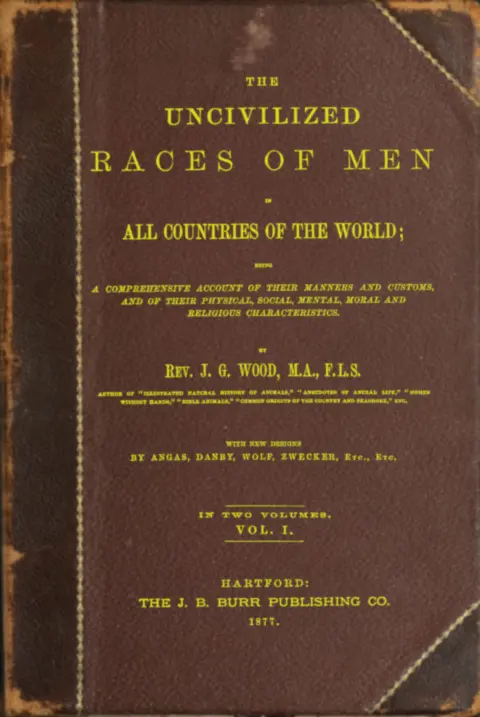
The uncivilized races of men in all countries of the world; vol. 1 of 2 Being a comprehensive account of their manners and customs, and of their physical, social, mental, moral and religious characteristics
J. G. (John George) Wood
THE CLASSIC COLLECTION · 1878
"The Uncivilized Races of Men in All Countries of the World; Vol. 2 of 2" by Rev. J. G. Wood is a comprehensive anthropological publication written in the late 19th century. This work delves into the manners, customs, and various characteristics of uncivilized tribes primarily in the Americas and the islands between there and Asia, including parts of Australia and New Zealand. It aims to provide a detailed account of the social, mental, physical, and religious aspects of these tribes, often drawing comparisons and observational insights from extensive research. The opening of this volume introduces readers to the themes of medicine, burial practices, and cultural beliefs of Australian Indigenous people. It highlights the roles of 'bilbos' (native doctors) in treating ailments, which includes bizarre treatments such as bloodletting and the use of a crystal believed to have healing powers. Additionally, it discusses various mourning and burial rites, showcasing contrasting practices for men and women, and examining the societal perceptions surrounding death. The portrayal of these cultural customs offers a vivid picture of the intricate life and traditions of the Australian natives, setting the stage for deeper exploration into the rituals and beliefs of other tribes across the world in subsequent sections.
Introduction adapted from the source catalogue; source summaries may be automatically generated.
Free to read · English · 513,705 words · No account needed
MAKE TIME FOR A GOOD BOOK
On by default. Untick to stop anonymous reading totals. Each page counts after 10 seconds in view. How this works.
Anonymous counting is on unless you have switched it off.
“The objects of worship are the nats, benign or malignant,--the first such as Sinlah, the sky spirit, who gives rain and good crops; Chan and Shitah, who cause the sun and moon to rise. These they worship because their fathers did so and told their children that they were good. Cringwan is the beneficent patron of agriculture; but the malignant nats must be bribed not to ruin the crops. When the ground is cleared for sowing, Masoo is appeased with pork and fowls burned at the foot of the village altars; when the paddy is eared, buffaloes and pigs are sacrificed to Cajat. A man about to travel is placed under the care of Muron, the toomsa, after due sacrifices, requesting him to tell the other nats not to harm that man. Neglect of Mowlain will result in the want of compraw, or silver, the great object of a Kakhyen’s desire; and if hunters forbear offerings to Chilong some one will be killed by stag or tiger. Chilong and Muron are two of ten brothers who have an especial interest in Kakhyen affairs, and another, named Phee, is the guardian of the night. Every hill, forest, and stream has its own nat of greater or less power; every accident or illness is the work of some malignant or vindictive one of ‘these viewless ministers.’
The character of this race of mountaineers is not attractive. They are not brave as warriors, but are quarrelsome and revengeful, and if atonement for a wrong be not made they perpetuate a feud implacably. They do not seek an open, fair fight, but lie in wait and attack stealthily, springing like the tiger upon their foes. Anderson touches their portrait with these dark lines,--“lazy, thievish, and untrustworthy.”
Their thieving propensity extends to man-stealing. They are the
kidnappers of the country.
Dr. Anderson, however, charitably intimates that perhaps the moral deterioration of these fierce, cruel highlanders may be the result of “the knavish injustice of the Chinese traders, or the high-handed extortion and wrong on the part of the Burmese.” The readers of this work will remember many and sad proofs in these sketches of the uncivilized races, that tribes, possessing naturally many excellent traits, have been transformed and degraded into most selfish, brutal, and cruel people by the pillage and piracy of their neighbors, and sometimes by the rapacity and fraud of those that are called civilized and Christian nations.
Abyssinia, 641.
Accawaios, So. America, 1222.
Admiralty Islanders, 970.
Adoption of Parents, Namaquas, 279.
AGRICULTURE among the Badema, 367. Bakalai, 492. Batoka, 350. Bayeye, 338. Bouka, 971. Dinka, 470. Djour, 448. Fuegians, 1168. Gani, 430. Guianans, 1246. Hebrides, New, 972. Hottentots, 231. Kaffirs, 138, 139-144. Manganjas, 355. Ovambos, 319. Shekiani, 522. Wasagara, 407. Watusi, 409.
Ahitas, Philippine Islands, 920.
Your reading position is saved on this browser. Take it to another device with a library code. Reading pages adapt to text, rather than matching a printed edition.
J. G. (John George) Wood
J. G. (John George) Wood
BEHIND THE BOOK
This eBook is for the use of anyone anywhere in the United States and most other parts of the world at no cost and with almost no restrictions whatsoever. You may copy it, give it away or re-use it under the terms of the Project Gutenberg License included with this eBook or online at www.gutenberg.org. If you are not located in the United States, you will have to check the laws of the country where you are located before using this eBook. Read the source licence.
The original source file, including credits and licence, is retained by this library. Request an original-format copy at no charge. Please include the book title and Project Gutenberg identifier #69074.
KEEP YOUR CURIOSITY GOING
Cécile Tormay

Moritz Busch
John L. Ransom
Frances Wright
Cécile Tormay

Mabel Potter Daggett