THE CLASSIC COLLECTION✦Sex and Society: Studies in the Social Psychology of SexCLASSIC FREE BOOKS
Sex and Society: Studies in the Social Psychology of Sex
William Isaac Thomas
THE CLASSIC COLLECTION · 1923
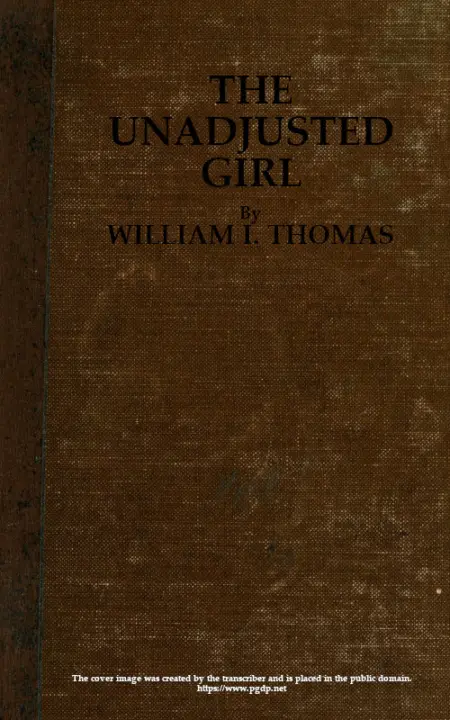
"The Unadjusted Girl, With Cases and Standpoint for Behavior Analysis" by William I. Thomas is a sociological study written in the early 20th century. This work dives into the complexities of human behavior, particularly focusing on the so-called "unadjusted" individuals, such as delinquents, and explores the social and psychological factors that contribute to their behavior. Thomas employs case studies to illustrate his theories on the interplay between innate human instincts and societal influences. The opening of the book sets a thoughtful and analytical tone, establishing that understanding human behavior requires an investigation beyond simple categorizations of individuals. Thomas begins by discussing the fundamental wishes that drive human action, such as the desire for new experiences and the need for security. He emphasizes that maladjustment in individuals arises not from inherent flaws but from the effects of societal pressures and personal experiences. Through this lens, he reflects on the cases of girls and women categorized as delinquents, suggesting that their behavior is a manifestation of deeper emotional and social conflicts rather than mere moral failings. The stage is set for a detailed exploration of how societal constructs influence individual behavior and mental health.
Introduction adapted from the source catalogue; source summaries may be automatically generated.
Free to read · English · 91,637 words · No account needed
MAKE TIME FOR A GOOD BOOK
On by default. Untick to stop anonymous reading totals. Each page counts after 10 seconds in view. How this works.
Anonymous counting is on unless you have switched it off.
Nevertheless, as the result of a series of experiments on the behavior of animals, one of the psychologists assumed that similar work might be done on the newborn child with no more discomfort than he suffers in having his ears scrubbed and certainly no more damage than he receives from the strains and distortions suffered in the act of being born. I quote from the record of these experiments:
On the psychological side our knowledge of infant life is almost nil.... A prominent professor of education once said to us, “You will find when you have taught as many children as I have that you can do nothing with a child until it is over five years of age.” Our own view after studying many hundreds of infants is that one can make or break the child so far as its personality is concerned long before the age of five is reached. We believe that by the end of the second year the pattern of the future individual is already laid down. Many things which go into the making of this pattern are under the control of the parents, but as yet they have not been made aware of them. The question as to whether the child will possess a stable or unstable personality, whether it is going to be timid and beset with many fears and subject to rages and tantrums, whether it will exhibit tendencies of general over or under emotionalism, and the like, has been answered already by the end of the two year period.
There are several reasons why the minute psychological study of infant life is important.... (1) There are no standards of behavior or conduct for young infants. Our experimental work, which even at the end of two years is just beginning, has taught us that the study of infant activity from birth onward will enable us to tell with some accuracy what a normal child at three months of age can and should do and what additional complexities in behavior should appear as the months go by. Psychological laboratories in many institutions ought to be able to make cross-sections of the activity of any infant at any age and tell whether the streams of activity are running their normal course, and whether certain ones are lagging or have not even appeared. After sufficient work has been done to enable us to have confidence in our standards we should be able to detect feeble-mindedness, deficiencies in habit, and deviations in emotional life. If a proper analysis of the activity streams can be made at a very early age the whole care of the child may be altered with beneficial results.... At present we simply have not the data for the enumeration of man’s original tendencies, and it will be impossible to obtain those data until we have followed through the development of the activity of many infants from birth to advanced childhood. Children of five years of age and over are enormously sophisticated. The home environment and outside companions have so shaped them that the original tendencies cannot be observed. The habits put on in such an environment quickly overlay the primitive and hereditary equipment. A workable psychology of human instincts and emotions can thus never be attained by merely observing the behavior of the adult.... (2) By reason of this defect the study of vocational and business psychology is in a backward state. The attempt to select a vocation for a boy or girl in the light of our present knowledge of the original nature of man is little more than a leap in the dark. High sounding names like the constructive instinct, the instinct of workmanship, and the like, which are now so much used by the sociologists and the economists, will remain empty phrases until we have increased our knowledge of infancy and childhood. The only reasonable way, it would seem to us, of ever determining a satisfactory knowledge of the various original vocational bents and capacities of the human race is for psychologists to bring up under the supervision of medical men a large group of infants under controlled but varied and sympathetic conditions. Children begin to reach for, select, play with and to manipulate objects from about the 150th day on. What objects they select day by day, what form their manipulation takes, and what early habits develop upon such primitive instinctive activity should be recorded day by day in black and white. There will be marked individual differences in the material selected, in the length of time any type of material will be utilized, and in the early constructive habits which will arise with respect to all materials worked with by the infant. Without instruction one infant (eighteen to twenty months in an observed case) will build a neat wall with her blocks, with one color always facing her. If the block is turned while she is not looking she will quickly change it and correct the defect. In other children such a bit of behavior can be inculcated only with the greatest difficulty. Still another child cannot be made to play with blocks but will work with twigs and sticks by the hour. Variations in the selection and use of material are the rule in infancy, but until we have followed up the future course of such variations upon infants whose past we have watched day by day we are in no position to make generalizations about the original tendencies which underlie the vocations. (3) Finally, until we have obtained data upon the emotional life of the infant and the normal curve of instinctive and habit activity at the various ages, new methods for correcting deviations in emotional, instinctive and habit development cannot be worked out. Let us take a concrete example. A certain child is afraid of animals of every type, furry objects, the dark, etc. These fears are not hereditary. Our experiments will be convincing upon that point. What steps can we take to remove these fears which, unless they are removed in infancy, may become an enduring part of the child’s personality?[113]
Your reading position is saved on this browser. Take it to another device with a library code. Reading pages adapt to text, rather than matching a printed edition.
BEHIND THE BOOK
This eBook is for the use of anyone anywhere in the United States and most other parts of the world at no cost and with almost no restrictions whatsoever. You may copy it, give it away or re-use it under the terms of the Project Gutenberg License included with this eBook or online at www.gutenberg.org. If you are not located in the United States, you will have to check the laws of the country where you are located before using this eBook. Read the source licence.
The original source file, including credits and licence, is retained by this library. Request an original-format copy at no charge. Please include the book title and Project Gutenberg identifier #59826.
KEEP YOUR CURIOSITY GOING

Abby Morton Diaz
Helen Hunt Jackson
Mary Frances Blaisdell
Stuart Dodgson Collingwood

Kate Douglas Smith Wiggin
Hesba Stretton