THE CLASSIC COLLECTION✦Hawthorne (English Men of Letters Series)CLASSIC FREE BOOKS
Hawthorne (English Men of Letters Series)
Henry James
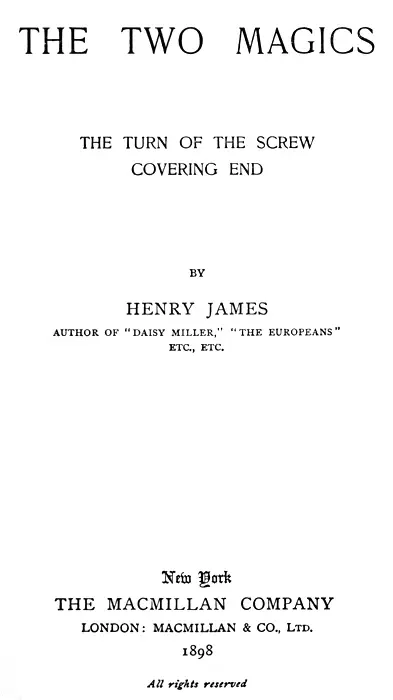
THE CLASSIC COLLECTION · 1898
"The Two Magics: The Turn of the Screw, Covering End" by Henry James is a novel written in the late 19th century. This work presents a supernatural narrative that delves into themes of innocence and malevolence, centering around the enigmatic character of a governess who is hired to care for two children at a remote estate. As she navigates her duties, she faces the haunting presence of malevolent apparitions that threaten the children's well-being. At the start of the story, a group of friends gathers around a fire, sharing eerie tales. One of them, Douglas, hints at a particularly ghastly story involving two children and a dreadful visitation that shook a child and her mother. His intrigue piques the guests' curiosity, leading to the promise of sharing Douglas's unsettling tale, which is intricately connected to the governess. The narrative unfolds as Douglas prepares to read the manuscript of a deceased governess who experienced a haunting at the estate of Bly, where ominous events involving the children are set to transpire. The opening thoroughly establishes the tone of suspense and the chilling atmosphere that pervades the tale, hinting that the governess's experiences will be both beautiful and horrifying.
Introduction adapted from the source catalogue; source summaries may be automatically generated.
Free to read · English · 78,856 words · No account needed
MAKE TIME FOR A GOOD BOOK
On by default. Untick to stop anonymous reading totals. Each page counts after 10 seconds in view. How this works.
Anonymous counting is on unless you have switched it off.
“For you, Mrs. Gracedew?” He took a few steps, looking at his shoes again and as if to give her time to plead--since he wished to be quite fair--that it was not for her. “I’m in to the tune of fifty thousand.”
She was silent, on this announcement, so long that he once more faced her; but if what he showed her in doing so at last made her speak, it also took the life from her tone. “That’s a great deal of money, Mr. Prodmore.”
The tone didn’t matter, but only the truth it expressed, which he so thoroughly liked to hear. “So I’ve often had occasion to say to myself!”
“If it’s a large sum for you, then,” said Mrs. Gracedew, “it’s a still larger one for me.” She sank into a chair with a vague melancholy; such a mass loomed huge, and she sat down before it as a solitary herald, resigning himself with a sigh to wait, might have leaned against a tree before a besieged city. “We women”--she wished to conciliate--“have more modest ideas.”
But Mr. Prodmore would scarce condescend to parley. “Is it
as a ‘modest idea’ that you describe your extraordinary
intrusion----?”
His question scarce reached her; she was so lost for the moment in the sense of innocent community with her sex. “I mean I think we measure things often rather more exactly.”
There would have been no doubt of Mr. Prodmore’s very different community as he rudely replied: “Then you measured this thing exactly half an hour ago!”
It was a long way to go back, but Mrs. Gracedew, in her seat, musingly made the journey, from which she then suddenly returned with a harmless, indeed quite a happy, memento. “Was I very grotesque?”
He demurred. “Grotesque?”
“I mean--did I go on about it?”
Mr. Prodmore would have no general descriptions; he was specific, he was vivid. “You banged the desk. You raved. You shrieked.”
This was a note she appeared indulgently, almost tenderly, to recognise. “We do shriek at Missoura Top!”
“I don’t know what you do at Missoura Top, but I know what you did
at Covering End!”
She warmed at last to his tone. “So do I then! I surprised you. You weren’t at all prepared----”
He took her briskly up. “No--and I’m not prepared yet!”
Mrs. Gracedew could quite see it. “Yes, you’re too astonished.”
“My astonishment’s my own affair,” he retorted--“not less so
than my memory!”
“Oh, I yield to your memory,” said the charming woman, “and I confess my extravagance. But quite, you know, as extravagance.”
Your reading position is saved on this browser. Take it to another device with a library code. Reading pages adapt to text, rather than matching a printed edition.
Henry James
Henry James
Henry James

Henry James
BEHIND THE BOOK
This eBook is for the use of anyone anywhere in the United States and most other parts of the world at no cost and with almost no restrictions whatsoever. You may copy it, give it away or re-use it under the terms of the Project Gutenberg License included with this eBook or online at www.gutenberg.org. If you are not located in the United States, you will have to check the laws of the country where you are located before using this eBook. Read the source licence.
The original source file, including credits and licence, is retained by this library. Request an original-format copy at no charge. Please include the book title and Project Gutenberg identifier #42486.
KEEP YOUR CURIOSITY GOING
Coulson Kernahan

Maurice Baring
Frances Wright
Cécile Tormay

Frederic Jesup Stimson

W. H. P. (William Henry Pope) Jarvis