THE CLASSIC COLLECTION✦Hawthorne (English Men of Letters Series)CLASSIC FREE BOOKS
Hawthorne (English Men of Letters Series)
Henry James
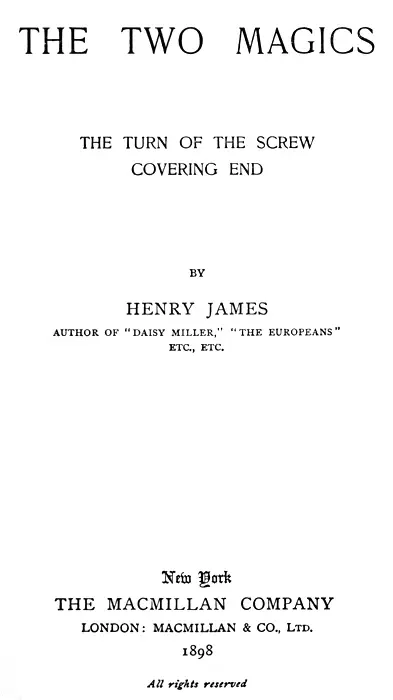
THE CLASSIC COLLECTION · 1898
"The Two Magics: The Turn of the Screw, Covering End" by Henry James is a novel written in the late 19th century. This work presents a supernatural narrative that delves into themes of innocence and malevolence, centering around the enigmatic character of a governess who is hired to care for two children at a remote estate. As she navigates her duties, she faces the haunting presence of malevolent apparitions that threaten the children's well-being. At the start of the story, a group of friends gathers around a fire, sharing eerie tales. One of them, Douglas, hints at a particularly ghastly story involving two children and a dreadful visitation that shook a child and her mother. His intrigue piques the guests' curiosity, leading to the promise of sharing Douglas's unsettling tale, which is intricately connected to the governess. The narrative unfolds as Douglas prepares to read the manuscript of a deceased governess who experienced a haunting at the estate of Bly, where ominous events involving the children are set to transpire. The opening thoroughly establishes the tone of suspense and the chilling atmosphere that pervades the tale, hinting that the governess's experiences will be both beautiful and horrifying.
Introduction adapted from the source catalogue; source summaries may be automatically generated.
Free to read · English · 78,856 words · No account needed
MAKE TIME FOR A GOOD BOOK
On by default. Untick to stop anonymous reading totals. Each page counts after 10 seconds in view. How this works.
Anonymous counting is on unless you have switched it off.
The tone showed a consternation that Mr. Prodmore’s was alert to soothe. “Ah, as long, you know, as you like!”
Yule’s alarm, however, was not assuaged; it appeared to grow as he stared, much discomposed, yet sharply thinking, at the door to which his friend had pointed. “Oh, longer than this, please!” Then as he turned away: “Do you mean she knows----?”
“That she’s here on view?” Mr. Prodmore hung fire a moment, but was equal to the occasion. “She knows nothing whatever. She’s as unconscious as the rose on its stem!”
His companion was visibly relieved. “That’s right--let her remain so! I’ll first take the house,” said Clement Yule.
“Shall I go round with you?” Mr. Prodmore asked.
The young man’s reflection was brief. “Thank you. I’d rather, on the whole, go round alone.”
The old servant who had admitted the gentlemen came back at this crisis from the morning-room, looking from under a bent brow and with much limpid earnestness from one of them to the other. The one he first addressed had evidently, though quite unaware of it, inspired him with a sympathy from which he now took a hint. “There’s tea on, sir!” he persuasively jerked as he passed the younger man.
The elder answered. “Then I’ll join my daughter.” He gained the morning-room door, whence he repeated with an appropriate gesture--that of offering proudly, with light, firm fingers, a flower of his own celebrated raising--his happy formula of Miss Prodmore’s state. “The rose on its stem!” Scattering petals, diffusing fragrance, he thus passed out.
Chivers, meanwhile, had rather pointlessly settled once more in its place some small object that had not strayed; to whom Clement Yule, absently watching him, abruptly broke out. “I say, my friend, what colour is the rose?”
The old man looked up with a dimness that presently glimmered. “The rose, sir?” He turned to the open door and the shining day. “Rather a brilliant----”
“A brilliant----?” Yule was interested.
“Kind of old-fashioned red.” Chivers smiled with the pride of being thus able to testify, but the next instant his smile went out. “It’s the only one left--on the old west wall.”
His visitor’s mirth, at this, quickly enough revived. “My dear fellow, I’m not alluding to the sole ornament of the garden, but to the young lady at present in the morning-room. Do you happen to have noticed if she’s pretty?”
Chivers stood queerly rueful. “Laws, sir--it’s a matter I mostly
notice; but isn’t it, at the same time, sir, a matter--like--of
taste?”
Your reading position is saved on this browser. Take it to another device with a library code. Reading pages adapt to text, rather than matching a printed edition.
Henry James
Henry James
Henry James

Henry James
BEHIND THE BOOK
This eBook is for the use of anyone anywhere in the United States and most other parts of the world at no cost and with almost no restrictions whatsoever. You may copy it, give it away or re-use it under the terms of the Project Gutenberg License included with this eBook or online at www.gutenberg.org. If you are not located in the United States, you will have to check the laws of the country where you are located before using this eBook. Read the source licence.
The original source file, including credits and licence, is retained by this library. Request an original-format copy at no charge. Please include the book title and Project Gutenberg identifier #42486.
KEEP YOUR CURIOSITY GOING
Coulson Kernahan

Maurice Baring
Frances Wright
Cécile Tormay

Frederic Jesup Stimson

W. H. P. (William Henry Pope) Jarvis