THE CLASSIC COLLECTION✦Hawthorne (English Men of Letters Series)CLASSIC FREE BOOKS
Hawthorne (English Men of Letters Series)
Henry James
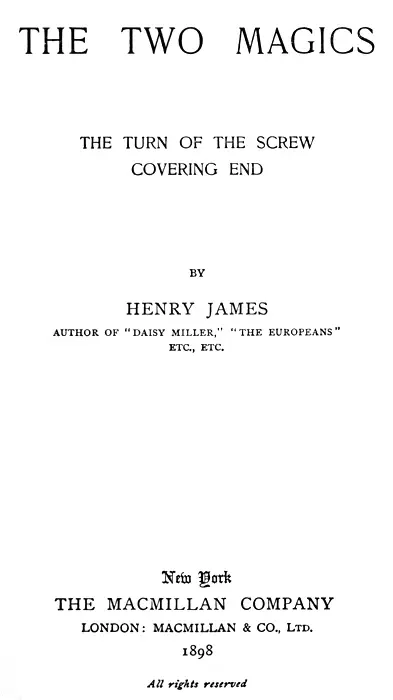
THE CLASSIC COLLECTION · 1898
"The Two Magics: The Turn of the Screw, Covering End" by Henry James is a novel written in the late 19th century. This work presents a supernatural narrative that delves into themes of innocence and malevolence, centering around the enigmatic character of a governess who is hired to care for two children at a remote estate. As she navigates her duties, she faces the haunting presence of malevolent apparitions that threaten the children's well-being. At the start of the story, a group of friends gathers around a fire, sharing eerie tales. One of them, Douglas, hints at a particularly ghastly story involving two children and a dreadful visitation that shook a child and her mother. His intrigue piques the guests' curiosity, leading to the promise of sharing Douglas's unsettling tale, which is intricately connected to the governess. The narrative unfolds as Douglas prepares to read the manuscript of a deceased governess who experienced a haunting at the estate of Bly, where ominous events involving the children are set to transpire. The opening thoroughly establishes the tone of suspense and the chilling atmosphere that pervades the tale, hinting that the governess's experiences will be both beautiful and horrifying.
Introduction adapted from the source catalogue; source summaries may be automatically generated.
Free to read · English · 78,856 words · No account needed
MAKE TIME FOR A GOOD BOOK
On by default. Untick to stop anonymous reading totals. Each page counts after 10 seconds in view. How this works.
Anonymous counting is on unless you have switched it off.
None the less, the rest of the day, I watched for further occasion to approach my colleague, especially as, toward evening, I began to fancy she rather sought to avoid me. I overtook her, I remember, on the staircase; we went down together, and at the bottom I detained her, holding her there with a hand on her arm. “I take what you said to me at noon as a declaration that you’ve never known him to be bad.”
She threw back her head; she had clearly, by this time, and very honestly, adopted an attitude. “Oh, never known him--I don’t pretend that!”
I was upset again. “Then you have known him----?”
“Yes indeed, Miss, thank God!”
On reflection I accepted this. “You mean that a boy who never
is----?”
“Is no boy for me!”
I held her tighter. “You like them with the spirit to be naughty?” Then, keeping pace with her answer, “So do I!” I eagerly brought out. “But not to the degree to contaminate----”
“To contaminate?”--my big word left her at a loss. I explained
it. “To corrupt.”
She stared, taking my meaning in; but it produced in her an odd laugh. “Are you afraid he’ll corrupt you?” She put the question with such a fine bold humour that, with a laugh, a little silly doubtless, to match her own, I gave way for the time to the apprehension of ridicule.
But the next day, as the hour for my drive approached, I cropped up in another place. “What was the lady who was here before?”
“The last governess? She was also young and pretty--almost as young and almost as pretty, Miss, even as you.”
“Ah, then, I hope her youth and her beauty helped her!” I recollect throwing off. “He seems to like us young and pretty!”
“Oh, he did,” Mrs. Grose assented: “it was the way he liked everyone!” She had no sooner spoken indeed than she caught herself up. “I mean that’s his way--the master’s.”
I was struck. “But of whom did you speak first?”
She looked blank, but she coloured. “Why, of him.”
“Of the master?”
“Of who else?”
There was so obviously no one else that the next moment I had lost my impression of her having accidentally said more than she meant; and I merely asked what I wanted to know. “Did she see anything in the boy----?”
“That wasn’t right? She never told me.”
I had a scruple, but I overcame it. “Was she careful--particular?”
Mrs. Grose appeared to try to be conscientious. “About some
things--yes.”
“But not about all?”
Again she considered. “Well, Miss--she’s gone. I won’t tell
tales.”
Your reading position is saved on this browser. Take it to another device with a library code. Reading pages adapt to text, rather than matching a printed edition.
Henry James
Henry James
Henry James

Henry James
BEHIND THE BOOK
This eBook is for the use of anyone anywhere in the United States and most other parts of the world at no cost and with almost no restrictions whatsoever. You may copy it, give it away or re-use it under the terms of the Project Gutenberg License included with this eBook or online at www.gutenberg.org. If you are not located in the United States, you will have to check the laws of the country where you are located before using this eBook. Read the source licence.
The original source file, including credits and licence, is retained by this library. Request an original-format copy at no charge. Please include the book title and Project Gutenberg identifier #42486.
KEEP YOUR CURIOSITY GOING
Coulson Kernahan

Maurice Baring
Frances Wright
Cécile Tormay

Frederic Jesup Stimson

W. H. P. (William Henry Pope) Jarvis