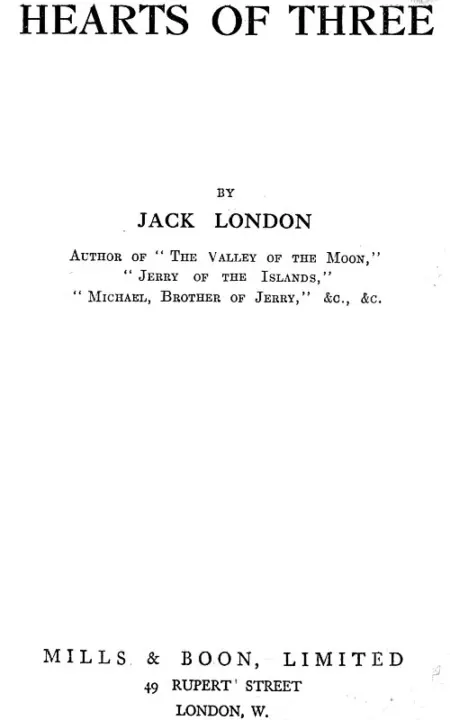
Hearts of three
Jack London
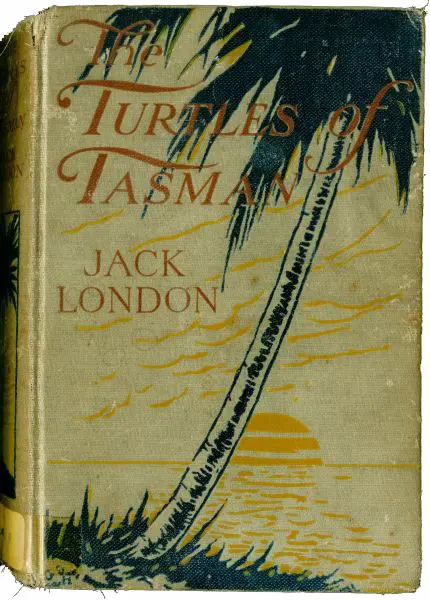
THE CLASSIC COLLECTION · 1916
"The Turtles of Tasman" by Jack London is a novel written in the early 20th century. The book delves into the lives of Frederick Travers and his brother Tom, whose contrasting lifestyles highlight themes of order, responsibility, and the human experience. It captures the tension between Frederick's aim for respectability through hard work and Tom's more carefree, adventurous spirit that reflects a life full of untamed experiences. The opening of the story sets the stage for a reunion between the two brothers after many years apart. Frederick, a successful and austere businessman, is preparing to welcome Tom back home, who has returned with his daughter, Bronislawa. As Frederick navigates the complexities of family dynamics, he reflects on the differences between his disciplined life and Tom's flamboyant one. The stage is set for exploring their contrasting philosophies, as well as the turmoil Tom's presence brings to Frederick's structured world, introducing themes of familial bonds, resentment, and a search for meaning in their different choices.
Introduction adapted from the source catalogue; source summaries may be automatically generated.
Free to read · English · 50,037 words · No account needed
MAKE TIME FOR A GOOD BOOK
On by default. Untick to stop anonymous reading totals. Each page counts after 10 seconds in view. How this works.
Anonymous counting is on unless you have switched it off.
Yet the song of it is good. When the moon is full we shall sing it about the Stone. We shall beat upon our breasts and sing, "O liver! O red liver!" And all the women in the caves shall be affrightened.
Oan:
I will not have that song of the liver! It shall be Ok's song; the tribe must say, "Ok hath made the song!"
Ok:
Ay! I shall be a great singer; I shall sing of a wolf's heart, and say,
"Behold, it is red!"
Uk:
Thou art a fool, and shalt sing only, "Hai, hai!" as thy father before thee. But Oan shall make me a song of my club, for the women listen to his songs.
Oan:
I will make thee no songs, neither of thy club, nor thy cave, nor thy doe's-liver. Yea! though thou give me no more flesh, yet will I live alone in the forest, and eat the seed of grasses, and likewise rabbits, that are easily snared. And I will sleep in a tree-top, and I will sing nightly:
The bright day is gone.
The night maketh me sad, sad, sad,
sad, sad, sad--
Uk:
Ok and Un, arise and slay!
(Ok and Un rush upon Oan, who stoops and picks up two casting-stones, with one of which he strikes Ok between the eyes, and with the other mashes the hand of Un, so that he drops his club. Uk arises.)
Uk:
Behold! Gurr cometh! he cometh swiftly from the wood!
(The Tribe, including Oan and Ala, rush for the cave-mouths. As Oan passes Uk, the latter runs behind Oan and crushes his skull with a blow of his club.)
Uk:
O men! O men with the heart of hyenas! Behold, Gurr cometh not! I did but strive to deceive you, that I might the more easily slay this singer, who is very swift of foot.... Gather ye before me, for I would speak wisdom.... It is not well that there be any song among us other than what our fathers sang in the past, or, if there be songs, let them be of such matters as are of common understanding. If a man sing of a deer, so shall he be drawn, it may be, to go forth and slay a deer, or even a moose. And if he sing of his casting-stones, it may be that he become more apt in the use thereof. And if he sing of his cave, it may be that he shall defend it more stoutly when Gurr teareth at the boulders. But it is a vain thing to make songs of the stars, that seem scornful even of me; or of the moon, which is never two nights the same; or of the day, which goeth about its business and will not linger though one pierce a she-babe with a flint. But as for me, I would have none of these songs. For if I sing of such in the council, how shall I keep my wits? And if I think thereof, when at the chase, it may be that I babble it forth, and the meat hear and escape. And ere it be time to eat, I do give my mind solely to the care of my hunting-gear. And if one sing when eating, he may fall short of his just portion. And when, one hath eaten, doth not he go straightway to sleep? So where shall men find a space for singing? But do ye as ye will: as for me, I will have none of these songs and stars.
Your reading position is saved on this browser. Take it to another device with a library code. Reading pages adapt to text, rather than matching a printed edition.
Jack London
Jack London
Jack London
Jack London
BEHIND THE BOOK
This eBook is for the use of anyone anywhere in the United States and most other parts of the world at no cost and with almost no restrictions whatsoever. You may copy it, give it away or re-use it under the terms of the Project Gutenberg License included with this eBook or online at www.gutenberg.org. If you are not located in the United States, you will have to check the laws of the country where you are located before using this eBook. Read the source licence.
The original source file, including credits and licence, is retained by this library. Request an original-format copy at no charge. Please include the book title and Project Gutenberg identifier #16257.
KEEP YOUR CURIOSITY GOING
Coulson Kernahan

Maurice Baring
Frances Wright
Cécile Tormay

Frederic Jesup Stimson

W. H. P. (William Henry Pope) Jarvis