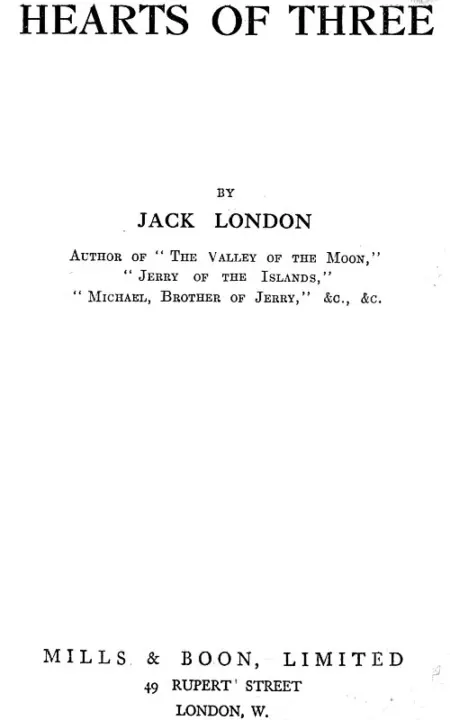
Hearts of three
Jack London
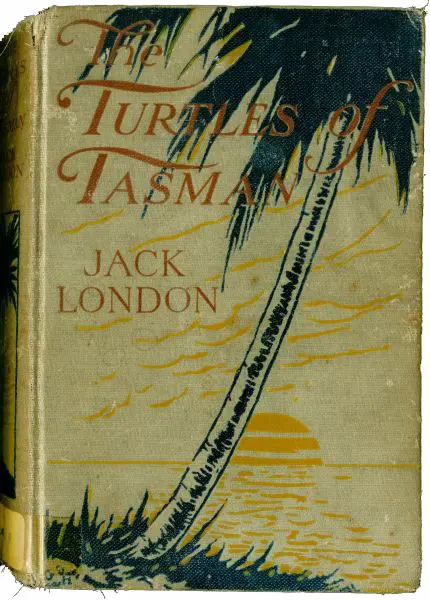
THE CLASSIC COLLECTION · 1916
"The Turtles of Tasman" by Jack London is a novel written in the early 20th century. The book delves into the lives of Frederick Travers and his brother Tom, whose contrasting lifestyles highlight themes of order, responsibility, and the human experience. It captures the tension between Frederick's aim for respectability through hard work and Tom's more carefree, adventurous spirit that reflects a life full of untamed experiences. The opening of the story sets the stage for a reunion between the two brothers after many years apart. Frederick, a successful and austere businessman, is preparing to welcome Tom back home, who has returned with his daughter, Bronislawa. As Frederick navigates the complexities of family dynamics, he reflects on the differences between his disciplined life and Tom's flamboyant one. The stage is set for exploring their contrasting philosophies, as well as the turmoil Tom's presence brings to Frederick's structured world, introducing themes of familial bonds, resentment, and a search for meaning in their different choices.
Introduction adapted from the source catalogue; source summaries may be automatically generated.
Free to read · English · 50,037 words · No account needed
MAKE TIME FOR A GOOD BOOK
On by default. Untick to stop anonymous reading totals. Each page counts after 10 seconds in view. How this works.
Anonymous counting is on unless you have switched it off.
Ross Shanklin scrambled to his feet and stood watchfully and awkwardly. The little girl took the mother's hand, and she, in turn, looked at him frankly and pleasantly, with a recognition of his humanness that was a new thing to him. In his mind ran the thought: the woman who ain't afraid. Not a hint was there of the timidity he was accustomed to seeing in women's eyes. And he was quite aware, and never more so, of his bleary-eyed, forbidding appearance.
"How do you do?" she greeted him sweetly and naturally.
"How do you do, ma'am," he responded, unpleasantly conscious of the huskiness and rawness of his voice.
"And did you have an interesting time, too?" she smiled.
"Yes, ma'am. I sure did. I was just telling your little girl about
hosses."
"He was a cowboy, once, mamma," she cried.
The mother smiled her acknowledgment to him, and looked fondly down at the little girl. The thought that came into Ross Shanklin's mind was the awfulness of the crime if any one should harm either of the wonderful pair. This was followed by the wish that some terrible danger should threaten, so that he could fight, as he well knew how, with all his strength and life, to defend them.
"You'll have to come along, dear," the mother said. "It's growing late." She looked at Ross Shanklin hesitantly. "Would you care to have something to eat?"
"No, ma'am, thanking you kindly just the same. I ... I ain't hungry."
"Then say good-bye, Joan," she counselled.
"Good-bye." The little girl held out her hand, and her eyes lighted roguishly. "Good-bye, Mr. Man from the bad, wicked world."
To him, the touch of her hand as he pressed it in his was the capstone
of the whole adventure.
"Good-bye, little fairy," he mumbled. "I reckon I got to be pullin'
along."
But he did not pull along. He stood staring after his vision until it vanished through the gate. The day seemed suddenly empty. He looked about him irresolutely, then climbed the fence, crossed the bridge, and slouched along the road. He was in a dream. He did not note his feet nor the way they led him. At times he stumbled in the dust-filled ruts.
A mile farther on, he aroused at the crossroads. Before him stood the saloon. He came to a stop and stared at it, licking his lips. He sank his hand into his pants pocket and fumbled a solitary dime. "God!" he muttered. "God!" Then, with dragging, reluctant feet, went on along the road.
Your reading position is saved on this browser. Take it to another device with a library code. Reading pages adapt to text, rather than matching a printed edition.
Jack London
Jack London
Jack London
Jack London
BEHIND THE BOOK
This eBook is for the use of anyone anywhere in the United States and most other parts of the world at no cost and with almost no restrictions whatsoever. You may copy it, give it away or re-use it under the terms of the Project Gutenberg License included with this eBook or online at www.gutenberg.org. If you are not located in the United States, you will have to check the laws of the country where you are located before using this eBook. Read the source licence.
The original source file, including credits and licence, is retained by this library. Request an original-format copy at no charge. Please include the book title and Project Gutenberg identifier #16257.
KEEP YOUR CURIOSITY GOING
Coulson Kernahan

Maurice Baring
Frances Wright
Cécile Tormay

Frederic Jesup Stimson

W. H. P. (William Henry Pope) Jarvis