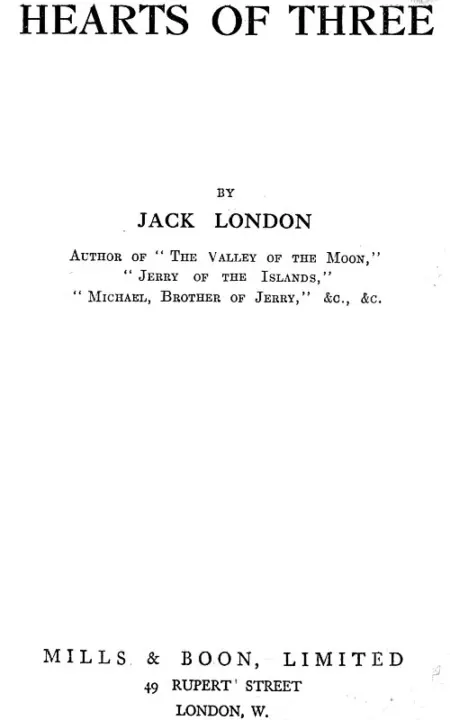
Hearts of three
Jack London
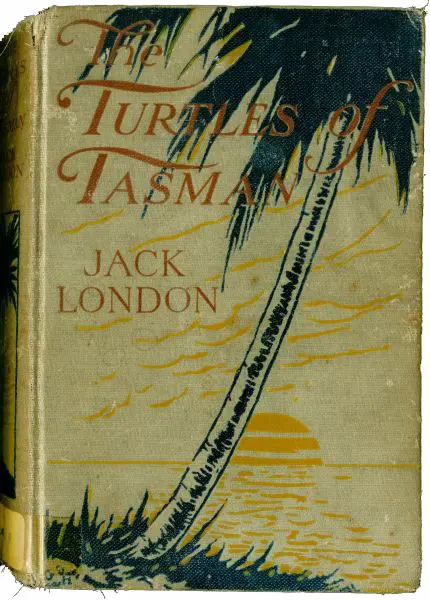
THE CLASSIC COLLECTION · 1916
"The Turtles of Tasman" by Jack London is a novel written in the early 20th century. The book delves into the lives of Frederick Travers and his brother Tom, whose contrasting lifestyles highlight themes of order, responsibility, and the human experience. It captures the tension between Frederick's aim for respectability through hard work and Tom's more carefree, adventurous spirit that reflects a life full of untamed experiences. The opening of the story sets the stage for a reunion between the two brothers after many years apart. Frederick, a successful and austere businessman, is preparing to welcome Tom back home, who has returned with his daughter, Bronislawa. As Frederick navigates the complexities of family dynamics, he reflects on the differences between his disciplined life and Tom's flamboyant one. The stage is set for exploring their contrasting philosophies, as well as the turmoil Tom's presence brings to Frederick's structured world, introducing themes of familial bonds, resentment, and a search for meaning in their different choices.
Introduction adapted from the source catalogue; source summaries may be automatically generated.
Free to read · English · 50,037 words · No account needed
MAKE TIME FOR A GOOD BOOK
On by default. Untick to stop anonymous reading totals. Each page counts after 10 seconds in view. How this works.
Anonymous counting is on unless you have switched it off.
The brother, with clenched hands and threatening eyes, looked to Madge
for counsel.
"Go, go, please," she begged. "He is right. I know he is right."
Another time, when Strang's condition seemed more promising, the brother
said:
"Doc, you're a wonder, and all this time I've forgotten to ask your
name."
"None of your damn business. Don't bother me. Get out."
The mangled right arm ceased from its healing, burst open again in a
frightful wound.
"Necrosis," said Linday.
"That does settle it," groaned the brother.
"Shut up!" Linday snarled. "Get out! Take Daw with you. Take Bill, too. Get rabbits--alive--healthy ones. Trap them. Trap everywhere."
"How many?" the brother asked.
"Forty of them--four thousand--forty thousand--all you can get. You'll help me, Mrs. Strang. I'm going to dig into that arm and size up the damage. Get out, you fellows. You for the rabbits."
And he dug in, swiftly, unerringly, scraping away disintegrating bone, ascertaining the extent of the active decay.
"It never would have happened," he told Madge, "if he hadn't had so many other things needing vitality first. Even he didn't have vitality enough to go around. I was watching it, but I had to wait and chance it. That piece must go. He could manage without it, but rabbit-bone will make it what it was."
From the hundreds of rabbits brought in, he weeded out, rejected, selected, tested, selected and tested again, until he made his final choice. He used the last of his chloroform and achieved the bone-graft--living bone to living bone, living man and living rabbit immovable and indissolubly bandaged and bound together, their mutual processes uniting and reconstructing a perfect arm.
And through the whole trying period, especially as Strang mended, occurred passages of talk between Linday and Madge. Nor was he kind, nor she rebellious.
"It's a nuisance," he told her. "But the law is the law, and you'll need a divorce before we can marry again. What do you say? Shall we go to Lake Geneva?"
"As you will," she said.
And he, another time: "What the deuce did you see in him anyway? I know he had money. But you and I were managing to get along with some sort of comfort. My practice was averaging around forty thousand a year then--I went over the books afterward. Palaces and steam yachts were about all that was denied you."
"Perhaps you've explained it," she answered. "Perhaps you were too interested in your practice. Maybe you forgot me."
"Humph," he sneered. "And may not your Rex be too interested in panthers
and short sticks?"
He continually girded her to explain what he chose to call her
infatuation for the other man.
Your reading position is saved on this browser. Take it to another device with a library code. Reading pages adapt to text, rather than matching a printed edition.
Jack London
Jack London
Jack London
Jack London
BEHIND THE BOOK
This eBook is for the use of anyone anywhere in the United States and most other parts of the world at no cost and with almost no restrictions whatsoever. You may copy it, give it away or re-use it under the terms of the Project Gutenberg License included with this eBook or online at www.gutenberg.org. If you are not located in the United States, you will have to check the laws of the country where you are located before using this eBook. Read the source licence.
The original source file, including credits and licence, is retained by this library. Request an original-format copy at no charge. Please include the book title and Project Gutenberg identifier #16257.
KEEP YOUR CURIOSITY GOING
Coulson Kernahan

Maurice Baring
Frances Wright
Cécile Tormay

Frederic Jesup Stimson

W. H. P. (William Henry Pope) Jarvis