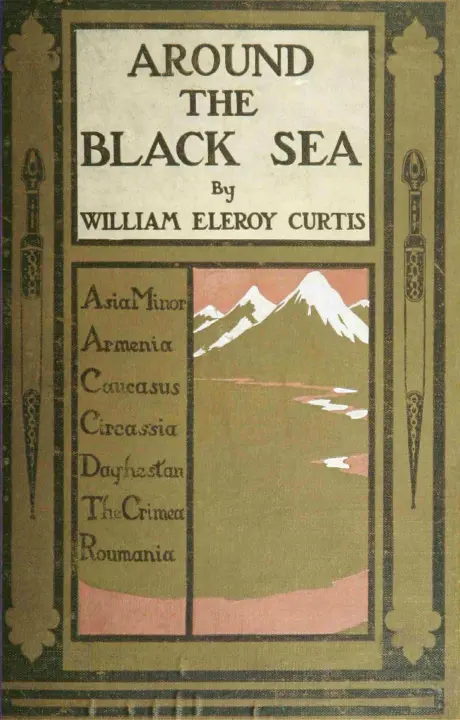
Around the Black Sea Asia Minor, Armenia, Caucasus, Circassia, Daghestan, the Crimea, Roumania
William Eleroy Curtis

THE CLASSIC COLLECTION · 1903
"The Turk and his Lost Provinces: Greece, Bulgaria, Servia, Bosnia" by William Eleroy Curtis is a historical account written in the early 20th century. The book explores the political dynamics, historical contexts, and social conditions of the Balkan states during a tumultuous period characterized by Ottoman rule and rising nationalist sentiments. It aims to provide insights into the plight of the Christian populations in these regions and the challenges they faced under Turkish governance. The opening of the book sets a critical tone, discussing the dire humanitarian situation in the Balkan Peninsula under Ottoman rule. Curtis establishes a historical backdrop by emphasizing the cultural and political significance of the region, while detailing the tragic consequences of Turkish oppression on its inhabitants, particularly during the upheaval in Macedonia. He highlights the ongoing atrocities and injustices faced by Christians, including massacres and forced conversions, underscoring the lack of effective intervention from European powers, which complicates any hope for reform or relief. In essence, the opening serves to lay the foundation for a detailed examination of the intricate political machinations that have left these provinces "lost" to their former glories and plunged in suffering.
Introduction adapted from the source catalogue; source summaries may be automatically generated.
Free to read · English · 106,786 words · No account needed
MAKE TIME FOR A GOOD BOOK
On by default. Untick to stop anonymous reading totals. Each page counts after 10 seconds in view. How this works.
Anonymous counting is on unless you have switched it off.
Said Pasha understood the situation, and, instead of going to the palace, sought an asylum at the British embassy, where Lord Dufferin, then ambassador, gave him protection. Nobody knew what had become of the grand vizier until after seven days, when he sent a carefully prepared report of his proceedings and the motives for the conspiracy against him to the Sultan by the hand of the British ambassador. The latter explained to the Sultan his opinion of the case, and vouched for Said Pasha as an honest, truthful and loyal man. The Sultan was not convinced, but agreed to accept Said Pasha’s resignation without further proceedings, and gave a formal assurance that if his former prime minister left the embassy and returned to his own home he would not be injured. Lord Dufferin notified the Sultan that the British government would hold him responsible for any injury that Said Pasha might suffer, and that in case of his death not even a plea of sickness would be accepted. From that hour Said Pasha was the safest man in Turkey. The Sultan sent his own physician and two of his most trusted aides-de-camp to live in his house to protect him, and, adopting Lord Dufferin’s suggestion, made an investigation of the charges against him. Nobody knows how he got at the facts, but he executed some of his new favorites, sent others into exile and finally restored Said Pasha to power and gave him his confidence as fully as he ever gives it to any one.
It is said that Shanghai, China, is the dirtiest city in the world, that Peking is ten times as dirty as Shanghai, and that Canton is ten times as dirty as Peking: but Constantinople is as dirty as all the rest of them put together, and the pavements are simply horrible. Yet the Sultan, who has never ridden about his capital, is laboring under the delusion that it is well paved and sweet and clean. Several years ago he took a notion to go by carriage instead of by boat to Seraglio Point upon his annual pilgrimage to worship before the holy mantle of the Prophet Mohammed, and the officers of the municipal government covered the pavement of the streets through which he was to pass with fine sand two or three inches deep. This not only concealed the filth, but made a smooth and comfortable track for his carriage. The Sultan was delighted, and gave instructions to fix all the streets in Constantinople in the same manner, allotting a large sum of money to pay the expenses. The officials took the money and put it in their pockets, and nothing was done to the streets. The Sultan honestly believes that Constantinople is one of the best-kept cities in Europe, and often boasts of that fact to foreign visitors. As he dare not go through the streets to see for himself, and is surrounded by men whose interests and safety require them to maintain the deception, he will probably never discover how he has been deceived. The two great bridges across the Golden Horn, which connect Stamboul, the Turkish town, with Galata, the foreign settlement, produce not less than $2,000 a day in tolls. Every foot passenger is charged a penny, about the same fee as that collected by the ferry companies of New York, and carriages pay ten cents. But of the receipts not more than $100 a day goes into the public treasury. The rest is stolen by people who have charge of the collections. Everybody gets his “squeeze,” from the general manager down to the Turks with white aprons who stand at the entrances and take the money. Curious people have taken the trouble to stand at the approaches to the bridge and count the number of passengers within a certain time as a basis for an estimate of the revenues, and assert that $2,000 a day is a low calculation. It is also asserted that not more than ten per cent of the customs collections goes into the treasury. The balance is stolen by the officials, who receive no salaries and are expected to take care of themselves. Sometimes they get their money out of the importers and exporters by blackmail, because each collector of customs is required to turn a certain amount into the treasury every month, but some of them simply take a proportion of the ordinary receipts and are satisfied with that.
Your reading position is saved on this browser. Take it to another device with a library code. Reading pages adapt to text, rather than matching a printed edition.
William Eleroy Curtis

William Eleroy Curtis
William Eleroy Curtis
William Eleroy Curtis
BEHIND THE BOOK
This eBook is for the use of anyone anywhere in the United States and most other parts of the world at no cost and with almost no restrictions whatsoever. You may copy it, give it away or re-use it under the terms of the Project Gutenberg License included with this eBook or online at www.gutenberg.org. If you are not located in the United States, you will have to check the laws of the country where you are located before using this eBook. Read the source licence.
The original source file, including credits and licence, is retained by this library. Request an original-format copy at no charge. Please include the book title and Project Gutenberg identifier #71013.
KEEP YOUR CURIOSITY GOING
Wilfrid Scawen Blunt
Wilfrid Scawen Blunt

E. W. (Edgar Watson) Howe
Cécile Tormay

Moritz Busch
John L. Ransom