THE CLASSIC COLLECTION✦The miracle of Saint AnthonyCLASSIC FREE BOOKS
The miracle of Saint Anthony
Maurice Maeterlinck
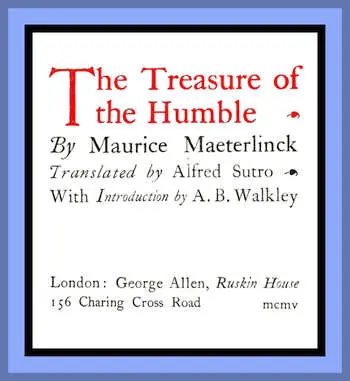
THE CLASSIC COLLECTION · 1905
"The Treasure of the Humble" by Maurice Maeterlinck is a philosophical work written in the late 19th century. In this volume, Maeterlinck explores profound themes of mysticism, silence, and the inner life of the soul, articulating a vision that connects humanity to a deeper spiritual reality. Through essays that draw on philosophies from various traditions, he presents a contemplation of the unseen intricacies of existence, inviting the reader into an exploration of their mysterious and often overlooked depths. At the start of the book, Maeterlinck sets a tone of reverent contemplation, emphasizing the power and necessity of silence for genuine communication and understanding. He reflects on the limitations of spoken words, arguing that true connection happens in moments of shared silence that transcend conventional interaction. The opening portion showcases the author's inclination towards mysticism as he suggests that silence can unveil hidden truths and foster a deeper understanding of ourselves and others. His thoughts serve as an invitation to consider the life of the soul, describing its profound simplicity and the hidden beauty that lies beneath the surface of ordinary existence.
Introduction adapted from the source catalogue; source summaries may be automatically generated.
Free to read · English · 34,050 words · No account needed
MAKE TIME FOR A GOOD BOOK
On by default. Untick to stop anonymous reading totals. Each page counts after 10 seconds in view. How this works.
Anonymous counting is on unless you have switched it off.
We can form no adequate conception of what this silent activity of the souls that surround us may really mean. Perhaps you have spoken a pure word to one of your fellows by whom it has not been understood. You look upon it as lost and dismiss it from your mind. But one day, peradventure, the word comes up again extraordinarily transformed, and revealing the unexpected fruit it has borne in the darkness; then silence once more falls over all. But it matters not; we have learned that nothing can be lost in the soul, and that even to the very pettiest there come moments of splendour. It is unmistakably borne home to us that even the unhappiest and the most destitute of men have at the depths of their being and in spite of themselves a treasure of beauty that they cannot despoil. They have but to acquire the habit of dipping into this treasure. It suffices not that beauty should keep solitary festival in life; it has to become a festival of every day. There needs no great effort to be admitted into the ranks of those ‘whose eyes no longer behold earth in flower and sky in glory in infinitesimal fragments, but indeed in sublime masses,’ and I speak here of flowers and sky that are purer and more lasting than those that we behold. Thousands of channels there are through which the beauty of our soul may sail even unto our thoughts. Above all is there the wonderful, central channel of love.
Is it not in love that are found the purest elements of beauty that we can offer to the soul? Some there are who do thus in beauty love each other. And to love thus means that, little by little, the sense of ugliness is lost; that one’s eyes are closed to all the littlenesses of life, to all but the freshness and virginity of the very humblest of souls. Loving thus, we have no longer even the need to forgive. Loving thus, we can no longer have anything to conceal, for that the ever-present soul transforms all things into beauty. It is to behold evil in so far only as it purifies indulgence, and teaches us no longer to confound the sinner with his sin. Loving thus do we raise on high within ourselves all those about us who have attained an eminence where failure has become impossible; heights whence a paltry action has so far to fall that, touching earth, it is compelled to yield up its diamond soul. It is to transform, though all unconsciously, the feeblest intention that hovers about us into illimitable movement. It is to summon all that is beautiful in earth, heaven or soul, to the banquet of love. Loving thus, we do indeed exist before our fellows as we exist before God. It means that the least gesture will call forth the presence of the soul with all its treasure. No longer is there need of death, disaster or tears for that the soul shall appear; a smile suffices. Loving thus, we perceive truth in happiness as profoundly as some of the heroes perceived it in the radiance of greatest sorrow. It means that the beauty that turns into love is undistinguishable from the love that turns into beauty. It means to be able no longer to tell where the ray of a star leaves off and the kiss of an ordinary thought begins. It means to have come so near to God that the angels possess us. Loving thus, the same soul will have been so beautified by us all that it will become, little by little, the ‘unique angel’ mentioned by Swedenborg. It means that each day will reveal to us a new beauty in that mysterious angel, and that we shall walk together in a goodness that shall ever become more and more living, loftier and loftier. For there exists also a lifeless beauty, made up of the past alone; but the veritable love renders the past useless, and its approach creates a boundless future of goodness, without disaster and without tears. To love thus is but to free one’s soul, and to become as beautiful as the soul thus freed. ‘If, in the emotion that this spectacle cannot fail to awaken in thee,’ says the great Plotinus, when dealing with kindred matters—and of all the intellects known to me that of Plotinus draws the nearest to the divine—‘If, in the emotion that this spectacle cannot fail to awaken in thee, thou proclaimest not that it is beautiful; and if, plunging thine eyes into thyself, thou dost not then feel the charm of beauty, it is in vain that, thy disposition being such, thou shouldst seek the intelligible beauty; for thou wouldst seek it only with that which is ugly and impure. Therefore it is that the discourse we hold here is not addressed to all men. But if thou hast recognised beauty within thyself, see that thou rise to the recollection of the intelligible beauty.’
Your reading position is saved on this browser. Take it to another device with a library code. Reading pages adapt to text, rather than matching a printed edition.
Maurice Maeterlinck

Maurice Maeterlinck

Maurice Maeterlinck

Maurice Maeterlinck
BEHIND THE BOOK
This eBook is for the use of anyone anywhere in the United States and most other parts of the world at no cost and with almost no restrictions whatsoever. You may copy it, give it away or re-use it under the terms of the Project Gutenberg License included with this eBook or online at www.gutenberg.org. If you are not located in the United States, you will have to check the laws of the country where you are located before using this eBook. Read the source licence.
The original source file, including credits and licence, is retained by this library. Request an original-format copy at no charge. Please include the book title and Project Gutenberg identifier #48217.
KEEP YOUR CURIOSITY GOING

David Patterson (Spirit) Hatch

David Patterson (Spirit) Hatch

David Patterson (Spirit) Hatch
Coulson Kernahan

Ralph Waldo Emerson

Maurice Baring