THE CLASSIC COLLECTION✦The miracle of Saint AnthonyCLASSIC FREE BOOKS
The miracle of Saint Anthony
Maurice Maeterlinck
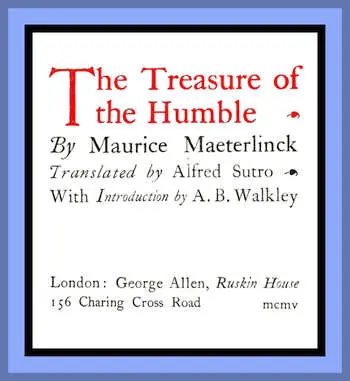
THE CLASSIC COLLECTION · 1905
"The Treasure of the Humble" by Maurice Maeterlinck is a philosophical work written in the late 19th century. In this volume, Maeterlinck explores profound themes of mysticism, silence, and the inner life of the soul, articulating a vision that connects humanity to a deeper spiritual reality. Through essays that draw on philosophies from various traditions, he presents a contemplation of the unseen intricacies of existence, inviting the reader into an exploration of their mysterious and often overlooked depths. At the start of the book, Maeterlinck sets a tone of reverent contemplation, emphasizing the power and necessity of silence for genuine communication and understanding. He reflects on the limitations of spoken words, arguing that true connection happens in moments of shared silence that transcend conventional interaction. The opening portion showcases the author's inclination towards mysticism as he suggests that silence can unveil hidden truths and foster a deeper understanding of ourselves and others. His thoughts serve as an invitation to consider the life of the soul, describing its profound simplicity and the hidden beauty that lies beneath the surface of ordinary existence.
Introduction adapted from the source catalogue; source summaries may be automatically generated.
Free to read · English · 34,050 words · No account needed
MAKE TIME FOR A GOOD BOOK
On by default. Untick to stop anonymous reading totals. Each page counts after 10 seconds in view. How this works.
Anonymous counting is on unless you have switched it off.
And yet what is needed to become the grown-up person for whom they lie in wait? So little! The soul is not exacting. A thought that is almost beautiful—a thought that you speak not, but that you cherish within you at this moment, will irradiate you as though you were a transparent vase. They will see it and their greeting to you will be very different than had you been meditating how best to deceive your brother. We are surprised when certain men tell us that they have never come across real ugliness, that they cannot conceive that a soul can be base. Yet need there be no cause for surprise. These men had ‘begun.’ They themselves had been the first to be beautiful, and had therefore attracted all the beauty that passed by, as a lighthouse attracts the vessels from the four corners of the horizon. Some there are who complain of women, for instance, never dreaming that, the first time a man meets a woman, a single word or thought that denies the beautiful or profound will be enough to poison for ever his existence in her soul. ‘For my part,’ said a sage to me one day, ‘I have never come across a single woman who did not bring to me something that was great.’ He was great himself first of all; therein lay his secret. There is one thing only that the soul can never forgive; it is to have been compelled to behold, or share, or pass close to an ugly action, word, or thought. It cannot forgive, for forgiveness here were but the denial of itself. And yet with the generality of men, ingenuity, strength and skill do but imply that the soul must first of all be banished from their life, and that every impulse that lies too deep must be carefully brushed aside. Even in love do they act thus, and therefore it is that the woman, who is so much nearer the truth, can scarcely ever live a moment of the true life with them. It is as though men dreaded the contact of their soul, and were anxious to keep its beauty at immeasurable distance. Whereas, on the contrary, we should endeavour to move in advance of ourselves. If at this moment you think or say something that is too beautiful to be true in you—if you have but endeavoured to think or say it to-day, on the morrow it will be true. We must try to be more beautiful than ourselves; we shall never distance our soul. We can never err when it is question of silent or hidden beauty. Besides, so long as the spring within us be limpid, it matters but little whether error there be or not. But do any of us ever dream of making the slightest unseen effort? And yet in the domain where we are everything is effective, for that everything is waiting. All the doors are unlocked, we have but to push them open, and the palace is full of manacled queens. A single word will very often suffice to clear the mountain of refuse. Why not have the courage to meet a base question with a noble answer? Do you imagine it would pass quite unnoticed or merely arouse surprise? Do you not think it would be more akin to the discourse that would naturally be held between two souls? We know not where it may give encouragement, where freedom. Even he who rejects your words will, in spite of himself, have taken a step towards the beauty that is within him. Nothing of beauty dies without having purified something, nor can aught of beauty be lost. Let us not be afraid of sowing it along the road. It may remain there for weeks or years, but like the diamond it cannot dissolve, and finally there will pass by some one whom its glitter will attract; he will pick it up and go his way, rejoicing. Then why keep back a lofty, beautiful word, for that you doubt whether others will understand? An instant of higher goodness was impending over you; why hinder its coming, even though you believe not that those about you will profit thereby? What if you are among men of the valley, is that sufficient reason for checking the instinctive movement of your soul towards the mountain peaks? Does darkness rob deep feeling of its power? Have the blind nought but their eyes wherewith to distinguish those who love them from those who love them not? Can the beauty not exist that is not understood, and is there not in every man something that does understand—in regions far beyond what he seems to understand, far beyond, too, what he believes he understands? ‘Even to the very wretchedest of all,’ said to me one day the loftiest minded creature it has ever been my happiness to know, ‘even to the very wretchedest of all I never have the courage to say anything in reply that is ugly or mediocre.’ I have for a long time followed that man’s life, and have seen the inexplicable power he exercised over the most obscure, the most unapproachable, the blindest, even the most rebellious of souls. For no tongue can tell the power of a soul that strives to live in an atmosphere of beauty, and is actively beautiful in itself. And indeed is it not the quality of this activity that renders a life either miserable or divine?
Your reading position is saved on this browser. Take it to another device with a library code. Reading pages adapt to text, rather than matching a printed edition.
Maurice Maeterlinck

Maurice Maeterlinck

Maurice Maeterlinck

Maurice Maeterlinck
BEHIND THE BOOK
This eBook is for the use of anyone anywhere in the United States and most other parts of the world at no cost and with almost no restrictions whatsoever. You may copy it, give it away or re-use it under the terms of the Project Gutenberg License included with this eBook or online at www.gutenberg.org. If you are not located in the United States, you will have to check the laws of the country where you are located before using this eBook. Read the source licence.
The original source file, including credits and licence, is retained by this library. Request an original-format copy at no charge. Please include the book title and Project Gutenberg identifier #48217.
KEEP YOUR CURIOSITY GOING

David Patterson (Spirit) Hatch

David Patterson (Spirit) Hatch

David Patterson (Spirit) Hatch
Coulson Kernahan

Ralph Waldo Emerson

Maurice Baring