THE CLASSIC COLLECTION✦The miracle of Saint AnthonyCLASSIC FREE BOOKS
The miracle of Saint Anthony
Maurice Maeterlinck
THE CLASSIC COLLECTION · 1905
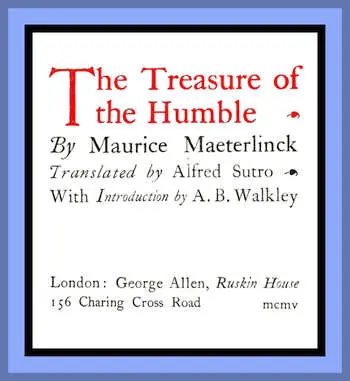
"The Treasure of the Humble" by Maurice Maeterlinck is a philosophical work written in the late 19th century. In this volume, Maeterlinck explores profound themes of mysticism, silence, and the inner life of the soul, articulating a vision that connects humanity to a deeper spiritual reality. Through essays that draw on philosophies from various traditions, he presents a contemplation of the unseen intricacies of existence, inviting the reader into an exploration of their mysterious and often overlooked depths. At the start of the book, Maeterlinck sets a tone of reverent contemplation, emphasizing the power and necessity of silence for genuine communication and understanding. He reflects on the limitations of spoken words, arguing that true connection happens in moments of shared silence that transcend conventional interaction. The opening portion showcases the author's inclination towards mysticism as he suggests that silence can unveil hidden truths and foster a deeper understanding of ourselves and others. His thoughts serve as an invitation to consider the life of the soul, describing its profound simplicity and the hidden beauty that lies beneath the surface of ordinary existence.
Introduction adapted from the source catalogue; source summaries may be automatically generated.
Free to read · English · 34,050 words · No account needed
MAKE TIME FOR A GOOD BOOK
On by default. Untick to stop anonymous reading totals. Each page counts after 10 seconds in view. How this works.
Anonymous counting is on unless you have switched it off.
THERE is a tragic element in the life of every day that is far more real, far more penetrating, far more akin to the true self that is in us than the tragedy that lies in great adventure. But, readily as we all may feel this, to prove it is by no means easy, inasmuch as this essential tragic element comprises more than that which is merely material or merely psychological. It goes beyond the determined struggle of man against man, and desire against desire: it goes beyond the eternal conflict of duty and passion. Its province is rather to reveal to us how truly wonderful is the mere act of living, and to throw light upon the existence of the soul, self-contained in the midst of ever-restless immensities; to hush the discourse of reason and sentiment, so that above the tumult may be heard the solemn, uninterrupted whisperings of man and his destiny. It is its province to point out to us the uncertain, dolorous footsteps of the being, as he approaches, or wanders from, his truth, his beauty, or his God. And further, to show us, and make us understand, the countless other things therewith connected, of which tragic poets have but vouchsafed us passing glimpses. And here do we come to an essential point, for could not these things, of which we have had only passing glimpses, be placed in front of the others, and shown to us first of all? The mysterious chant of the Infinite, the ominous silence of the soul and of God, the murmur of Eternity on the horizon, the destiny or fatality that we are conscious of within us, though by what tokens none can tell—do not all these underlie King Lear, Macbeth, Hamlet? And would it not be possible, by some interchanging of the rôles, to bring them nearer to us, and send the actors farther off? Is it beyond the mark to say that the true tragic element, normal, deep-rooted, and universal, that the true tragic element of life only begins at the moment when so-called adventures, sorrows, and dangers have disappeared? Is the arm of happiness not longer than that of sorrow, and do not certain of its attributes draw nearer to the soul? Must we indeed roar like the Atrides, before the Eternal God will reveal Himself in our life? and is He never by our side at times when the air is calm, and the lamp burns on, unflickering? When we think of it, is it not the tranquillity that is terrible, the tranquillity watched by the stars? and is it in tumult or in silence that the spirit of life quickens within us? Is it not when we are told, at the end of the story, ‘They were happy,’ that the great disquiet should intrude itself? What is taking place while they are happy? Are there not elements of deeper gravity and stability in happiness, in a single moment of repose, than in the whirlwind of passion? Is it not then that we at last behold the march of time—ay, and of many another on-stealing besides, more secret still—is it not then that the hours rush forward? Are not deeper chords set vibrating by all these things than by the dagger-stroke of conventional drama? Is it not at the very moment when a man believes himself secure from bodily death that the strange and silent tragedy of the being and the immensities does indeed raise its curtain on the stage? Is it while I flee before a naked sword that my existence touches its most interesting point? Is life always at its sublimest in a kiss? Are there not other moments, when one hears purer voices that do not fade away so soon? Does the soul only flower on nights of storm? Hitherto, doubtless, this belief has prevailed. It is only the life of violence, the life of bygone days, that is perceived by nearly all our tragic writers; and truly may one say that anachronism dominates the stage, and that dramatic art dates back as many years as the art of sculpture. Far different is it with the other arts—with painting and music, for instance—for these have learned to select and reproduce those obscurer phases of daily life that are not the less deep-rooted and amazing. They know that all that life has lost, as regards mere superficial ornament, has been more than counterbalanced by the depth, the intimate meaning and the spiritual gravity it has acquired. The true artist no longer chooses Marius triumphing over the Cimbrians, or the assassination of the Duke of Guise, as fit subjects for his art; for he is well aware that the psychology of victory or murder is but elementary and exceptional, and that the solemn voice of men and things, the voice that issues forth so timidly and hesitatingly, cannot be heard amidst the idle uproar of acts of violence. And therefore will he place on his canvas a house lost in the heart of the country, an open door at the end of a passage, a face or hands at rest, and by these simple images will he add to our consciousness of life, which is a possession that it is no longer possible to lose.
Your reading position is saved on this browser. Take it to another device with a library code. Reading pages adapt to text, rather than matching a printed edition.
Maurice Maeterlinck

Maurice Maeterlinck

Maurice Maeterlinck

Maurice Maeterlinck
BEHIND THE BOOK
This eBook is for the use of anyone anywhere in the United States and most other parts of the world at no cost and with almost no restrictions whatsoever. You may copy it, give it away or re-use it under the terms of the Project Gutenberg License included with this eBook or online at www.gutenberg.org. If you are not located in the United States, you will have to check the laws of the country where you are located before using this eBook. Read the source licence.
The original source file, including credits and licence, is retained by this library. Request an original-format copy at no charge. Please include the book title and Project Gutenberg identifier #48217.
KEEP YOUR CURIOSITY GOING

David Patterson (Spirit) Hatch

David Patterson (Spirit) Hatch

David Patterson (Spirit) Hatch
Coulson Kernahan

Ralph Waldo Emerson

Maurice Baring