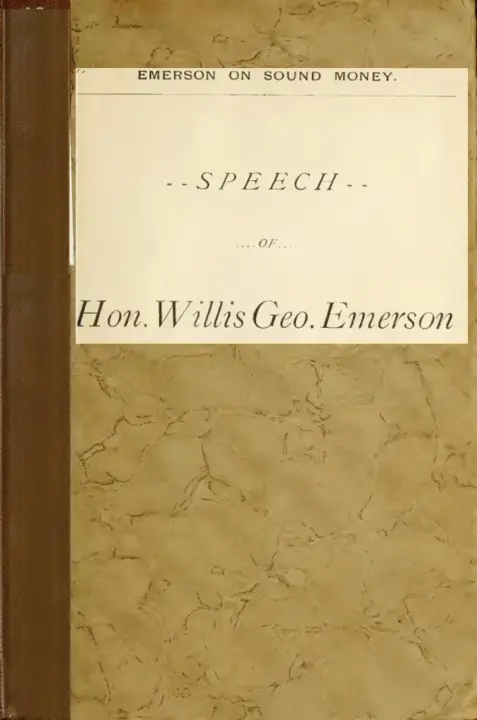
Emerson on Sound Money A Speech, 1896
Willis George Emerson
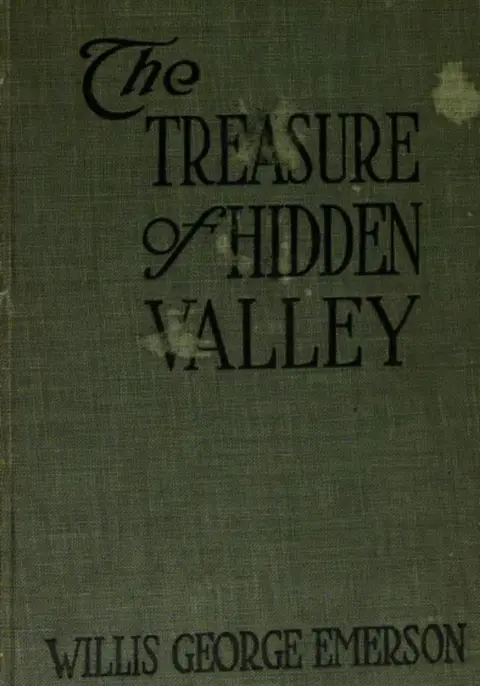
THE CLASSIC COLLECTION · 1915
"The Treasure of Hidden Valley" by Willis George Emerson is a novel written in the early 20th century. The book follows Roderick Warfield, a young man recently home from New York, who faces financial struggles and the weight of familial expectations. The story delves into themes of adventure, ambition, and the allure of a hidden treasure, sparked by revelations from Roderick’s deceased father about a mysterious gold mine in Wyoming. The opening of the novel sets the stage for Roderick's return to his Iowa hometown, where he receives a cool reception from his wealthy uncle, Allen Miller. The tension between them is thick, rooted in differing values regarding wealth and ambition, especially as Roderick seeks financial backing for a speculative mining deal. After a fiery confrontation, he leaves home, buoyed by a letter from his father that reveals the location of a lost mine. This begins Roderick's journey toward adventure, with destiny calling him to the rugged landscapes of Wyoming, where he hopes to unearth both treasure and the secrets of his family legacy.
Introduction adapted from the source catalogue; source summaries may be automatically generated.
Free to read · English · 107,144 words · No account needed
MAKE TIME FOR A GOOD BOOK
On by default. Untick to stop anonymous reading totals. Each page counts after 10 seconds in view. How this works.
Anonymous counting is on unless you have switched it off.
“Oh, I catch your drift,” laughed Roderick. “Well, you brought the trouble on yourself, my boy. It was you who gave me away by declaring I could sing.”
“Which shows the folly of paying a false compliment,” retorted Whitley. “However, I’m going to get another dance anyhow.”
He made a step toward Gail, but Roderick laid a detaining hand on his
shoulder.
“Not just yet; the next is mine.” And with audacity that amazed himself Roderick advanced to Gail, bowed, and offered his arm. The soft strains of a dreamy waltz had just begun.
Without a word she accepted his invitation, and together they floated away among the maze of dancers.
“Well, that’s going some,” murmured Whitley, as he glanced around in quest of consolation. Dorothy Shields appeared to be monopolized by Grant Jones, but the two lawyers, Eragdon and Carlisle, were glowering at each other, as if in defiance as to which should carry off Barbara. So Whitley solved the problem by sailing in and appropriating her for himself. He was happy, she seemed pleased, and the rivals, turning away from each other, had the cold consolation that neither had profited by the other’s momentary hesitation.
After the first few rounds Roderick opened a conversation with his partner. He felicitated her upon her playing and singing. She thanked him and said: “Most heartily can I return the compliment.” He bowed his acknowledgment.
“You must come to Conchshell ranch and call on my father. He will be glad to meet you—has been an invalid all the winter, but I’m thankful he is better now.”
“I’ll be honored and delighted to make his acquaintance,” replied
Roderick.
“Then perhaps we can have some more singing together,” she went on.
“Which will be a great pleasure to me,” he interjected fervently.
“And to me,” she said, smiling.
Whether listening or speaking there was something infinitely charming about Gail Holden. When conversing her beautiful teeth reminded one of a cupid’s mouth full of pearls.
“It has been some time,” explained Roderick, “since I was over
your way.”
For a moment their eyes met and she mischievously replied;
“Oh, yes. Next time, I’ll not only sing for you, but if you wish I will teach you how to throw the lariat.”
“I don’t presume,” replied Roderick banteringly, “you will guarantee what I might catch even if I turned out to be an expert?”
“That,” Gail quickly rejoined, “rests entirely with your own
cleverness.”
Your reading position is saved on this browser. Take it to another device with a library code. Reading pages adapt to text, rather than matching a printed edition.
Willis George Emerson
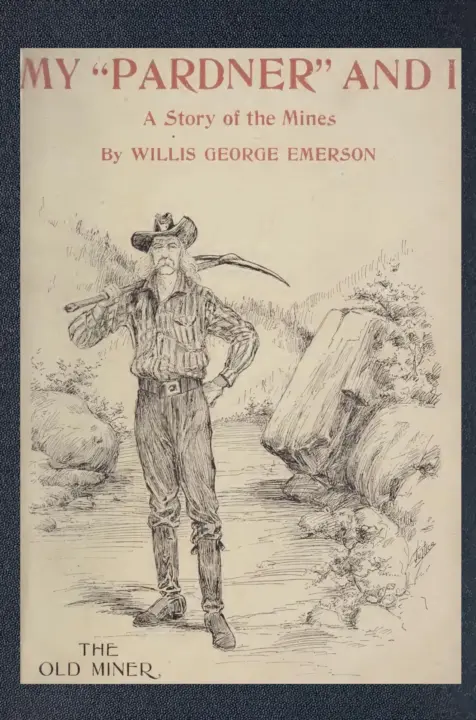
Willis George Emerson
Willis George Emerson
Willis George Emerson
BEHIND THE BOOK
This eBook is for the use of anyone anywhere in the United States and most other parts of the world at no cost and with almost no restrictions whatsoever. You may copy it, give it away or re-use it under the terms of the Project Gutenberg License included with this eBook or online at www.gutenberg.org. If you are not located in the United States, you will have to check the laws of the country where you are located before using this eBook. Read the source licence.
The original source file, including credits and licence, is retained by this library. Request an original-format copy at no charge. Please include the book title and Project Gutenberg identifier #52461.
KEEP YOUR CURIOSITY GOING
Coulson Kernahan

Maurice Baring
Frances Wright
Cécile Tormay

Frederic Jesup Stimson

W. H. P. (William Henry Pope) Jarvis