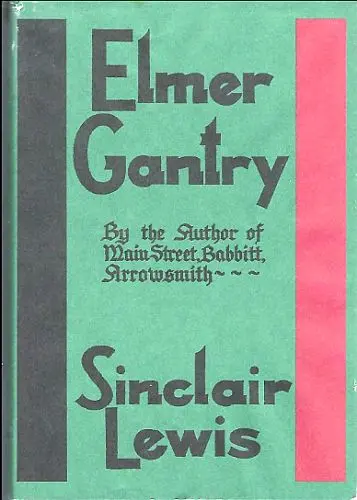
Elmer Gantry
Sinclair Lewis
THE CLASSIC COLLECTION · 1915
"The Trail of the Hawk: A Comedy of the Seriousness of Life" by Sinclair Lewis is a novel written in the early 20th century. The story begins with the youthful adventures of Carl Ericson, a boy brimming with mischief and imagination in his small hometown of Joralemon, Minnesota. As Carl navigates the challenges of childhood and the expectations of his Norwegian-American heritage, the novel delves into themes of personal growth and the search for meaning amid the mundane aspects of life. At the start of the narrative, we meet Carl Ericson, an imaginative eight-year-old boy engaged in a variety of mischievous activities, including pretending to lead armies and fantasizing about hunting and adventure. His interactions with his family reveal a blend of fondness and tension, particularly with his strict father. Dreaming of exploring the world beyond his backyard, Carl's adventures lead him to a chance encounter with Gertie Cowles, a girl who has just moved to his town. Their initial interactions highlight both the innocence of childhood and the onset of adolescent feelings, setting the stage for a journey that will see Carl evolve from a playful boy into a young man wrestling with his identity and aspirations.
Introduction adapted from the source catalogue; source summaries may be automatically generated.
Free to read · English · 123,245 words · No account needed
MAKE TIME FOR A GOOD BOOK
On by default. Untick to stop anonymous reading totals. Each page counts after 10 seconds in view. How this works.
Anonymous counting is on unless you have switched it off.
Every one turned toward a boy of five or six, round as a baby chicken, in his fuzzy miniature pajamas, protectingly holding a cotton monkey under his arm, sturdy and shy and defiant.
"Why, Arthur!" "Why, my son!" "Oh, the darling baby!" from the table.
"Come here, Arthur, and let's hear your troubles before nurse nabs you, old son," said Phil, not at all condescendingly, rising from the table, holding out his arms.
"No, no! You just let me go! I want to see Hawk Ericson. Is that Hawk Ericson?" demanded the son of Aunt Emma, pointing at Carl.
"Yes, sweetheart," said Ruth, softly, proudly.
Running madly about the end of the table, Arthur jumped at Carl's lap.
Carl swung him up and inquired, "What is it, old man?"
"Are you Hawk Ericson?"
"At your commands, cap'n."
Aunt Emma rose and said, masterfully, "Come, little son, now you've seen Mr. Ericson it's up to beddie again, up--to--beddie."
"No, no; please no, mamma! I've never seen a' aviator before, not in all my life, and you promised me 'cross your heart, at Pasadena you did, I could see one."
Arthur's face showed signs of imminent badness.
"Well, you may stay for a while, then," said Aunt Emma, weakly, unconscious that her sway had departed from her, while the rest of the table grinned, except Carl, who was absorbed in Arthur's ecstasy.
"I'm going to be a' aviator, too; I think a' aviator is braver than anybody. I'd rather be a' aviator than a general or a policeman or anybody. I got a picture of you in my scrap-book--you got a funny hat like Cousin Bobby wears when he plays football in it. Shall I get you the picture in my scrap-book?... Honest, will you give me another?"
Aunt Emma made one more attempt to coax Arthur up to bed, but his Majesty refused, and she compromised by scolding his nurse and sending up for his dressing-gown, a small, blue dressing-gown on which yellow ducks and white bunny-rabbits paraded proudly.
"Like our blue bowl!" Carl remarked to Ruth.
Not till after coffee in the drawing-room would Arthur consent to go to bed. This real head of the Emma Winslow family was far too much absorbed in making Carl tell of his long races, and "Why does a flying-machine fly? What's a wind pressure? Why does the wind shove up? Why is the wings curved? Why does it want to catch the wind?" The others listened, including even Aunt Emma.
Carl went home early. Ruth had the opportunity to confide:
Your reading position is saved on this browser. Take it to another device with a library code. Reading pages adapt to text, rather than matching a printed edition.
Sinclair Lewis
Sinclair Lewis
Sinclair Lewis
Sinclair Lewis
BEHIND THE BOOK
This eBook is for the use of anyone anywhere in the United States and most other parts of the world at no cost and with almost no restrictions whatsoever. You may copy it, give it away or re-use it under the terms of the Project Gutenberg License included with this eBook or online at www.gutenberg.org. If you are not located in the United States, you will have to check the laws of the country where you are located before using this eBook. Read the source licence.
The original source file, including credits and licence, is retained by this library. Request an original-format copy at no charge. Please include the book title and Project Gutenberg identifier #26610.
KEEP YOUR CURIOSITY GOING
Coulson Kernahan

Maurice Baring
Frances Wright
Cécile Tormay

Frederic Jesup Stimson

W. H. P. (William Henry Pope) Jarvis