THE CLASSIC COLLECTION✦The Touch of AbnerCLASSIC FREE BOOKS
The Touch of Abner
H. A. (Hiram Alfred) Cody
THE CLASSIC COLLECTION · 1923
The trail of the Golden Horn by H. A. Cody is a novel written in the early 20th century. Set in the northern wilderness, it blends adventure, mystery, and romance as a lone trapper, Hugo, stumbles on a murdered family’s cabin and saves a child, drawing the attention of the Mounted Police and the quiet determination of Nurse Marion Brisbane, who is secretly searching for her lost father. Rugged landscapes, a looming peak called the Golden Horn, and a menacing outlaw known as Bill the Slugger shape a tense pursuit through snowbound trails.
The opening of the novel follows Hugo as he finds a ransacked, smokeless Yukon cabin, blood-traces to open water, and a lone child whom he rescues; he also discovers a diamond ring and, shaken by a strange night vision, hauls the child to Kynox. There, Marion learns an old bearded stranger left the baby and, by lifting his cap as he slept, recognizes him as her long-vanished father; meanwhile word of the Haines murders spreads, and Sergeant John North arrives, declares his love to Marion, and heads back onto the trail. Caught in a blizzard, North and Marion shelter at a patrol-house where she reveals herself to Hugo, who bolts the instant he hears North’s name. At Big Chance, Marion tends Tim, a wounded prospector; Zell, the half‑breed girl who loves him, whispers that Bill the Slugger shot Tim and may be tied to the Cut‑Off crime and plotting harm to the Police, prompting Marion and Zell to dash by dogsled toward The Gap at night to warn North and fetch the missionary, with wolves howling close behind.
Introduction adapted from the source catalogue; source summaries may be automatically generated.
Free to read · English · 82,226 words · No account needed
MAKE TIME FOR A GOOD BOOK
On by default. Untick to stop anonymous reading totals. Each page counts after 10 seconds in view. How this works.
Anonymous counting is on unless you have switched it off.
“I know you are, and, in a way, I am sorry. I would really like to carry you. I dare you to let me.”
“Nonsense,” Marion chided. “I am going to show you what I can do.”
“Very well, then,” the sergeant sighed, “follow on my heels, as Shakespeare says, and we shall soon reach the woods.”
The trail thus beaten down by two pairs of snow-shoes was not hard to follow, and in a short time the heavy timber was reached. Here the wind could not touch them, and they both breathed more freely as they stopped to rest.
“The patrol-house is only a few rods ahead,” North explained, “so we should be able to make it now without much trouble. Are you tired?”
“Not much,” was the reply. “You won’t have to carry me, after all, will
you?”
“I am afraid not. But, hello! here’s Rolfe back again.”
“I beat the way almost to the house,” the constable explained, “so I’m going after the dogs. I expect to have trouble.”
“Do the best you can,” North replied, “and I shall hurry back to help
you.”
It did not take the sergeant and Marion long to come in sight of the patrol-house. It was a small building, situated a few yards from the trail. As they approached, they could see smoke issuing from the stove pipe stuck up through the roof.
“Somebody’s ahead of us, I see,” North remarked. “The place will be
warm at any rate.”
In another minute they were at the door, which the sergeant at once unlatched and pushed open. They were accosted by the growl of a dog, but Marion paid little attention to the animal, for her eyes were fixed at once upon the man standing in the middle of the room. She knew him at once, and her heart almost stopped its beating. The sergeant, however, stepped forward as one who had a right to the place. If he recognized Hugo, the trapper, he gave no sign.
“Bad storm,” he remarked. “I’m glad you’ve got a good fire. I hope you won’t mind visitors.”
“Make yourself at home,” Hugo replied, mistaking him for a miner or a prospector. “All are welcome here.”
The sergeant then turned to Marion and noted how she was staring at the
trapper.
“You stay here,” he said, “while I go and give a hand with the dogs. I won’t be any longer than I can help.”
Your reading position is saved on this browser. Take it to another device with a library code. Reading pages adapt to text, rather than matching a printed edition.
H. A. (Hiram Alfred) Cody
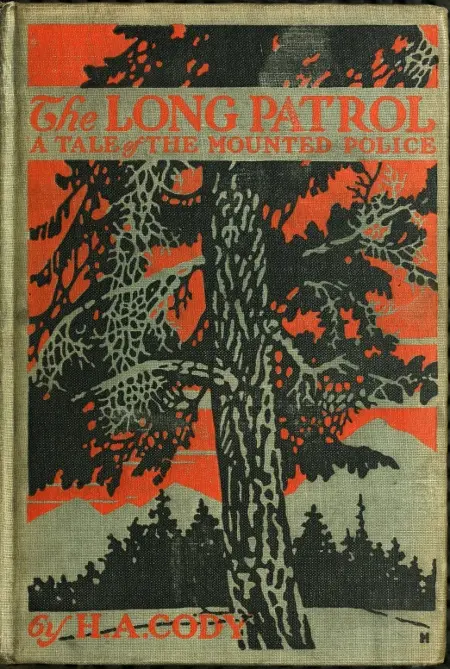
H. A. (Hiram Alfred) Cody
H. A. (Hiram Alfred) Cody
H. A. (Hiram Alfred) Cody
BEHIND THE BOOK
This eBook is for the use of anyone anywhere in the United States and most other parts of the world at no cost and with almost no restrictions whatsoever. You may copy it, give it away or re-use it under the terms of the Project Gutenberg License included with this eBook or online at www.gutenberg.org. If you are not located in the United States, you will have to check the laws of the country where you are located before using this eBook. Read the source licence.
The original source file, including credits and licence, is retained by this library. Request an original-format copy at no charge. Please include the book title and Project Gutenberg identifier #77231.
KEEP YOUR CURIOSITY GOING
Coulson Kernahan

Maurice Baring
Frances Wright
Cécile Tormay

Frederic Jesup Stimson

W. H. P. (William Henry Pope) Jarvis