THE CLASSIC COLLECTION✦The True Story of Our National Calamity of Flood, Fire and TornadoCLASSIC FREE BOOKS
The True Story of Our National Calamity of Flood, Fire and Tornado
Logan Marshall
THE CLASSIC COLLECTION · 1914
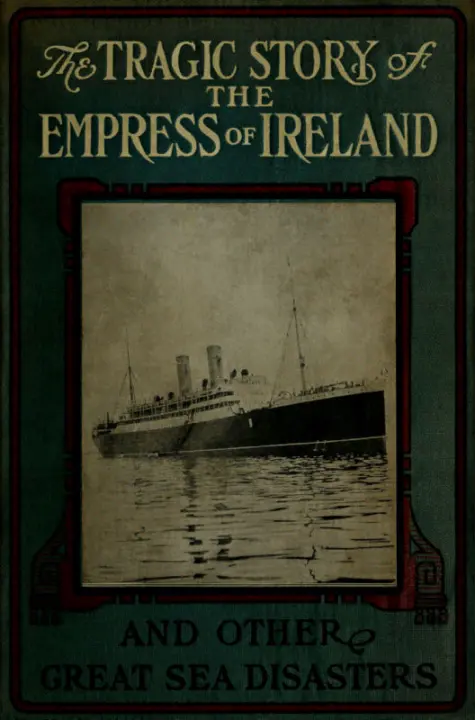
"The Tragic Story of the Empress of Ireland" by Logan Marshall is a historical account written in the early 20th century. The book documents the catastrophic sinking of the Canadian liner Empress of Ireland in 1914, one of the deadliest maritime disasters in Canadian history. Through survivors' accounts and various testimonies, it explores the circumstances that led to the disaster, including navigational errors and fog conditions that contributed to the tragedy. The opening of the narrative describes the ill-fated voyage of the Empress of Ireland as it embarks from Quebec filled with eager passengers. As the ship encounters fog on the night of May 29, 1914, the crew, led by Captain Henry George Kendall, attempts to navigate safely. Unfortunately, disaster strikes when the Empress collides with the Norwegian collier Storstad, leading to panic and chaos on board as the ship begins to sink within minutes. Survivors’ harrowing experiences unfold amidst desperate attempts to reach lifeboats and escape the icy waters, setting up an emotional exploration of human courage and loss that continues throughout the book.
Introduction adapted from the source catalogue; source summaries may be automatically generated.
Free to read · English · 73,531 words · No account needed
MAKE TIME FOR A GOOD BOOK
On by default. Untick to stop anonymous reading totals. Each page counts after 10 seconds in view. How this works.
Anonymous counting is on unless you have switched it off.
But to the one wounded ship that survives collision with a berg, a dozen perish. Presumably, when the shock comes, it loosens their bulkheads and they fill and founder, or the crash may injure the boilers or engines, which explode and tear out the sides, and the ship goes down like a plummet. As long ago as 1841, the steamer President, with 120 people aboard, crossing from New York to Liverpool in March, vanished from human ken. In 1854, in the same month, the City of Glasgow left Liverpool for Philadelphia with 480 souls, and was never again heard of. In February, 1856, the Pacific, from Liverpool for New York, carrying 185 persons, passed away down to a sunless sea. In May, 1870, the City of Boston, from that port for Liverpool, mustering 191 souls, met a similar fate. It has always been thought that these ships were sunk by collision with icebergs or floes. As shipping traffic has expanded, the losses have been more frequent. In February, 1892, the Naronic, from Liverpool for New York; in the same month in 1896, the State of Georgia, from Aberdeen for Boston; in February, 1899, the Alleghany, from New York for Dover; and once more in February, 1902, the Huronian, from Liverpool for St. John's--all disappeared without leaving a trace. Between February and May, the Grand Banks are most infested with ice, and collision therewith is the most likely explanation of the loss of these steamers, all well manned and in splendid trim, and meeting only the storms which scores of other ships have braved without a scathe.
Among the important marine disasters recorded since 1866 are the
following:
1866, Jan. 11.--Steamer London, on her way to Melbourne, foundered in the Bay of Biscay; 220 lives lost.
1866, Oct. 3.--Steamer Evening Star, from New York to New Orleans, foundered; about 250 lives lost.
1867, Oct. 29.--Royal Mail steamers Rhone and Wye and about fifty other vessels driven ashore and wrecked at St. Thomas, West Indies, by a hurricane; about 1,000 lives lost.
1873, Jan. 22.--British steamer Northfleet sunk in collision off
Dungeness; 300 lives lost.
1873, Nov. 23.--White Star liner Atlantic wrecked off Nova Scotia;
547 lives lost.
1873, Nov. 23.--French line Ville du Havre, from New York to Havre, in
collision with ship Locharn and sunk in sixteen minutes; 110 lives
lost.
1874, Dec. 24.--Emigrant vessel Cospatrick took fire and sank off
Auckland; 476 lives lost.
1875, May 7.--Hamburg Mail steamer Schiller wrecked in fog on Scilly
Islands; 200 lives lost.
1875, Nov. 4.--American steamer Pacific in collision thirty miles southwest of Cape Flattery; 236 lives lost.
1878, March 24.--British training ship Eurydice, a frigate, foundered near the Isle of Wight; 300 lives lost.
1878, Sept. 3.--British iron steamer Princess Alice sunk in the Thames
River; 700 lives lost.
Your reading position is saved on this browser. Take it to another device with a library code. Reading pages adapt to text, rather than matching a printed edition.
BEHIND THE BOOK
This eBook is for the use of anyone anywhere in the United States and most other parts of the world at no cost and with almost no restrictions whatsoever. You may copy it, give it away or re-use it under the terms of the Project Gutenberg License included with this eBook or online at www.gutenberg.org. If you are not located in the United States, you will have to check the laws of the country where you are located before using this eBook. Read the source licence.
The original source file, including credits and licence, is retained by this library. Request an original-format copy at no charge. Please include the book title and Project Gutenberg identifier #58274.
KEEP YOUR CURIOSITY GOING
Cécile Tormay

Moritz Busch
John L. Ransom
Frances Wright
Cécile Tormay

Mabel Potter Daggett