The Stark Munro Letters Being series of twelve letters written by J. Stark Munro, M.B., to his friend and former fellow-student, Herbert Swanborough, of Lowell, Massachusetts, during the years 1881-1884
Arthur Conan Doyle

THE CLASSIC COLLECTION · 1898
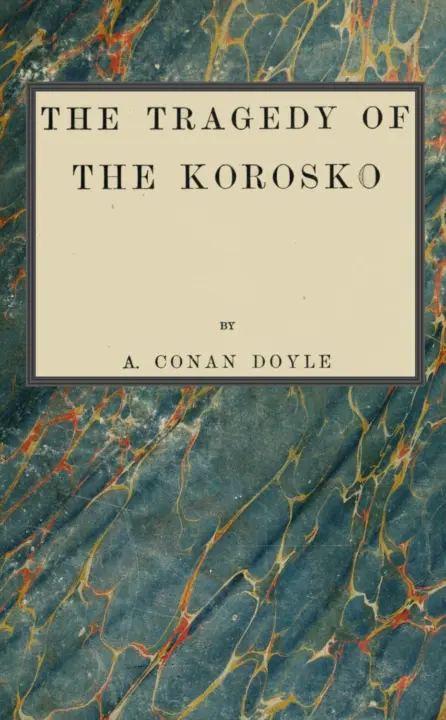
"The Tragedy of the Korosko" by Sir Arthur Conan Doyle is a novel written during the late 19th century. The story unfolds on the banks of the Nile in Nubia, following a diverse group of passengers aboard the "Korosko", including Colonel Cochrane, Miss Adams, and Mr. Stephens, as they embark on a journey that takes a tragic turn. The narrative explores themes of cultural encounters, the fragility of civilization, and the unpredictability of fate. At the start of the novel, the passengers of the "Korosko" are introduced as they set off on their expedition along the Nile, showcasing their varied backgrounds and personalities. The camaraderie aboard the vessel is palpable, with lively conversations and interactions that paint a vivid picture of the group dynamic. However, a sense of foreboding lingers as they traverse the vast, desolate beauty of Nubia, punctuated by ruins and reminders of a tumultuous past. The opening portion establishes a serene yet eerie atmosphere, hinting at the imminent danger that will disrupt their journey, culminating in their capture by a group of armed Bedouins, shattering the veneer of safety and leisure they had previously enjoyed.
Introduction adapted from the source catalogue; source summaries may be automatically generated.
Free to read · English · 46,989 words · No account needed
MAKE TIME FOR A GOOD BOOK
On by default. Untick to stop anonymous reading totals. Each page counts after 10 seconds in view. How this works.
Anonymous counting is on unless you have switched it off.
Miss Adams, who had been frozen into silence during the long cold night, began to thaw now in the cheery warmth of the rising sun. She looked about her, and rubbed her thin hands together.
“Why, Sadie,” she remarked, “I thought I heard you in the night, dear, and now I see that you have been crying.”
“I’ve been thinking, auntie.”
“Well, we must try and think of others, dearie, and not of ourselves.”
“It’s not of myself, auntie.”
“Never fret about me, Sadie.”
“No, auntie, I was not thinking of you.”
“Was it of any one in particular?”
“Of Mr. Stephens, auntie. How gentle he was, and how brave! To think of him fixing up every little thing for us, and trying to pull his jacket over his poor roped-up hands, with those murderers waiting all round him. He’s my saint and hero from now ever after.”
“Well, he’s out of his troubles anyhow,” said Miss Adams, with that bluntness which the years bring with them.
“Then I wish I was also.”
“I don’t see how that would help him.”
“Well, I think he might feel less lonesome,” said Sadie, and drooped her saucy little chin upon her breast.
The four had been riding in silence for some little time, when the Colonel clapped his hand to his brow with a gesture of dismay.
“Good God!” he cried, “I am going off my head.”
Again and again they had perceived it during the night, but he had seemed quite rational since daybreak. They were shocked therefore at this sudden outbreak, and tried to calm him with soothing words.
“Mad as a hatter,” he shouted. “Whatever do you think I saw?”
“Don’t trouble about it, whatever it was,” said Mrs. Belmont, laying her hand soothingly upon his as the camels closed together. “It is no wonder that you are overdone. You have thought and worked for all of us so long. We shall halt presently, and a few hours’ sleep will quite restore you.”
But the Colonel looked up again, and again he cried out in his agitation
and surprise.
“I never saw anything plainer in my life,” he groaned. “It is on the point of rock on our right front--poor old Stuart with my red cummerbund round his head just the same as we left him.”
The ladies had followed the direction of the Colonel’s frightened gaze, and in an instant they were all as amazed as he.
Your reading position is saved on this browser. Take it to another device with a library code. Reading pages adapt to text, rather than matching a printed edition.
Arthur Conan Doyle
Arthur Conan Doyle
Arthur Conan Doyle
Arthur Conan Doyle
BEHIND THE BOOK
This eBook is for the use of anyone anywhere in the United States and most other parts of the world at no cost and with almost no restrictions whatsoever. You may copy it, give it away or re-use it under the terms of the Project Gutenberg License included with this eBook or online at www.gutenberg.org. If you are not located in the United States, you will have to check the laws of the country where you are located before using this eBook. Read the source licence.
The original source file, including credits and licence, is retained by this library. Request an original-format copy at no charge. Please include the book title and Project Gutenberg identifier #12555.
KEEP YOUR CURIOSITY GOING
Coulson Kernahan

Maurice Baring
Frances Wright
Cécile Tormay

Frederic Jesup Stimson

W. H. P. (William Henry Pope) Jarvis


