The Stark Munro Letters Being series of twelve letters written by J. Stark Munro, M.B., to his friend and former fellow-student, Herbert Swanborough, of Lowell, Massachusetts, during the years 1881-1884
Arthur Conan Doyle

THE CLASSIC COLLECTION · 1898
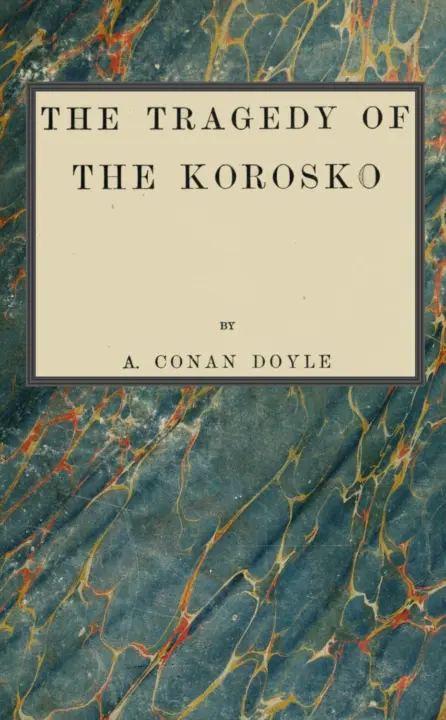
"The Tragedy of the Korosko" by Sir Arthur Conan Doyle is a novel written during the late 19th century. The story unfolds on the banks of the Nile in Nubia, following a diverse group of passengers aboard the "Korosko", including Colonel Cochrane, Miss Adams, and Mr. Stephens, as they embark on a journey that takes a tragic turn. The narrative explores themes of cultural encounters, the fragility of civilization, and the unpredictability of fate. At the start of the novel, the passengers of the "Korosko" are introduced as they set off on their expedition along the Nile, showcasing their varied backgrounds and personalities. The camaraderie aboard the vessel is palpable, with lively conversations and interactions that paint a vivid picture of the group dynamic. However, a sense of foreboding lingers as they traverse the vast, desolate beauty of Nubia, punctuated by ruins and reminders of a tumultuous past. The opening portion establishes a serene yet eerie atmosphere, hinting at the imminent danger that will disrupt their journey, culminating in their capture by a group of armed Bedouins, shattering the veneer of safety and leisure they had previously enjoyed.
Introduction adapted from the source catalogue; source summaries may be automatically generated.
Free to read · English · 46,989 words · No account needed
MAKE TIME FOR A GOOD BOOK
On by default. Untick to stop anonymous reading totals. Each page counts after 10 seconds in view. How this works.
Anonymous counting is on unless you have switched it off.
“Shucks, Sadie, don’t talk like that, child,” said the older woman nervously. “It’s enough to scare any one to listen to you.”
“Well, but don’t you feel it yourself, Auntie? Look at that great desert stretching away and away until it is lost in the shadows. Hear the sad whisper of the wind across it! It’s just the most solemn thing that ever I saw in my life.”
“I’m glad we’ve found something that will make you solemn, my dear,” said her Aunt. “I’ve sometimes thought--Sakes alive, what’s that?”
From somewhere amongst the hill shadows upon the other side of the river there had risen a high shrill whimpering, rising and swelling, to end in a long weary wail.
“It’s only a jackal, Miss Adams,” said Stephens. “I heard one when we went out to see the Sphinx by moonlight.”
But the American lady had risen, and her face showed that her nerves had
been ruffled.
“If I had my time over again I wouldn’t have come past Assouan,” said she. “I can’t think what possessed me to bring you all the way up here, Sadie. Your mother will think that I am clean crazy, and I’d never dare to look her in the eye if anything went wrong with us. I’ve seen all I want to see of this river, and all I ask now is to be back at Cairo again.”
“Why, Auntie,” cried the girl, “it isn’t like you to be faint-hearted.”
“Well, I don’t know how it is, Sadie, but I feel a bit unstrung, and that beast caterwauling over yonder was just more than I could put up with. There’s one consolation, we are scheduled to be on our way home to-morrow, after we’ve seen this one rock or temple, or whatever it is. I’m full up of rocks and temples, Mr. Stephens. I shouldn’t mope if I never saw another. Come, Sadie! Good-night!”
“Good-night! Good-night, Miss Adams!”
And the two ladies passed down to their cabins.
Monsieur Fardet was chatting, in a subdued voice, with Headingly, the young Harvard graduate, bending forward confidentially between the whiffs of his cigarette.
“Dervishes, Mister Headingly!” said he, speaking excellent English, but separating his syllables as a Frenchman will. “There are no Dervishes. They do not exist.”
“Why, I thought the woods were full of them,” said the American.
Monsieur Fardet glanced across to where the red core of Colonel Cochrane’s cigar was glowing through the darkness.
Your reading position is saved on this browser. Take it to another device with a library code. Reading pages adapt to text, rather than matching a printed edition.
Arthur Conan Doyle
Arthur Conan Doyle
Arthur Conan Doyle
Arthur Conan Doyle
BEHIND THE BOOK
This eBook is for the use of anyone anywhere in the United States and most other parts of the world at no cost and with almost no restrictions whatsoever. You may copy it, give it away or re-use it under the terms of the Project Gutenberg License included with this eBook or online at www.gutenberg.org. If you are not located in the United States, you will have to check the laws of the country where you are located before using this eBook. Read the source licence.
The original source file, including credits and licence, is retained by this library. Request an original-format copy at no charge. Please include the book title and Project Gutenberg identifier #12555.
KEEP YOUR CURIOSITY GOING
Coulson Kernahan

Maurice Baring
Frances Wright
Cécile Tormay

Frederic Jesup Stimson

W. H. P. (William Henry Pope) Jarvis


