The Stark Munro Letters Being series of twelve letters written by J. Stark Munro, M.B., to his friend and former fellow-student, Herbert Swanborough, of Lowell, Massachusetts, during the years 1881-1884
Arthur Conan Doyle

THE CLASSIC COLLECTION · 1898
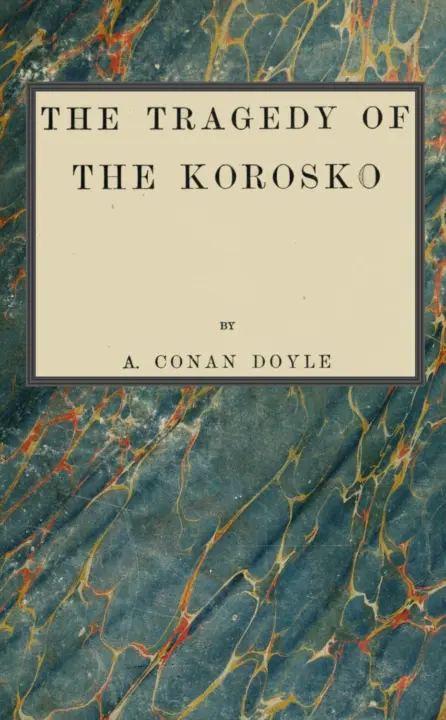
"The Tragedy of the Korosko" by Sir Arthur Conan Doyle is a novel written during the late 19th century. The story unfolds on the banks of the Nile in Nubia, following a diverse group of passengers aboard the "Korosko", including Colonel Cochrane, Miss Adams, and Mr. Stephens, as they embark on a journey that takes a tragic turn. The narrative explores themes of cultural encounters, the fragility of civilization, and the unpredictability of fate. At the start of the novel, the passengers of the "Korosko" are introduced as they set off on their expedition along the Nile, showcasing their varied backgrounds and personalities. The camaraderie aboard the vessel is palpable, with lively conversations and interactions that paint a vivid picture of the group dynamic. However, a sense of foreboding lingers as they traverse the vast, desolate beauty of Nubia, punctuated by ruins and reminders of a tumultuous past. The opening portion establishes a serene yet eerie atmosphere, hinting at the imminent danger that will disrupt their journey, culminating in their capture by a group of armed Bedouins, shattering the veneer of safety and leisure they had previously enjoyed.
Introduction adapted from the source catalogue; source summaries may be automatically generated.
Free to read · English · 46,989 words · No account needed
MAKE TIME FOR A GOOD BOOK
On by default. Untick to stop anonymous reading totals. Each page counts after 10 seconds in view. How this works.
Anonymous counting is on unless you have switched it off.
“Well, well,” said the American, “I’m glad to know the rights of this business, for it has often puzzled me. But what does England get out of it?”
“She gets the country, monsieur.”
“I see. You mean, for example, that there is a favourable tariff for
British goods?”
“No, monsieur; it is the same for all.”
“Well, then, she gives the contracts to Britishers?”
“Precisely, monsieur.”
“For example, the railroad that they are building right through the country, the one that runs alongside the river, that would be a valuable contract for the British?”
Monsieur Fardet was an honest man, if an imaginative one.
“It is a French company, monsieur, which holds the railway contract,”
said he.
The American was puzzled.
“They don’t seem to get much for their trouble,” said he. “Still, of course, there must be some indirect pull somewhere. For example, Egypt no doubt has to pay and keep all those red-coats in Cairo.”
“Egypt, monsieur! No, they are paid by England.”
“Well, I suppose they know their own business best, but they seem to me to take a great deal of trouble, and to get mighty little in exchange. If they don’t mind keeping order and guarding the frontier, with a constant war against the Dervishes on their hands, I don’t know why any one should object. I suppose no one denies that the prosperity of the country has increased enormously since they came. The revenue returns show that. They tell me also that the poorer folks have justice, which they never had before.”
“What are they doing here at all?” cried the Frenchman angrily. “Let them go back to their island. We cannot have them all over the world.”
“Well, certainly, to us Americans, who live all in our own land, it does seem strange how you European nations are for ever slopping over into some other country which was not meant for you. It’s easy for us to talk, of course, for we have still got room and to spare for all our people. When we begin pushing each other over the edge we shall have to start annexing also. But at present just here in North Africa there is Italy in Abyssinia, and England in Egypt, and France in Algiers--”
“France!” cried Monsieur Fardet. “Algiers belongs to France. You laugh, monsieur. I have the honour to wish you a very good-night.” He rose from his seat, and walked off, rigid with outraged patriotism, to his cabin.
Your reading position is saved on this browser. Take it to another device with a library code. Reading pages adapt to text, rather than matching a printed edition.
Arthur Conan Doyle
Arthur Conan Doyle
Arthur Conan Doyle
Arthur Conan Doyle
BEHIND THE BOOK
This eBook is for the use of anyone anywhere in the United States and most other parts of the world at no cost and with almost no restrictions whatsoever. You may copy it, give it away or re-use it under the terms of the Project Gutenberg License included with this eBook or online at www.gutenberg.org. If you are not located in the United States, you will have to check the laws of the country where you are located before using this eBook. Read the source licence.
The original source file, including credits and licence, is retained by this library. Request an original-format copy at no charge. Please include the book title and Project Gutenberg identifier #12555.
KEEP YOUR CURIOSITY GOING
Coulson Kernahan

Maurice Baring
Frances Wright
Cécile Tormay

Frederic Jesup Stimson

W. H. P. (William Henry Pope) Jarvis


