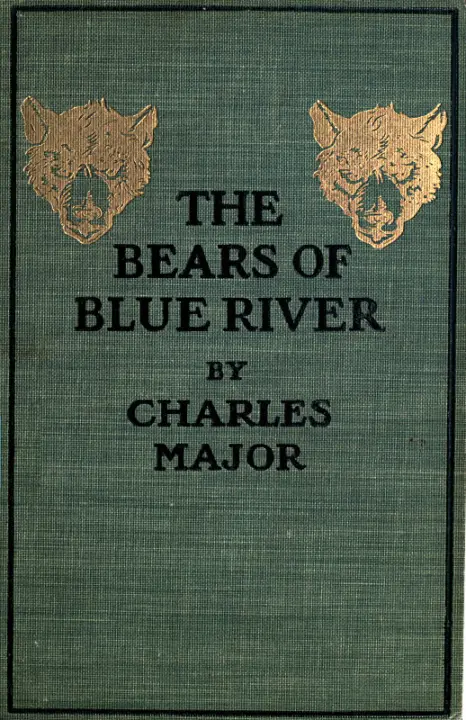
The Bears of Blue River
Charles Major
THE CLASSIC COLLECTION · 1912
"The Touchstone of Fortune" by Charles Major is a historical novel written during the early 20th century. The story is set against the backdrop of the Restoration period in England under King Charles II, focusing on the lives and loves of the socially prominent. The narrative centers around Baron Clyde and his cousin Frances Jennings, who faces the tumultuous social landscape of the court as she seeks a chance to elevate her family’s fortunes. At the start of the novel, we are introduced to the themes of luck, ambition, and moral complexity through the eyes of Baron Clyde, who reflects on the fortunes of his friend, George Hamilton, and the political machinations of the court. Clyde reveals his cousin Frances's beauty and potential and speaks of his plans to secure her a position as a maid of honor to the Duchess of York. The opening chapter establishes Frances’s precarious situation, growing tensions with her father’s fading fortunes, and her burgeoning, yet unsafe, attraction to George Hamilton, meant to illustrate the dangers that lurk within courtly life during a time of moral ambiguity and personal ambition.
Introduction adapted from the source catalogue; source summaries may be automatically generated.
Free to read · English · 92,319 words · No account needed
MAKE TIME FOR A GOOD BOOK
On by default. Untick to stop anonymous reading totals. Each page counts after 10 seconds in view. How this works.
Anonymous counting is on unless you have switched it off.
"If the king were unmarried, I would wager all I have that your cousin would be our queen within a month."
Count Grammont, who was standing behind me, leaned forward and whispered,
"Your cousin, baron?"
"Yes, count," I answered.
"Mon Dieu!" he returned, shrugging his shoulders. "You will soon be a duke. We may not call her the queen of hearts, for already we have one, but surely she is the duchess of hearts. I wish I might present her in Paris. Ah Dieu! She would make quickly my peace with my king!"
Poor Grammont's one object in life was that his peace might be made with his king. He lived only in the hope of a recall to Versailles.
Frances made a graceful courtesy, as she kissed their Highness's hands, and, when the brief ceremony of presentation to the duke was over, turned to Mary and me, glad to have a moment's respite beside us. She said nothing, but I could see that for the moment the gorgeous scene about us had bewildered her. The vast mouldings of gold, the frescoed cupids, nymphs and goddesses, the wonderful paintings, the brilliant tapestries, all fairly shone in the light of a thousand wax candles, while the polished floor of many-colored woods was a mirror under her feet, reflecting all this beauty.
The powdered and rouged courtiers, arrayed in silks, gold lace and jewels, seemed more like creatures from a land of phantasy than beings of flesh and blood. The men with their great curled wigs, their plumed, bejewelled hats and glittering gold swords, seemed to have stepped from the pages of a wonderful picture-book, and the women, whose gorgeous gowns exposed their bepowdered skin halfway to their waists, measuring from the chin, and whose lifted petticoats made a proportionate display, measuring from the feet, surely were brought from some fair land of folly and shame.
I touched Frances's hand to awaken her, and whispered: "Show neither wonder nor interest. See nothing, or these fools about us will laugh."
She laughed nervously, nodding her head to tell me that she understood.
"But I must look. I can't help it," she said.
"You must see it all without looking," I suggested, and Mary helped me
out by saying:--
"It is all tinsel, not worth looking at. That is the quality of all you will see at court; gold foil, king and all."
Presently I saw the gentlemen removing their hats and tucking them under their arms, so I knew the king had entered, and felt sure he would soon come up to salute his hostess, the duchess, near whom we were standing.
Your reading position is saved on this browser. Take it to another device with a library code. Reading pages adapt to text, rather than matching a printed edition.
Charles Major
Charles Major
Charles Major
Charles Major
BEHIND THE BOOK
This eBook is for the use of anyone anywhere in the United States and most other parts of the world at no cost and with almost no restrictions whatsoever. You may copy it, give it away or re-use it under the terms of the Project Gutenberg License included with this eBook or online at www.gutenberg.org. If you are not located in the United States, you will have to check the laws of the country where you are located before using this eBook. Read the source licence.
The original source file, including credits and licence, is retained by this library. Request an original-format copy at no charge. Please include the book title and Project Gutenberg identifier #14242.
KEEP YOUR CURIOSITY GOING
Cécile Tormay

Moritz Busch
Coulson Kernahan
John L. Ransom

Maurice Baring
Frances Wright