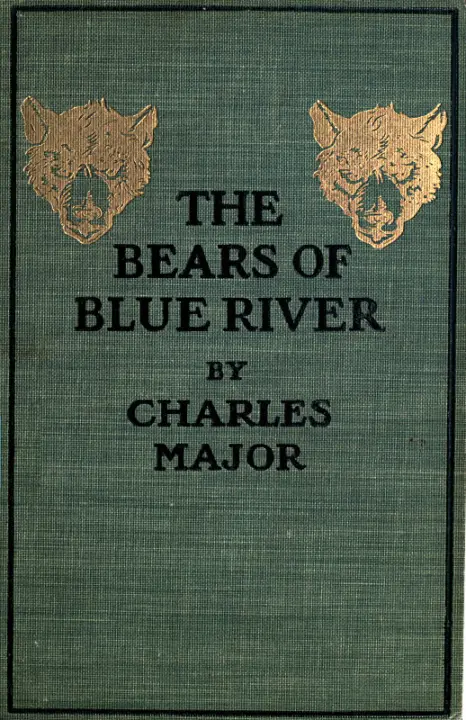
The Bears of Blue River
Charles Major
THE CLASSIC COLLECTION · 1912
"The Touchstone of Fortune" by Charles Major is a historical novel written during the early 20th century. The story is set against the backdrop of the Restoration period in England under King Charles II, focusing on the lives and loves of the socially prominent. The narrative centers around Baron Clyde and his cousin Frances Jennings, who faces the tumultuous social landscape of the court as she seeks a chance to elevate her family’s fortunes. At the start of the novel, we are introduced to the themes of luck, ambition, and moral complexity through the eyes of Baron Clyde, who reflects on the fortunes of his friend, George Hamilton, and the political machinations of the court. Clyde reveals his cousin Frances's beauty and potential and speaks of his plans to secure her a position as a maid of honor to the Duchess of York. The opening chapter establishes Frances’s precarious situation, growing tensions with her father’s fading fortunes, and her burgeoning, yet unsafe, attraction to George Hamilton, meant to illustrate the dangers that lurk within courtly life during a time of moral ambiguity and personal ambition.
Introduction adapted from the source catalogue; source summaries may be automatically generated.
Free to read · English · 92,319 words · No account needed
MAKE TIME FOR A GOOD BOOK
On by default. Untick to stop anonymous reading totals. Each page counts after 10 seconds in view. How this works.
Anonymous counting is on unless you have switched it off.
While I was crossing the park on my way back to Whitehall, the wind moaned and groaned--it did not breathe. The stars did not twinkle--they glared. The nightingales did not sing--they screamed. And the roses were odorless. Perhaps all this change to gloom was within me rather than without, but it existed just the same, and I went home and to bed, hating all the world save Bettina, whom I vowed for the hundredth time never to see again.
The next day at noon De Grammont came to my closet, where I had waited
for him all morning.
"Welcome to you, dear count!" I cried, leading him by the hand to a
chair.
"Perhaps you will not so warmly welcome me," he returned, "when you learn
my errand."
"I already know your errand, Count Grammont, and it makes you doubly welcome," I answered, drawing a chair for myself and sitting down in front of him.
"Ah, that is of good," he returned, rubbing his hands. "You already know the purpose of my visit?"
"Yes, I do, my dear count, but any purpose would delight me which brings the pleasure of your company."
"Ah, it is said like a civilized man," he returned, complimenting me by speaking English, though I shall not attempt to reproduce his pronunciation. "How far better it is to say: 'Monsieur, permit to me,' before one runs a man through than to do it as though one were sticking a mere pig. Is it not so?"
"True as sunshine, my dear count," I returned. "There's a vast difference between the trade of butchering and the gentle art of murder."
De Grammont threw back his head, laughing softly. "Ah, good, good! Very good, dear baron! The sentiment is beau-ti-ful and could not be better expressed--in English. You should have been born across the channel."
"I wish I had been born any place, not excepting hell, rather than in
England," I answered.
"True, true, what a hole it is," returned the count, regretfully. "The
Englishman is one pig."
He saw by the expression of my face that while I might abuse my own countrymen, I did not relish hearing it from others, so with true French tact he held up his hand to keep me from speaking till he could correct himself.
"Pardon, baron, I forgot the 'r,' The Englishman's affectation of a virtue he despises makes of him a prig--not a pig. Non, non! Mon Dieu! Not a pig--a prig! Is it not so?"
"True, true, count," I returned, unable to restrain a laugh. "It is the affectation of virtue that makes frank vice attractive by comparison."
Your reading position is saved on this browser. Take it to another device with a library code. Reading pages adapt to text, rather than matching a printed edition.
Charles Major
Charles Major
Charles Major
Charles Major
BEHIND THE BOOK
This eBook is for the use of anyone anywhere in the United States and most other parts of the world at no cost and with almost no restrictions whatsoever. You may copy it, give it away or re-use it under the terms of the Project Gutenberg License included with this eBook or online at www.gutenberg.org. If you are not located in the United States, you will have to check the laws of the country where you are located before using this eBook. Read the source licence.
The original source file, including credits and licence, is retained by this library. Request an original-format copy at no charge. Please include the book title and Project Gutenberg identifier #14242.
KEEP YOUR CURIOSITY GOING
Cécile Tormay

Moritz Busch
Coulson Kernahan
John L. Ransom

Maurice Baring
Frances Wright