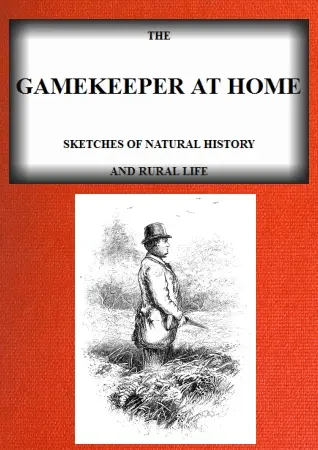
The Gamekeeper at Home: Sketches of natural history and rural life (Illustrated)
Richard Jefferies
THE CLASSIC COLLECTION · 1892
"The Toilers of the Field" by Richard Jefferies is a collection of essays and sketches written in the late 19th century. The book examines the lives of agricultural workers and farmers, painting a detailed portrait of rural life and the challenges faced by those who toil on the land. Through his exploration of different classes within the agricultural community, Jefferies offers insights into their daily routines, social interactions, and the impact of changing agricultural practices. The opening portion presents a vivid depiction of the life of farmers and laborers, detailing the structures of their homes and the daily tasks they undertake. Jefferies describes various types of farmhouses, their architecture, and the roles played by the individuals within them. He offers observations on the routines of farmers and laborers, emphasizing the hard work, community dynamics, and social hierarchies inherent in rural life. Additionally, the text hints at the economic and social transformations occurring in English agriculture during that period, capturing both the beauty and challenges of the agrarian lifestyle.
Introduction adapted from the source catalogue; source summaries may be automatically generated.
Free to read · English · 63,384 words · No account needed
MAKE TIME FOR A GOOD BOOK
On by default. Untick to stop anonymous reading totals. Each page counts after 10 seconds in view. How this works.
Anonymous counting is on unless you have switched it off.
They are much better clothed now than formerly. Corduroy trousers and slops are the usual style. Smock-frocks are going out of use, except for milkers and faggers. Almost every labourer has his Sunday suit, very often really good clothes, sometimes glossy black, with the regulation "chimneypot." His unfortunate walk betrays him, dress how he will. Since labour has become so expensive it has become a common remark among the farmers that the labourer will go to church in broadcloth and the masters in smock-frocks. The labourer never wears gloves--that has to come with the march of the times; but he is particularly choice over his necktie. The women must dress in the fashion. A very respectable draper in an agricultural district was complaining to me the other day that the poorest class of women would have everything in the fashionable style, let it change as often as it would. In former times, if he laid in a stock of goods suited to tradesmen, and farmers' wives and daughters, if the fashion changed, or they got out of date, he could dispose of them easily to the servants. Now no such thing. The quality did not matter so much, but the style must be the style of the day--no sale for remnants. The poorest girl, who had not got two yards of flannel on her back, must have the same style of dress as the squire's daughter--Dolly Vardens, chignons, and parasols for ladies who can work all day reaping in the broiling sun of August! Gloves, kid, for hands that milk the cows!
The cottages now are infinitely better than they were. There is scarcely room for further improvement in the cottages now erected upon estates. They have three bedrooms, and every appliance and comfort compatible with their necessarily small size. It is only the cottages erected by the labourers themselves on waste plots of ground which are open to objection. Those he builds himself are, indeed, as a rule, miserable huts, disgraceful to a Christian country. I have an instance before me at this moment where a man built a cottage with two rooms and no staircase or upper apartments, and in those two rooms eight persons lived and slept--himself and wife, grown-up daughters, and children. There was not a scrap of garden attached, not enough to grow half-a-dozen onions. The refuse and sewage was flung into the road, or filtered down a ditch into the brook which supplied that part of the village with water. In another case at one time there was a cottage in which twelve persons lived. This had upper apartments, but so low was the ceiling that a tall man could stand on the floor, with his head right through the opening for the staircase, and see along the upper floor under the beds! These squatters are the curse of the community. It is among them that fever and kindred infectious diseases break out; it is among them that wretched couples are seen bent double with rheumatism and affections of the joints caused by damp. They have often been known to remain so long, generation after generation, in these wretched hovels, that at last the lord of the manor, having neglected to claim quit-rent, they can defy him, and claim them as their own property, and there they stick, eyesores and blots, the fungi of the land. The cottages erected by farmers or by landlords are now, one and all, fit and proper habitations for human beings; and I verily believe it would be impossible throughout the length and breadth of Wiltshire to find a single bad cottage on any large estate, so well and so thoroughly have the landed proprietors done their work. On all farms gardens are attached to the cottages, in many instances very large, and always sufficient to produce enough vegetables for the resident. In villages the allotment system has been greatly extended of late years, and has been found most beneficial, both to owners and tenants. As a rule the allotments are let at a rate which may be taken as L4 per annum--a sum which pays the landlord very well, and enables the labourer to remunerate himself. In one village which came under my observation the clergyman of the parish has turned a portion of his glebe land into allotments--a most excellent and noble example, which cannot be too widely followed or too much extolled. He is thus enabled to benefit almost every one of his poor parishioners, and yet without destroying that sense of independence which is the great characteristic of a true Englishman. He has issued a book of rules and conditions under which these allotments are held, and he thus places a strong check upon drunkenness and dissolute habits, indulgence in which is a sure way to lose the portions of ground. There is scarcely an end to the benefits of the allotment system. In villages there cannot be extensive gardens, and the allotments supply their place. The extra produce above that which supplies the table and pays the rent is easily disposed of in the next town, and places many additional comforts in the labourer's reach. The refuse goes to help support and fatten the labourer's pig, which brings him in profit enough to pay the rent of his cottage, and the pig, in turn, manures the allotment. Some towns have large common lands, held under certain conditions; such are Malmesbury, with 500 acres, and Tetbury (the common land of which extends two miles), both these being arable, &c. These are not exactly in the use of labourers, but they are in the hands of a class to which the labourer often rises. Many labourers have fruit-trees in their gardens, which, in some seasons, prove very profitable. In the present year, to my knowledge, a labourer sold L4 worth of apples; and another made L3, 10s. off the produce of one pear-tree, pears being scarce.
Your reading position is saved on this browser. Take it to another device with a library code. Reading pages adapt to text, rather than matching a printed edition.
Richard Jefferies
Richard Jefferies
Richard Jefferies
Richard Jefferies
BEHIND THE BOOK
This eBook is for the use of anyone anywhere in the United States and most other parts of the world at no cost and with almost no restrictions whatsoever. You may copy it, give it away or re-use it under the terms of the Project Gutenberg License included with this eBook or online at www.gutenberg.org. If you are not located in the United States, you will have to check the laws of the country where you are located before using this eBook. Read the source licence.
The original source file, including credits and licence, is retained by this library. Request an original-format copy at no charge. Please include the book title and Project Gutenberg identifier #27516.
KEEP YOUR CURIOSITY GOING

David Patterson (Spirit) Hatch

David Patterson (Spirit) Hatch

David Patterson (Spirit) Hatch
Cécile Tormay

Moritz Busch
John L. Ransom