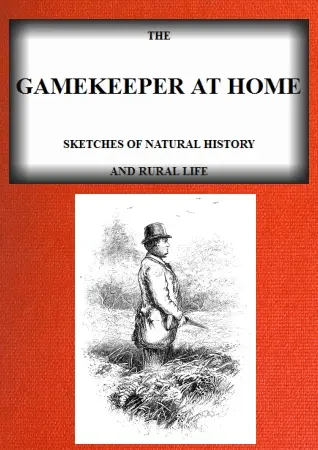
The Gamekeeper at Home: Sketches of natural history and rural life (Illustrated)
Richard Jefferies
THE CLASSIC COLLECTION · 1892
"The Toilers of the Field" by Richard Jefferies is a collection of essays and sketches written in the late 19th century. The book examines the lives of agricultural workers and farmers, painting a detailed portrait of rural life and the challenges faced by those who toil on the land. Through his exploration of different classes within the agricultural community, Jefferies offers insights into their daily routines, social interactions, and the impact of changing agricultural practices. The opening portion presents a vivid depiction of the life of farmers and laborers, detailing the structures of their homes and the daily tasks they undertake. Jefferies describes various types of farmhouses, their architecture, and the roles played by the individuals within them. He offers observations on the routines of farmers and laborers, emphasizing the hard work, community dynamics, and social hierarchies inherent in rural life. Additionally, the text hints at the economic and social transformations occurring in English agriculture during that period, capturing both the beauty and challenges of the agrarian lifestyle.
Introduction adapted from the source catalogue; source summaries may be automatically generated.
Free to read · English · 63,384 words · No account needed
MAKE TIME FOR A GOOD BOOK
On by default. Untick to stop anonymous reading totals. Each page counts after 10 seconds in view. How this works.
Anonymous counting is on unless you have switched it off.
"Thee built 'un thee-self, didn't 'ee?" said John, in his slow way.
"Ay, that I did," continued Jim, not seeing the drift of the remark. He not only built it, but he brought up nineteen children in it, and fourteen of them lived to grow up, all the offspring of one wife. And a time she had of it, too. None of them ever fell in that pond, though he often wished they would; and they were all pretty healthy, which was a bad thing, because it made them hungry, and if they had been ill the parish would have kept them. All that he had done on 12s. a week, and he minded the time when it was only 9s., ay, and even when it was 6s., and 'twas better then than it was now with 15s. That was before the Unions came about, in the time of the old workhouses in every parish. Then the farmers used to find everybody a job. Every morning they had to go round from one farmer to the other, and if there was no work then they went to the workhouse, or sometimes to the vestry-room in the church, where every man had a loaf of bread for every head there was in his family, so that the more children he had the more loaves of bread, which was a capital thing when the children were small. He had known a man in those times sent seven miles with a wheelbarrow to fetch a barrow load of coal from the canal wharf, and then have to wheel it back seven miles, and get one shilling for his day's work. Still they were better times than these, because the farmers for their own sake were forced to find the fellows something to do; but now they did not care, and it was a hard thing to find work, especially when a man grew old, and stiff about the joints. Now the Boards of Guardians would not give any relief unless the applicants were ill, or not able-bodied, and even then they were often required to break stones, and he was very much inclined to throw his spade in that old pond and go to the Union with the "missis" and all the lot for good. He had the rheumatism bad enough. It would serve them right. He had worked "nigh handy" sixty years; and all he had got by it he could put in his eye. They ought to keep him now. It was not half so good as the old times for all the talk; then the children could bring home a bit of wood out of the hedges to boil the pot with, but now they must not touch a stick, or there was the law on them in a minute. And then coal at the price it was. Why didn't his sons keep him? Where were they? One was a soldier, and another had gone to America, and the third was married and had a hard job to keep himself, and the fourth was gone nobody knew where. As for the wenches, they were no good in that way. So he and his "missis" muddled on at home with three of the youngest. And they could not let them alone even in that. He did go into the Union workhouse for a bit, a while ago, when the rheumatism was extraordinary bad, but some of the guardians smelt out that he had a cottage of his own, and it was against the law to relieve anybody that had property; so he must pay back the relief as a loan or sell the cottage. He was offered L25 for the place and garden, and he meant to have taken it, but when they came to look into the writings it was not clear that he could sell it. It was quit-rent land, and although the landlord had not taken the rent for twenty years, yet he had entered it in his book as paid (out of good nature), and the lawyers said it could not be done. But as they would not let him sell it, he would not turn out, not he. There he would stop--just to spite them. He knew that nook of his was wanted for cattle stalls on the new principle, and very handy it would be with all that water close at hand, but he had worked for sixty years, and had had nineteen children there, and he would not turn out. Not he. The parson's "missis" and the squire's "missis" came the other day about that youngest boy of his. They wanted to get him into some school up in London somewhere, but he remembered how the squire had served him just for picking up a dead rabbit that laid in his path one hard snow time. Six weeks in gaol because he could not pay the fine. And the parson turned him out of his allotment because he saw him stagger a little in the road one night with the rheumatism. It was a lie that he was drunk. And suppose he was? The parson had his wine, he reckoned. They should not have his boy. He rather hoped he would grow up a bad one, and bother them well. He minded when that sharp old Miss ---- was always coming round with tracts and blankets, like taking some straw to a lot of pigs, and lecturing his "missis" about economy. What a fuss she made, and scolded his wife as if she was a thief for having that fifteenth boy! His "missis" turned on her at last, and said, "Lor, miss, that's all the pleasure me an' my old man got." As for this talk about the labourers' Unions, it was all very well for the young men; but it made it worse still for the old ones. The farmers, if they had to give such a price, would have young men in full strength: there was no chance at all for an old fellow of sixty-four with rheumatism. Some of them, too, were terribly offended--some of the old sort--and turned off the few pensioners they had kept on at odd jobs for years. However, he supposed he must get back to that ditch again.
Your reading position is saved on this browser. Take it to another device with a library code. Reading pages adapt to text, rather than matching a printed edition.
Richard Jefferies
Richard Jefferies
Richard Jefferies
Richard Jefferies
BEHIND THE BOOK
This eBook is for the use of anyone anywhere in the United States and most other parts of the world at no cost and with almost no restrictions whatsoever. You may copy it, give it away or re-use it under the terms of the Project Gutenberg License included with this eBook or online at www.gutenberg.org. If you are not located in the United States, you will have to check the laws of the country where you are located before using this eBook. Read the source licence.
The original source file, including credits and licence, is retained by this library. Request an original-format copy at no charge. Please include the book title and Project Gutenberg identifier #27516.
KEEP YOUR CURIOSITY GOING

David Patterson (Spirit) Hatch

David Patterson (Spirit) Hatch

David Patterson (Spirit) Hatch
Cécile Tormay

Moritz Busch
John L. Ransom