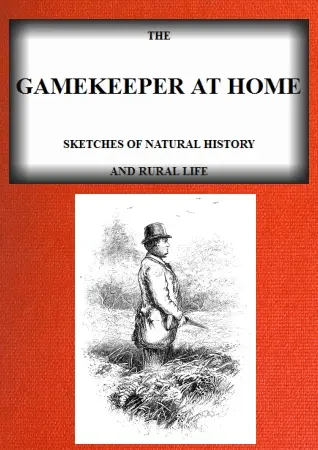
The Gamekeeper at Home: Sketches of natural history and rural life (Illustrated)
Richard Jefferies
THE CLASSIC COLLECTION · 1892
"The Toilers of the Field" by Richard Jefferies is a collection of essays and sketches written in the late 19th century. The book examines the lives of agricultural workers and farmers, painting a detailed portrait of rural life and the challenges faced by those who toil on the land. Through his exploration of different classes within the agricultural community, Jefferies offers insights into their daily routines, social interactions, and the impact of changing agricultural practices. The opening portion presents a vivid depiction of the life of farmers and laborers, detailing the structures of their homes and the daily tasks they undertake. Jefferies describes various types of farmhouses, their architecture, and the roles played by the individuals within them. He offers observations on the routines of farmers and laborers, emphasizing the hard work, community dynamics, and social hierarchies inherent in rural life. Additionally, the text hints at the economic and social transformations occurring in English agriculture during that period, capturing both the beauty and challenges of the agrarian lifestyle.
Introduction adapted from the source catalogue; source summaries may be automatically generated.
Free to read · English · 63,384 words · No account needed
MAKE TIME FOR A GOOD BOOK
On by default. Untick to stop anonymous reading totals. Each page counts after 10 seconds in view. How this works.
Anonymous counting is on unless you have switched it off.
The overcrowding in cottages leads to what may be called an indifference to decency. It is not that in families decency is wantonly and of a set purpose disregarded, but stern necessity leads to a coarseness and indelicacy which hardens the mind and deadens the natural modesty even of the best girls. Then the low scandals of the village talked over from cottage to cottage, the rude jokes of the hayfield, the general looseness and indifference which prevail as to morality, all prepare the girl for the too common fall. If she remains at home and works in the fields after the age of fifteen, unless uncommonly strong-minded, it is an open question whether she will or will not succumb. If she goes into a farmhouse as servant, the chances are in favour of her escaping temptation. But in farmhouses she may also sometimes run into the very jaws of danger. It is not uncommon in some districts for young labourers to sleep in the house, one or two who milk and have to be on the spot early. These take their supper in the kitchen or the brewhouse, and, despite the strictest precautions on the part of the mistress, enjoy plenty of opportunities for flirting with the girl. Young, full of animal spirits, giddy and ignorant, she thinks no harm of a romp, and finally falls, and has to leave her service. If a little may be said in favour of the poor girls, not a word can be said in favour of the agricultural men, who are immoral almost without exception, and will remain so until a better-educated generation with more self-respect arises. The number of poor girls, from fifteen to five-and-twenty, in agricultural parishes who have illegitimate offspring is extremely large, and is illustrated by the fact that, out of the marriages that take place--and agricultural poor are a marrying class--scarcely any occur until the condition of the girl is too manifest to be any longer concealed. Instances could be mentioned where the clergyman's wife, with a view to check the immorality around her, has offered a reward of a piece of furniture to the first married woman who does not bear a child till nine months after marriage; the custom being within three months. The frequency of the appeals to the petty sessions in rural districts for orders of contribution, by young unmarried girls, also illustrates the prevalent immorality. Of late the magistrates have taken the line of ordering contributions on a higher scale, on the grounds that the labourer earns larger wages, and that the cost of living has risen, and also as a check upon the men. This well-intentioned step has had the precisely opposite effect to what was wished. The labourer with higher wages feels the demand upon his pocket but very little more. The cost of living in rural outlying districts has risen only to a very trifling degree--barely perceptibly, in fact. Bread is cheap--that is the staple--rents are the same, and there are more allotments than ever, making vegetables more easy to obtain. The result, therefore, is this, that the girl feels she can sin with comparative immunity. She is almost sure to get her order (very few such appeals are refused); let this be supplemented with some aid from the parish, and she is none the worse off than before, for there is no prejudice against employing her in the fields. Should her fall take place with some young farmer's son from whom she may get a larger contribution in private, or by order of the magistrates, she is really and truly in a pecuniary sense better off than she was before, for she has a certain fixed income. The evil is aggravated by the new law, which enables the order to be extended over a longer term of years than formerly, so that for fifteen years is a common thing. If it is decided to recognise immorality, and to provide against the woman being unduly injured by it, then these orders are certainly the correct procedure; but if it is desired to suppress it, then they are a total failure. The girl who has had an illegitimate child is thought very little the worse of by her friends and her own class, especially if her seducer is a man who can afford to pay for it--that is the grand point. If she is fool enough to yield to a man who is badly off, she may be jeered at as a fool, but rarely reprimanded as a sinner, not even by her own mother. Such things are not looked upon by the rural poor as sins, but as accidents of their condition.
Your reading position is saved on this browser. Take it to another device with a library code. Reading pages adapt to text, rather than matching a printed edition.
Richard Jefferies
Richard Jefferies
Richard Jefferies
Richard Jefferies
BEHIND THE BOOK
This eBook is for the use of anyone anywhere in the United States and most other parts of the world at no cost and with almost no restrictions whatsoever. You may copy it, give it away or re-use it under the terms of the Project Gutenberg License included with this eBook or online at www.gutenberg.org. If you are not located in the United States, you will have to check the laws of the country where you are located before using this eBook. Read the source licence.
The original source file, including credits and licence, is retained by this library. Request an original-format copy at no charge. Please include the book title and Project Gutenberg identifier #27516.
KEEP YOUR CURIOSITY GOING

David Patterson (Spirit) Hatch

David Patterson (Spirit) Hatch

David Patterson (Spirit) Hatch
Cécile Tormay

Moritz Busch
John L. Ransom