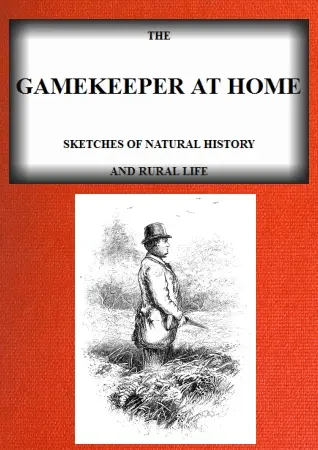
The Gamekeeper at Home: Sketches of natural history and rural life (Illustrated)
Richard Jefferies
THE CLASSIC COLLECTION · 1892
"The Toilers of the Field" by Richard Jefferies is a collection of essays and sketches written in the late 19th century. The book examines the lives of agricultural workers and farmers, painting a detailed portrait of rural life and the challenges faced by those who toil on the land. Through his exploration of different classes within the agricultural community, Jefferies offers insights into their daily routines, social interactions, and the impact of changing agricultural practices. The opening portion presents a vivid depiction of the life of farmers and laborers, detailing the structures of their homes and the daily tasks they undertake. Jefferies describes various types of farmhouses, their architecture, and the roles played by the individuals within them. He offers observations on the routines of farmers and laborers, emphasizing the hard work, community dynamics, and social hierarchies inherent in rural life. Additionally, the text hints at the economic and social transformations occurring in English agriculture during that period, capturing both the beauty and challenges of the agrarian lifestyle.
Introduction adapted from the source catalogue; source summaries may be automatically generated.
Free to read · English · 63,384 words · No account needed
MAKE TIME FOR A GOOD BOOK
On by default. Untick to stop anonymous reading totals. Each page counts after 10 seconds in view. How this works.
Anonymous counting is on unless you have switched it off.
This lovely little bird is so small and light that it can cling suspended on the end of a single narrow leaf, or needle of pine, and it does not depress the least branch on which it may alight. The gold-crest frequents the loneliest heath, the deepest pine wood, and the immediate neighbourhood of dwellings indifferently. A Scotch fir or pine grew so near a house in which I once lived that the boughs almost brushed the window, and when confined to my room by illness, it gave me much pleasure to watch a pair of these wrens who frequently visited the tree. They are also fond of thick thorn hedges, and, like all birds, have their favourite localities, so that if you see them once or twice in one place you should mark the tree or bush, for there they are almost certain to return. It would be quite possible for a person to pass several years in the country and never see one of these birds. There is a trick in finding birds' nests, and a trick in seeing birds. The first I noticed was in an orchard; soon after, I found a second in a yew-tree (close to a window), and after that constantly came upon them as they crept through brambles or in hedgerows, or a mere speck up in a fir-tree. So soon as I had seen one I saw plenty.
There is something very mournful in a deserted house, and the feeling is still further intensified if it happens to have once been a school, where a minor world played out its little drama, and left its history written on the walls. For a great boys' school is like a kingdom with its monarchs, its ministers, and executioners, and even its changes of dynasty. Such a house stood no long while since on the northern border-land of Wilts and Berks, a mansion in its origin back in the days of Charles II., and not utterly unconnected with the great events of those times, but which, for hard on a hundred years--from the middle of the eighteenth to the middle of the nineteenth century--was used as a superior grammar-school, or college, as it would now be called. Gradually falling in reputation, and supplanted by modern rivals for fifteen or twenty years, the huge hollow halls and endless dormitories were silent, and the storms that sway with savage force down from the hills wreaked their will upon the windows and the rotting roof. Inside the refectory--the windows being blown in--and over the antique-carved mantelpiece, two swallows' nests had been built to the ceiling or cornice. The whitewashed walls were yellow and green with damp, and covered with patches of saltpetre efflorescence. But they still bore, legible and plain, the hasty inscriptions scrawled on them, years and years before, by hands then young, but by now returned to dust. The history of this little kingdom, the hopes and joys, the fears and hatreds of the subjects, still remained, and might be gathered from these writings on the walls, just as are the history of Egypt and of Assyria now deciphered from the palaces and tombs. Here were the names of the kings--the head-masters--generally with some rough doggerel verse, not often very flattering, and illustrated with outline portraits. Here were caricatures of the ushers and tutors, hidden in some corner of the dormitories once, no doubt, concealed by the furniture, coupled with the very freest personalities, mostly in pencil, but often done with a burnt stick. Dates were scattered everywhere--not often the year, but the day of the month, doubtless memorable from some expedition or lark played off half a century since. Now and then there was a quotation from the classics--one describing the groaning and shouting of the dying Hercules, till the rocks and the sad hills resounded, which irresistibly suggested the idea of a thorough caning. Other inscriptions were a mixture of Latin and any English words that happened to rhyme, together producing the most extraordinary jumble. Where now are the merry hearts that traced these lines upon the plaster in an idle mood? Attached to the mansion was a great garden, or rather wilderness, with yew hedges ten feet high and almost as thick, a splendid filbert walk, an orchard, with a sun-dial. It is all--mansion and garden, noble yew-tree hedges and filbert walk, sun-dial and all--swept away now. The very plaster upon which generation after generation of boys recorded their history has been torn down, and has crumbled into dust. Greater kingdoms than this have disappeared since the world began, leaving not a sign even of their former existence.
Your reading position is saved on this browser. Take it to another device with a library code. Reading pages adapt to text, rather than matching a printed edition.
Richard Jefferies
Richard Jefferies
Richard Jefferies
Richard Jefferies
BEHIND THE BOOK
This eBook is for the use of anyone anywhere in the United States and most other parts of the world at no cost and with almost no restrictions whatsoever. You may copy it, give it away or re-use it under the terms of the Project Gutenberg License included with this eBook or online at www.gutenberg.org. If you are not located in the United States, you will have to check the laws of the country where you are located before using this eBook. Read the source licence.
The original source file, including credits and licence, is retained by this library. Request an original-format copy at no charge. Please include the book title and Project Gutenberg identifier #27516.
KEEP YOUR CURIOSITY GOING

David Patterson (Spirit) Hatch

David Patterson (Spirit) Hatch

David Patterson (Spirit) Hatch
Cécile Tormay

Moritz Busch
John L. Ransom