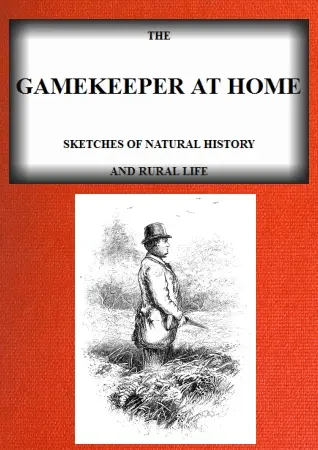
The Gamekeeper at Home: Sketches of natural history and rural life (Illustrated)
Richard Jefferies
THE CLASSIC COLLECTION · 1892
"The Toilers of the Field" by Richard Jefferies is a collection of essays and sketches written in the late 19th century. The book examines the lives of agricultural workers and farmers, painting a detailed portrait of rural life and the challenges faced by those who toil on the land. Through his exploration of different classes within the agricultural community, Jefferies offers insights into their daily routines, social interactions, and the impact of changing agricultural practices. The opening portion presents a vivid depiction of the life of farmers and laborers, detailing the structures of their homes and the daily tasks they undertake. Jefferies describes various types of farmhouses, their architecture, and the roles played by the individuals within them. He offers observations on the routines of farmers and laborers, emphasizing the hard work, community dynamics, and social hierarchies inherent in rural life. Additionally, the text hints at the economic and social transformations occurring in English agriculture during that period, capturing both the beauty and challenges of the agrarian lifestyle.
Introduction adapted from the source catalogue; source summaries may be automatically generated.
Free to read · English · 63,384 words · No account needed
MAKE TIME FOR A GOOD BOOK
On by default. Untick to stop anonymous reading totals. Each page counts after 10 seconds in view. How this works.
Anonymous counting is on unless you have switched it off.
Farmers are decidedly a marrying class of men. The farm is a business in which a wife is of material service, and can really be a helpmate. The lower class of farmers usually marry quite as much or more for that reason than any others. The higher classes of agriculturists feel that they have a right to marry because they too can show a home in which to keep a wife. Though they may not have any large amount of capital, still they possess a good house and sufficient provision. They are, therefore, a marrying class of men, but do not commonly contract matrimonial alliances very early in life. The great object of an agriculturist who has sons is to get them settled in farms, and it is astonishing to what an extent this is carried by men who do not seem to have much capital to start their children with. Instances are common in which a man has three or four sons all in farms, and doing fairly well. One of the greatest difficulties he has to contend against is the necessity of providing education. Where is a farmer, living perhaps two or three miles, often enough four and six miles, from a town, to send his boys to school? The upper class of agriculturists can, of course, afford to have a proper governess at home till they are old enough, and then send them to one of the so-called middle-class schools. The lower class, on the other hand, who do not aspire very high, and whose ideas are little more ambitious than those of their labourers, are contented with the school in the neighbouring village. Till recently these village schools were very poor affairs, something a little better than the old dame school, but not much. But since the new Education Act the lower class of farmers are in a better position with respect to education than those who possess much higher claims to social distinction. Where there is not a school board, the clergyman and the landowners have combined, and built first-rate schools, up to all the requirements of the Act, and attended by properly certified teachers. The lower class farmer, who is troubled with no scruples about the association of his boys with the labourers' children, can send them to this school at a very low charge indeed, and they will there receive a good foundation. But the middle-class farmer--the man who is neither an independent gentleman, nor obliged to live on bacon and greens--is unprovided for, and yet this class is the most numerous. They have better views for their sons than to confine those early impressions upon which so much depends to the narrow and rude, if not coarse manners of the labourers' children. They look higher than that, and they are fully justified in doing so. They do not, therefore, at all relish the idea of sending their boys to the national school of the parish, let it be never so well supplied with teachers. There is another objection to it. It has a faint suspicion of the pauper. Now if there is anything a downright English yeoman abominates more than all the rest it is any approach to the "parish." This is a "parish" school. It is not a paupers' school--that is admitted--but it is a "parish" school, to which the children of men who have often received relief are sent. The yeoman's instinct revolts at it. Attempts have been made to get over this niceness of feeling by erecting a special class-room for farmers' sons, and patriotic baronets have even gone so far as to send their own boys so as to set the example. But it is in vain. The middle-class farmer is above all men exclusive in his ideas. He detests the slightest flavour of communism. He likes to be completely and fully independent. He will not patronise the "parish" school. What then is he to do? At this present moment most farmers' sons are sent into the neighbouring towns to the middle-class schools which are to be found there. If the farmer is within two or three miles the boys walk or ride on ponies every morning. If it is farther than that they go as weekly boarders, and return home every Saturday. The fault in this system is simply and solely in the character of the school. Too often it is a school in name only, where the boys learn next to nothing at all, except mischief. Very few schools exist in these small country towns which afford a good education at a moderate price. It is almost impossible that they should exist without an endowment, as the scholars can never be numerous enough to make the profits exceed the expenditure. The result is that the middle-class farmer cannot give his boys a good education unless he sends them to what is called a middle-class school in some town at a great distance, and this he cannot afford. The sum demanded by these so-called middle-class schools is beyond his reach. He may, perhaps, if he has only one son, indulge in the expensive luxury of a sound and thorough education for him. But if there are several the thing is out of the question. With the girls it is even worse--where can he send them? They cannot very well walk or ride to and fro like the boys to the school in the nearest town, and if they are boarded at such schools, the education given is paltry and meagre in the extreme. A good girls' school is one of the rarest things in the country. The result is that a governess is kept while the girls are young. This governess is underpaid, and has consequently herself been only partially educated. Then as the girls grow older they are sent for a year or two, to "finish" them, to some young ladies' academy, and the ultimate product is a smattering of French and music, and crude ideas of fashion and refinement, which make them dissatisfied with their home and unfit for an agricultural life as the wife of a farmer.
Your reading position is saved on this browser. Take it to another device with a library code. Reading pages adapt to text, rather than matching a printed edition.
Richard Jefferies
Richard Jefferies
Richard Jefferies
Richard Jefferies
BEHIND THE BOOK
This eBook is for the use of anyone anywhere in the United States and most other parts of the world at no cost and with almost no restrictions whatsoever. You may copy it, give it away or re-use it under the terms of the Project Gutenberg License included with this eBook or online at www.gutenberg.org. If you are not located in the United States, you will have to check the laws of the country where you are located before using this eBook. Read the source licence.
The original source file, including credits and licence, is retained by this library. Request an original-format copy at no charge. Please include the book title and Project Gutenberg identifier #27516.
KEEP YOUR CURIOSITY GOING

David Patterson (Spirit) Hatch

David Patterson (Spirit) Hatch

David Patterson (Spirit) Hatch
Cécile Tormay

Moritz Busch
John L. Ransom