THE CLASSIC COLLECTION✦The way the world is goingCLASSIC FREE BOOKS
The way the world is going
H. G. (Herbert George) Wells
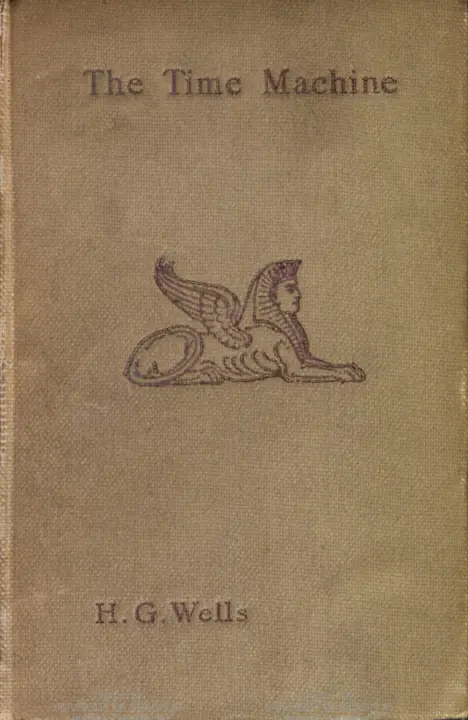
THE CLASSIC COLLECTION · 1895
"The Time Machine" by H. G. Wells is a science fiction novella published in 1895. A Victorian scientist known as the Time Traveller journeys to the year 802,701, where he discovers humanity has evolved into two distinct species: the childlike Eloi and the savage Morlocks. This groundbreaking work popularized the concept of time travel and coined the term "time machine." Wells crafts a haunting vision of the future that explores class divisions and social inequality, taking readers on an unforgettable adventure through time's darkest possibilities.
Introduction adapted from the source catalogue; source summaries may be automatically generated.
Free to read · English · 32,746 words · No account needed
MAKE TIME FOR A GOOD BOOK
On by default. Untick to stop anonymous reading totals. Each page counts after 10 seconds in view. How this works.
Anonymous counting is on unless you have switched it off.
“That is the germ of my great discovery. But you are wrong to say that we cannot move about in Time. For instance, if I am recalling an incident very vividly I go back to the instant of its occurrence: I become absent-minded, as you say. I jump back for a moment. Of course we have no means of staying back for any length of Time, any more than a savage or an animal has of staying six feet above the ground. But a civilised man is better off than the savage in this respect. He can go up against gravitation in a balloon, and why should he not hope that ultimately he may be able to stop or accelerate his drift along the Time-Dimension, or even turn about and travel the other way?”
“Oh, this,” began Filby, “is all—”
“Why not?” said the Time Traveller.
“It’s against reason,” said Filby.
“What reason?” said the Time Traveller.
“You can show black is white by argument,” said Filby, “but you will
never convince me.”
“Possibly not,” said the Time Traveller. “But now you begin to see the object of my investigations into the geometry of Four Dimensions. Long ago I had a vague inkling of a machine—”
“To travel through Time!” exclaimed the Very Young Man.
“That shall travel indifferently in any direction of Space and Time, as the driver determines.”
Filby contented himself with laughter.
“But I have experimental verification,” said the Time Traveller.
“It would be remarkably convenient for the historian,” the Psychologist suggested. “One might travel back and verify the accepted account of the Battle of Hastings, for instance!”
“Don’t you think you would attract attention?” said the Medical Man. “Our ancestors had no great tolerance for anachronisms.”
“One might get one’s Greek from the very lips of Homer and Plato,” the Very Young Man thought.
“In which case they would certainly plough you for the Little-go. The German scholars have improved Greek so much.”
“Then there is the future,” said the Very Young Man. “Just think! One might invest all one’s money, leave it to accumulate at interest, and hurry on ahead!”
“To discover a society,” said I, “erected on a strictly communistic
basis.”
“Of all the wild extravagant theories!” began the Psychologist.
“Yes, so it seemed to me, and so I never talked of it until—”
“Experimental verification!” cried I. “You are going to verify that?”
“The experiment!” cried Filby, who was getting brain-weary.
“Let’s see your experiment anyhow,” said the Psychologist, “though it’s all humbug, you know.”
Your reading position is saved on this browser. Take it to another device with a library code. Reading pages adapt to text, rather than matching a printed edition.
H. G. (Herbert George) Wells
H. G. (Herbert George) Wells
H. G. (Herbert George) Wells
H. G. (Herbert George) Wells
BEHIND THE BOOK
This eBook is for the use of anyone anywhere in the United States and most other parts of the world at no cost and with almost no restrictions whatsoever. You may copy it, give it away or re-use it under the terms of the Project Gutenberg License included with this eBook or online at www.gutenberg.org. If you are not located in the United States, you will have to check the laws of the country where you are located before using this eBook. Read the source licence.
The original source file, including credits and licence, is retained by this library. Request an original-format copy at no charge. Please include the book title and Project Gutenberg identifier #35.
KEEP YOUR CURIOSITY GOING
Wilfrid Scawen Blunt
Wilfrid Scawen Blunt
E. W. (Edgar Watson) Howe
Coulson Kernahan

Maurice Baring
Frances Wright