
The fourth plague
Edgar Wallace
THE CLASSIC COLLECTION · 1929
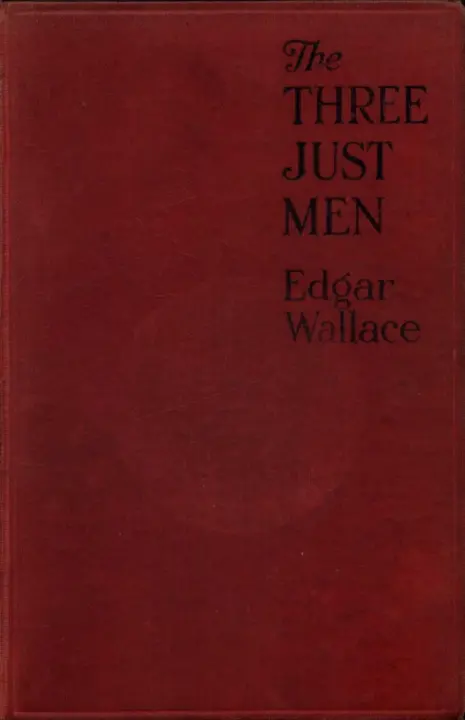
"The Three Just Men" by Edgar Wallace is a crime fiction novel written in the early 20th century. The story revolves around the exploits of a clandestine group of vigilantes known as the Three Just Men, who take it upon themselves to exact justice where the law fails. Central to the plot is Mirabelle Leicester, a young woman who becomes unknowingly entwined in their dangerous world after she seeks employment in London. At the start of the narrative, we are introduced to Mirabelle Leicester, who discovers a job advertisement that sets her on a path to the big city. Her aunt, Alma, expresses concern for Mirabelle’s safety as they discuss the notorious reputation of the Four Just Men, a group that presumably inspired fear across London. Meanwhile, a series of mysterious deaths attributed to a venomous escaped snake complicates the atmosphere of dread in the city. As Mirabelle secures the job with the enigmatic Dr. Oberzohn, it becomes evident that her life is about to collide dramatically with the unfolding events involving the Just Men and their controversial methods of dispensing justice. The opening engages readers with intrigue, suggesting a mix of suspense, danger, and moral ambiguity that sets the tone for Mirabelle's forthcoming adventure.
Introduction adapted from the source catalogue; source summaries may be automatically generated.
Free to read · English · 93,908 words · No account needed
MAKE TIME FOR A GOOD BOOK
On by default. Untick to stop anonymous reading totals. Each page counts after 10 seconds in view. How this works.
Anonymous counting is on unless you have switched it off.
“It couldn’t have been Lew, or you’d have been dead,” he said. He was examining the muzzle of the pistol. “It was you all right.” He chuckled. “Ain’t you the game one! Sister, you ought to be——”
He stopped dead, staring through the window. He was paralysed with amazement at the sight of a bare-headed Aunt Alma flying along the Gloucester Road. With an oath he turned to the girl.
“How did she get out? Have you got anybody here? Now speak up.”
“The cupboard under the stairs leads to the wine cellar,” said Mirabelle coolly, “and there are two ways out of the wine cellar. I think Aunt Alma found one of them.”
With an oath, he took a step towards her, gripped her by the arm and jerked her towards the door.
“Lively!” he said, and dragged her down the stairs through the hall,
into the kitchen.
He shot back the bolts, but the lock of the kitchen door had been
turned.
“This way.” He swore cold-bloodedly, and, her arm still in his powerful grip, he hurried along the passage and pulled open the door.
It was an unpropitious moment. A man was walking down the path, a half-smile on his face, as though he was thinking over a remembered jest. At the sight of him the pedlar dropped the girl’s arm and his hand went like lightning to his pocket.
“When will you die?” said Leon Gonsalez softly. “Make a choice, and make
it quick!”
And the gun in his hand seemed to quiver with homicidal eagerness.
Chapter XV Two “Accidents”
THE pedlar, his face twitching, put up his shaking hands.
Leon walked to him, took the Browning from his moist grip and dropped it
into his pocket.
“Your friends are waiting, of course?” he said pleasantly.
The pedlar did not answer.
“Cuccini too? I thought I had incapacitated him for a long time.”
“They’ve gone,” growled the pedlar.
Gonsalez looked round in perplexity.
“I don’t want to take you into the house. At the same time, I don’t want to leave you here,” he said. “I almost wish you’d drawn that gun of yours,” he added regretfully. “It would have solved so many immediate problems.”
This particular problem was solved by the return of the dishevelled Alma and the restoration to her of her gun.
“I would so much rather you shot him than I,” said Leon earnestly. “The police are very suspicious of my shootings, and they never wholly believe that they are done in self-defence.”
Your reading position is saved on this browser. Take it to another device with a library code. Reading pages adapt to text, rather than matching a printed edition.
Edgar Wallace
Edgar Wallace
Edgar Wallace
Edgar Wallace
BEHIND THE BOOK
This eBook is for the use of anyone anywhere in the United States and most other parts of the world at no cost and with almost no restrictions whatsoever. You may copy it, give it away or re-use it under the terms of the Project Gutenberg License included with this eBook or online at www.gutenberg.org. If you are not located in the United States, you will have to check the laws of the country where you are located before using this eBook. Read the source licence.
The original source file, including credits and licence, is retained by this library. Request an original-format copy at no charge. Please include the book title and Project Gutenberg identifier #69790.
KEEP YOUR CURIOSITY GOING
Coulson Kernahan

Maurice Baring
Frances Wright
Cécile Tormay

Frederic Jesup Stimson

W. H. P. (William Henry Pope) Jarvis