
The fourth plague
Edgar Wallace
THE CLASSIC COLLECTION · 1929
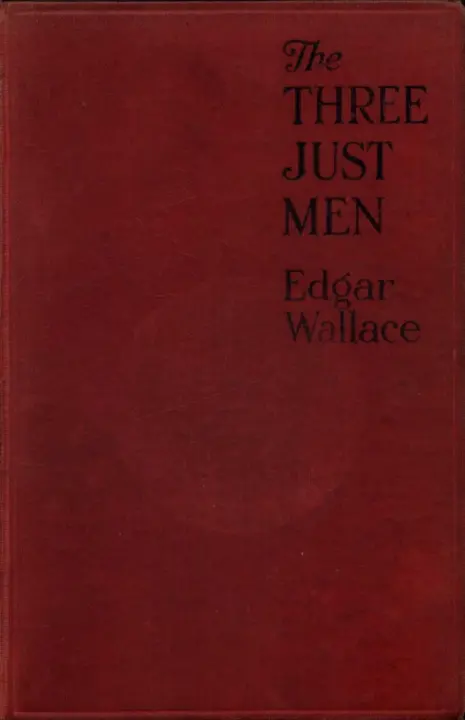
"The Three Just Men" by Edgar Wallace is a crime fiction novel written in the early 20th century. The story revolves around the exploits of a clandestine group of vigilantes known as the Three Just Men, who take it upon themselves to exact justice where the law fails. Central to the plot is Mirabelle Leicester, a young woman who becomes unknowingly entwined in their dangerous world after she seeks employment in London. At the start of the narrative, we are introduced to Mirabelle Leicester, who discovers a job advertisement that sets her on a path to the big city. Her aunt, Alma, expresses concern for Mirabelle’s safety as they discuss the notorious reputation of the Four Just Men, a group that presumably inspired fear across London. Meanwhile, a series of mysterious deaths attributed to a venomous escaped snake complicates the atmosphere of dread in the city. As Mirabelle secures the job with the enigmatic Dr. Oberzohn, it becomes evident that her life is about to collide dramatically with the unfolding events involving the Just Men and their controversial methods of dispensing justice. The opening engages readers with intrigue, suggesting a mix of suspense, danger, and moral ambiguity that sets the tone for Mirabelle's forthcoming adventure.
Introduction adapted from the source catalogue; source summaries may be automatically generated.
Free to read · English · 93,908 words · No account needed
MAKE TIME FOR A GOOD BOOK
On by default. Untick to stop anonymous reading totals. Each page counts after 10 seconds in view. How this works.
Anonymous counting is on unless you have switched it off.
“Where has this young lady gone? That is all I want to know.”
“She has gone home, I tell you.”
Leon went to the door and beckoned Meadows; they spoke together in low tones, and then Meadows entered the room and was greeted with a stiff nod from the owner of the house.
“What’s the idea of this, Meadows—sending this bird to cross-examine
me?”
“This bird came on his own,” said Meadows coldly, “if you mean Mr. Gonsalez? I have no right to prevent any person from cross-examining you. Where is the young lady?”
“I tell you she has gone home. If you don’t believe me, search the
house—either of you.”
He was not bluffing: Leon was sure of that. He turned to the detective.
“I personally have no wish to trouble this gentleman any more.”
He was leaving the room when, from over his shoulder:
“That snake is busy again, Newton.”
“What snake are you talking about?”
“He killed a man to-night on the Thames Embankment. I hope it will not spoil Lisa Marthon’s evening.”
Meadows, watching the man, saw him change colour.
“I don’t know what you mean,” he said loudly.
“You arranged with Lisa to pick up Barberton to-night and get him talking. And there she is, poor girl, all dressed to kill, and only a dead man to vamp—only a murdered man.” He turned suddenly, and his voice grew hard. “That is a good word, isn’t it, Newton—murder?”
“I didn’t know anything about it.”
As Newton’s hand came towards the bell:
“We can show ourselves out,” said Leon.
He shut the door behind him, and presently there was a slam of the outer door. Monty got to the window too late to see his unwelcome guests depart, and went up to his room to change, more than a little perturbed in mind.
The footman called him from the hall.
“I’m sorry about that affair, sir. I thought it was a ‘busy’ . . .”
“You think too much, Fred”—Newton threw the words down at his servitor with a snarl. “Go back to your place, which is the servants’ hall. I’ll ring you if I want you.”
He resumed his progress up the stairs and the man turned sullenly away.
He opened the door of his room, switched on the light, had closed the door and was half-way to his dressing-table, when an arm like steel closed round his neck, he was jerked suddenly backward on to the floor, and looked up into the inscrutable face of Gonsalez.
“Shout and you die!” whispered a voice in his ear.
Newton lay quiet.
Your reading position is saved on this browser. Take it to another device with a library code. Reading pages adapt to text, rather than matching a printed edition.
Edgar Wallace
Edgar Wallace
Edgar Wallace
Edgar Wallace
BEHIND THE BOOK
This eBook is for the use of anyone anywhere in the United States and most other parts of the world at no cost and with almost no restrictions whatsoever. You may copy it, give it away or re-use it under the terms of the Project Gutenberg License included with this eBook or online at www.gutenberg.org. If you are not located in the United States, you will have to check the laws of the country where you are located before using this eBook. Read the source licence.
The original source file, including credits and licence, is retained by this library. Request an original-format copy at no charge. Please include the book title and Project Gutenberg identifier #69790.
KEEP YOUR CURIOSITY GOING
Coulson Kernahan

Maurice Baring
Frances Wright
Cécile Tormay

Frederic Jesup Stimson

W. H. P. (William Henry Pope) Jarvis