
The fourth plague
Edgar Wallace
THE CLASSIC COLLECTION · 1929
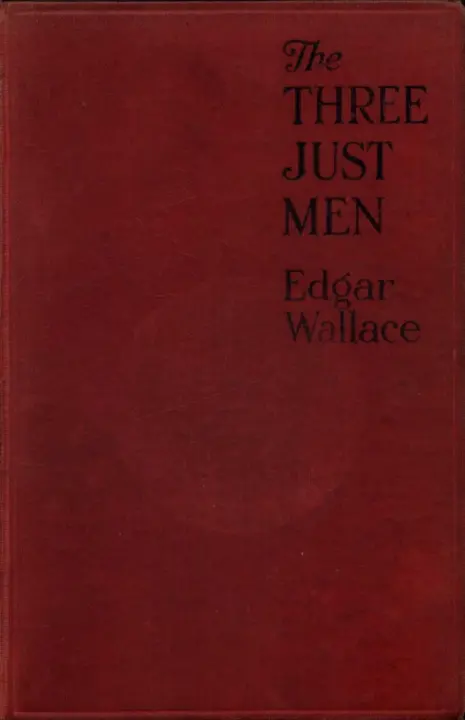
"The Three Just Men" by Edgar Wallace is a crime fiction novel written in the early 20th century. The story revolves around the exploits of a clandestine group of vigilantes known as the Three Just Men, who take it upon themselves to exact justice where the law fails. Central to the plot is Mirabelle Leicester, a young woman who becomes unknowingly entwined in their dangerous world after she seeks employment in London. At the start of the narrative, we are introduced to Mirabelle Leicester, who discovers a job advertisement that sets her on a path to the big city. Her aunt, Alma, expresses concern for Mirabelle’s safety as they discuss the notorious reputation of the Four Just Men, a group that presumably inspired fear across London. Meanwhile, a series of mysterious deaths attributed to a venomous escaped snake complicates the atmosphere of dread in the city. As Mirabelle secures the job with the enigmatic Dr. Oberzohn, it becomes evident that her life is about to collide dramatically with the unfolding events involving the Just Men and their controversial methods of dispensing justice. The opening engages readers with intrigue, suggesting a mix of suspense, danger, and moral ambiguity that sets the tone for Mirabelle's forthcoming adventure.
Introduction adapted from the source catalogue; source summaries may be automatically generated.
Free to read · English · 93,908 words · No account needed
MAKE TIME FOR A GOOD BOOK
On by default. Untick to stop anonymous reading totals. Each page counts after 10 seconds in view. How this works.
Anonymous counting is on unless you have switched it off.
“She’s here all right,” said Joan, who was not at all embarrassed by the presence of the footman. “Monty, isn’t she a bit of a fool? She couldn’t say boo to a goose. What is the general scheme?”
He was brushing his hair delicately in the mirror above the hall-stand.
“What’s what scheme?” he asked, after the servant had gone, as he strolled into the drawing-room before her.
“Bringing her here—is she sitting into a game?”
“Don’t be stupid,” said Monty without heat, as he dropped wearily to a low divan and drew a silken cushion behind him. “Nor inquisitive,” he added. “You haven’t scared her, have you?”
“I like that!” she said indignantly.
She was one of those ladies who speak more volubly and with the most assurance when there is a mirror in view, and she had her eyes fixed upon herself all the time she was talking, patting a strand of hair here and there, twisting her head this way and that to get a better effect, and never once looking at the man until he drew attention to himself.
“Scared! I’ll bet she’s never been to such a beautiful house in her life! What is she, Monty? A typist or something? I don’t understand her.”
“She’s a lady,” said Monty offensively. “That’s the type that’ll always seem like a foreign language to you.”
She lifted one shoulder delicately.
“I don’t pretend to be a lady, and what I am, you’ve made me,” she said, and the reproach was mechanical. He had heard it before, not only from her but from others similarly placed. “I don’t think it’s very kind to throw my education up in my face, considering the money I’ve made for you.”
“And for yourself.” He yawned. “Get me some tea.”
“You might say ‘please’ now and again,” she said resentfully, and he smiled as he took up the evening paper, paying her no more attention, until she had rung the bell with a vicious jerk and the silver tray came in and was deposited on a table near him.
“Where are you going to-night?”
His interest in her movements was unusual, and she was flattered.
“You know very well, Monty, where I’m going to-night,” she said reproachfully. “You promised to take me too. I think you’d look wonderful as a Crusader—one of them—those old knights in armour.”
He nodded, but not to her comment.
“I remember, of course—the Arts Ball.”
His surprise was so well simulated that she was deceived.
Your reading position is saved on this browser. Take it to another device with a library code. Reading pages adapt to text, rather than matching a printed edition.
Edgar Wallace
Edgar Wallace
Edgar Wallace
Edgar Wallace
BEHIND THE BOOK
This eBook is for the use of anyone anywhere in the United States and most other parts of the world at no cost and with almost no restrictions whatsoever. You may copy it, give it away or re-use it under the terms of the Project Gutenberg License included with this eBook or online at www.gutenberg.org. If you are not located in the United States, you will have to check the laws of the country where you are located before using this eBook. Read the source licence.
The original source file, including credits and licence, is retained by this library. Request an original-format copy at no charge. Please include the book title and Project Gutenberg identifier #69790.
KEEP YOUR CURIOSITY GOING
Coulson Kernahan

Maurice Baring
Frances Wright
Cécile Tormay

Frederic Jesup Stimson

W. H. P. (William Henry Pope) Jarvis