
The fourth plague
Edgar Wallace
THE CLASSIC COLLECTION · 1929
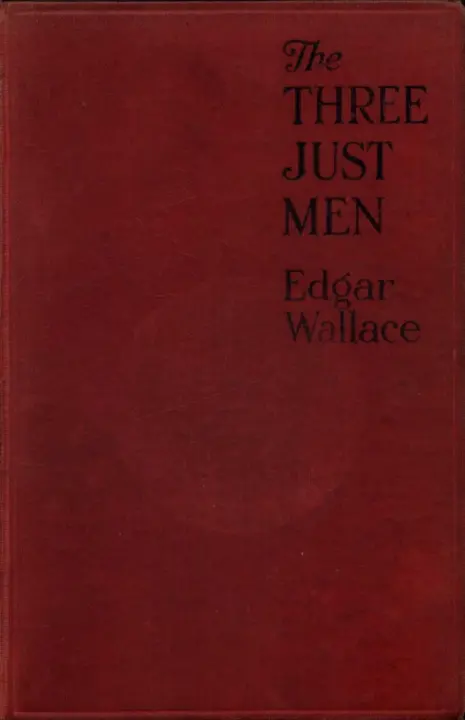
"The Three Just Men" by Edgar Wallace is a crime fiction novel written in the early 20th century. The story revolves around the exploits of a clandestine group of vigilantes known as the Three Just Men, who take it upon themselves to exact justice where the law fails. Central to the plot is Mirabelle Leicester, a young woman who becomes unknowingly entwined in their dangerous world after she seeks employment in London. At the start of the narrative, we are introduced to Mirabelle Leicester, who discovers a job advertisement that sets her on a path to the big city. Her aunt, Alma, expresses concern for Mirabelle’s safety as they discuss the notorious reputation of the Four Just Men, a group that presumably inspired fear across London. Meanwhile, a series of mysterious deaths attributed to a venomous escaped snake complicates the atmosphere of dread in the city. As Mirabelle secures the job with the enigmatic Dr. Oberzohn, it becomes evident that her life is about to collide dramatically with the unfolding events involving the Just Men and their controversial methods of dispensing justice. The opening engages readers with intrigue, suggesting a mix of suspense, danger, and moral ambiguity that sets the tone for Mirabelle's forthcoming adventure.
Introduction adapted from the source catalogue; source summaries may be automatically generated.
Free to read · English · 93,908 words · No account needed
MAKE TIME FOR A GOOD BOOK
On by default. Untick to stop anonymous reading totals. Each page counts after 10 seconds in view. How this works.
Anonymous counting is on unless you have switched it off.
The letter was in an educated hand.
“He didn’t strike me as a man who wrote books,” said Meadows, and
continued his search.
Presently he unfolded a dilapidated map, evidently of Angola. It was rather on the small scale, so much so that it took in a portion of the Kalahari Desert in the south, and showed in the north the undulations of the rolling Congo.
“No marks of any kind,” said Meadows, carrying the chart to the window to examine it more carefully. “And that, I think, is about all—unless this is something.”
“This” was wrapped in a piece of cloth, and was fastened to the bottom and the sides of the trunk by two improvised canvas straps. Meadows tried to pull it loose and whistled.
“Gold,” he said. “Nothing else can weigh quite as heavily as this.”
He lifted out the bundle eventually, unwrapped the covering, and gazed in amazement on the object that lay under his eyes. It was an African bête, a nude, squat idol, rudely shaped, the figure of a native woman.
“Gold?” said Manfred incredulously, and tried to lift it with his finger and thumb. He took a firmer grip and examined the discovery closely.
There was no doubt that it was gold, and fine gold. His thumb-nail made a deep scratch in the base of the statuette. He could see the marks where the knife of the inartistic sculptor had sliced and carved.
Meadows knew the coast fairly well: he had made many trips to Africa and had stopped off at various ports en route.
“I’ve never seen anything exactly like it before,” he said, “and it isn’t recent workmanship either. When you see this”—he pointed to a physical peculiarity of the figure—“you can bet that you’ve got something that’s been made at least a couple of hundred years, and probably before then. The natives of West and Central Africa have not worn toe-rings, for example, since the days of the Cæsars.”
He weighed the idol in his hand.
“Roughly ten pounds,” he said. “In other words, eight hundred pounds’
worth of gold.”
He was examining the cloth in which the idol had been wrapped, and
uttered an exclamation.
“Look at this,” he said.
Written on one corner, in indelible pencil, were the words:
“Second shelf up left Gods lobby sixth.”
Suddenly Manfred remembered.
“Would you have this figure put on the scales right away?” he said. “I’m curious to know the exact weight.”
“Why?” asked Meadows in surprise, as he rang the bell.
Your reading position is saved on this browser. Take it to another device with a library code. Reading pages adapt to text, rather than matching a printed edition.
Edgar Wallace
Edgar Wallace
Edgar Wallace
Edgar Wallace
BEHIND THE BOOK
This eBook is for the use of anyone anywhere in the United States and most other parts of the world at no cost and with almost no restrictions whatsoever. You may copy it, give it away or re-use it under the terms of the Project Gutenberg License included with this eBook or online at www.gutenberg.org. If you are not located in the United States, you will have to check the laws of the country where you are located before using this eBook. Read the source licence.
The original source file, including credits and licence, is retained by this library. Request an original-format copy at no charge. Please include the book title and Project Gutenberg identifier #69790.
KEEP YOUR CURIOSITY GOING
Coulson Kernahan

Maurice Baring
Frances Wright
Cécile Tormay

Frederic Jesup Stimson

W. H. P. (William Henry Pope) Jarvis