
The fourth plague
Edgar Wallace
THE CLASSIC COLLECTION · 1929
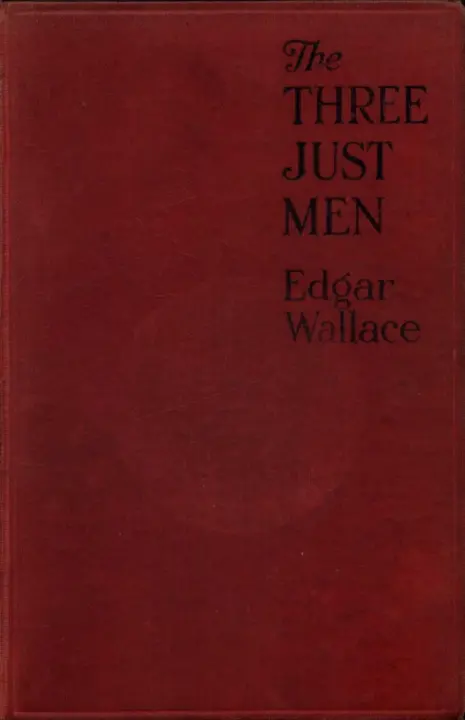
"The Three Just Men" by Edgar Wallace is a crime fiction novel written in the early 20th century. The story revolves around the exploits of a clandestine group of vigilantes known as the Three Just Men, who take it upon themselves to exact justice where the law fails. Central to the plot is Mirabelle Leicester, a young woman who becomes unknowingly entwined in their dangerous world after she seeks employment in London. At the start of the narrative, we are introduced to Mirabelle Leicester, who discovers a job advertisement that sets her on a path to the big city. Her aunt, Alma, expresses concern for Mirabelle’s safety as they discuss the notorious reputation of the Four Just Men, a group that presumably inspired fear across London. Meanwhile, a series of mysterious deaths attributed to a venomous escaped snake complicates the atmosphere of dread in the city. As Mirabelle secures the job with the enigmatic Dr. Oberzohn, it becomes evident that her life is about to collide dramatically with the unfolding events involving the Just Men and their controversial methods of dispensing justice. The opening engages readers with intrigue, suggesting a mix of suspense, danger, and moral ambiguity that sets the tone for Mirabelle's forthcoming adventure.
Introduction adapted from the source catalogue; source summaries may be automatically generated.
Free to read · English · 93,908 words · No account needed
MAKE TIME FOR A GOOD BOOK
On by default. Untick to stop anonymous reading totals. Each page counts after 10 seconds in view. How this works.
Anonymous counting is on unless you have switched it off.
Every gang-leader attended upon Mr. Oberzohn once a week with his pay-roll, and it was usually the custom for the Herr Doktor to bring his cash-box into the room and extract sufficient to liquidate his indebtedness to the leader. It was a big box, and on pay-day, as this was, filled to the top with bank-notes and Treasury bills. He brought it back now, put it on the table, consulted the little slip that Cuccini offered to him, and, taking out a pad of notes, fastened about by a rubber band, he wetted his finger and thumb.
“You needn’t count them,” said Cuccini. “We’ll take the lot.”
The doctor turned to see that Cuccini was carelessly holding a gun in
his hand.
“The fact is, doctor,” said Cuccini coolly, “we’ve seen the red light, and if we don’t skip now, while the skipping’s good, there’s going to be no place we can stay comfortable in this little island, and I guess we’ll follow Gurther.”
One glance the doctor gave at the pistol and then he resumed his counting, as though nothing had happened.
“Twenty, thirty, forty, fifty . . .”
“Now quit that,” said Cuccini roughly. “I tell you, you needn’t count.”
“My friend, I prefer to know what I am going to lose. It is a pardonable piece of curiosity.”
He raised his hand to the wall, where a length of cord hung, and pulled at it gently, without taking his eyes from the bank-notes.
“What are you doing? Put up your hands!” hissed Cuccini.
“Shoot, I beg.” Oberzohn threw a pad of notes on the table. “There is your pay.” He slammed down the lid of the box. “Now you shall go, if you can go! Do you hear them?” He raised his hand, and to the strained ears of the men came a gentle rustling sound from the passage outside as though somebody were dragging a piece of parchment along the floor. “Do you hear? You shall go if you can,” said the doctor again, with amazing calmness.
“The snakes!” breathed Cuccini, going white, and the hand that held the
pistol shook.
“Shoot them, my friend,” sneered Oberzohn. “If you see them, shoot them. But you will not see them, my brave man. They will be—where? No eyes shall see them come or go. They may lie behind a picture, they may wait until the door is opened, and then . . . !”
Cuccini’s mouth was dry.
“Call ’em off, doctor,” he said tremulously.
“Your gun—on the table.”
Still the rustling sound was audible. Cuccini hesitated for a second, then obeyed, and took up the notes.
Your reading position is saved on this browser. Take it to another device with a library code. Reading pages adapt to text, rather than matching a printed edition.
Edgar Wallace
Edgar Wallace
Edgar Wallace
Edgar Wallace
BEHIND THE BOOK
This eBook is for the use of anyone anywhere in the United States and most other parts of the world at no cost and with almost no restrictions whatsoever. You may copy it, give it away or re-use it under the terms of the Project Gutenberg License included with this eBook or online at www.gutenberg.org. If you are not located in the United States, you will have to check the laws of the country where you are located before using this eBook. Read the source licence.
The original source file, including credits and licence, is retained by this library. Request an original-format copy at no charge. Please include the book title and Project Gutenberg identifier #69790.
KEEP YOUR CURIOSITY GOING
Coulson Kernahan

Maurice Baring
Frances Wright
Cécile Tormay

Frederic Jesup Stimson

W. H. P. (William Henry Pope) Jarvis