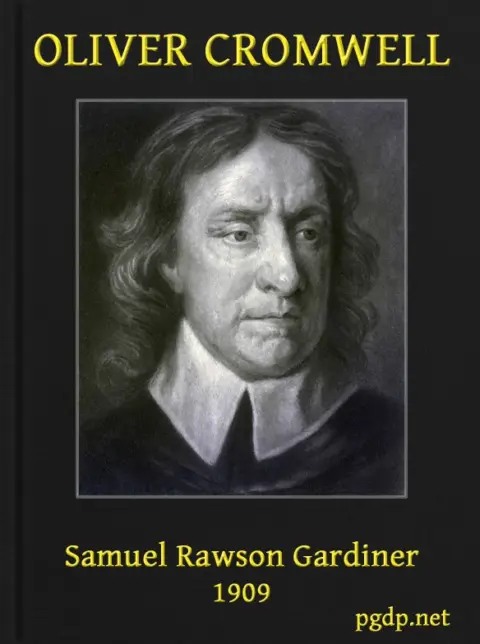
Oliver Cromwell
Samuel Rawson Gardiner
THE CLASSIC COLLECTION · 1881
"The Thirty Years' War, 1618-1648" by Samuel Rawson Gardiner is a historical account written in the late 19th century. This work explores the complex and tumultuous period of the Thirty Years' War, which ravaged much of Europe, particularly Germany and France, examining the political and religious strife that motivated the conflict. It also delves into the ramifications of this war, showcasing the evolution of national identity and the struggle for religious tolerance amidst the chaos of war. The opening of the book provides a preface that emphasizes the specialized nature of the subject matter, highlighting its focus on Continental history as opposed to English history. Gardiner acknowledges the challenges in presenting this topic, citing the absence of national unity in Germany and the intricate interplay between various political and religious factions. He introduces the reader to the key themes of the book, including the tensions surrounding Protestantism, the failure of the German Diet to act as a cohesive governing body, and the growing conflict between Catholic and Protestant states. Furthermore, he suggests that the underlying issues of disunity and the principles of religious toleration will shape the narrative throughout the work.
Introduction adapted from the source catalogue; source summaries may be automatically generated.
Free to read · English · 77,707 words · No account needed
MAKE TIME FOR A GOOD BOOK
On by default. Untick to stop anonymous reading totals. Each page counts after 10 seconds in view. How this works.
Anonymous counting is on unless you have switched it off.
Werth, John of, general in Maximilian's service, 207.
Weston, Sir Richard, represents England at the Congress at Brussels, 57.
Westphalia, the Peace of, opening of negotiations for, 209;
signature of, 213;
its results, 215.
White Hill, battle of the, 45.
Wiesloch, combat of, 57.
William, Landgrave of Hesse Cassel, joins Gustavus, 138; shut out from the benefits of the treaty of Prague, 186; his alliance with France, 190.
Wimpfen, battle of, 57.
Winter-king, nickname of Frederick, 39.
Wismar in Wallenstein's hands, 108.
Wittingau, occupied by Mansfeld, 48.
Wittstock, battle of, 194.
Wolfenbüttel holds out for Christian IV., 101;
battle at, 201.
Wrangel, succeeds Torstenson as commander of the Swedes, 209;
joins Turenne, 212.
Würtemberg, accepts the terms of the treaty of Prague, 195.
Würzburg taken by Gustavus, 147;
surrenders to Turenne, 212.
Ypres, surrenders to the French, 224.
Znaim, Wallenstein confers with Eggenberg at, 153.
Zusmarshausen, battle of, 231.
An Important Historical Series.
EDWARD E. MORRIS, M.A.,
Of Lincoln College, Oxford.
Head Master of the Bedfordshire Middle-Class Public School, &c.
Each 1 vol. 16mo. with Outline Maps. Price per volume, in cloth, $1.00.
Histories of countries are rapidly becoming so numerous that it is almost impossible for the most industrious student to keep pace with them. Such works are, of course, still less likely to be mastered by those of limited leisure. It is to meet the wants of this very numerous class of readers that the Epochs of History has been projected. The series will comprise a number of compact, handsomely printed manuals, prepared by thoroughly competent hands, each volume complete in itself, and sketching succinctly the most important epochs in the world's history, always making the history of a nation subordinate to this more general idea. No attempt will be made to recount all the events of any given period. The aim will be to bring out in the clearest light the salient incidents and features of each epoch. Special attention will be paid to the literature, manners, state of knowledge, and all those characteristics which exhibit the life of a people as well as the policy of their rulers during any period. To make the text more readily intelligible, outline maps will be given with each volume, and where this arrangement is desirable they will be distributed throughout the text so as to be more easy of reference. A series of works based upon this general plan can not fail to be widely useful in popularizing history as science has lately been popularized. Those who have been discouraged from attempting more ambitious works because of their magnitude, will naturally turn to these Epochs of History to get a general knowledge of any period; students may use them to great advantage in refreshing their memories and in keeping the true perspective of events, and in schools they will be of immense service as text books,--a point which shall be kept constantly in view in their preparation.
Your reading position is saved on this browser. Take it to another device with a library code. Reading pages adapt to text, rather than matching a printed edition.
Samuel Rawson Gardiner
Samuel Rawson Gardiner
BEHIND THE BOOK
This eBook is for the use of anyone anywhere in the United States and most other parts of the world at no cost and with almost no restrictions whatsoever. You may copy it, give it away or re-use it under the terms of the Project Gutenberg License included with this eBook or online at www.gutenberg.org. If you are not located in the United States, you will have to check the laws of the country where you are located before using this eBook. Read the source licence.
The original source file, including credits and licence, is retained by this library. Request an original-format copy at no charge. Please include the book title and Project Gutenberg identifier #40082.
KEEP YOUR CURIOSITY GOING
Cécile Tormay

Moritz Busch
John L. Ransom
Frances Wright
Cécile Tormay

Mabel Potter Daggett