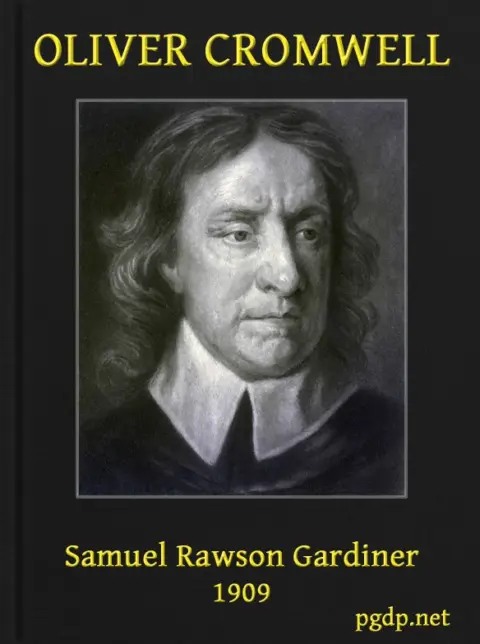
Oliver Cromwell
Samuel Rawson Gardiner
THE CLASSIC COLLECTION · 1881
"The Thirty Years' War, 1618-1648" by Samuel Rawson Gardiner is a historical account written in the late 19th century. This work explores the complex and tumultuous period of the Thirty Years' War, which ravaged much of Europe, particularly Germany and France, examining the political and religious strife that motivated the conflict. It also delves into the ramifications of this war, showcasing the evolution of national identity and the struggle for religious tolerance amidst the chaos of war. The opening of the book provides a preface that emphasizes the specialized nature of the subject matter, highlighting its focus on Continental history as opposed to English history. Gardiner acknowledges the challenges in presenting this topic, citing the absence of national unity in Germany and the intricate interplay between various political and religious factions. He introduces the reader to the key themes of the book, including the tensions surrounding Protestantism, the failure of the German Diet to act as a cohesive governing body, and the growing conflict between Catholic and Protestant states. Furthermore, he suggests that the underlying issues of disunity and the principles of religious toleration will shape the narrative throughout the work.
Introduction adapted from the source catalogue; source summaries may be automatically generated.
Free to read · English · 77,707 words · No account needed
MAKE TIME FOR A GOOD BOOK
On by default. Untick to stop anonymous reading totals. Each page counts after 10 seconds in view. How this works.
Anonymous counting is on unless you have switched it off.
Netherlands, the Spanish, defended against a French attack, 191.
Netherlands, United States of the, end of their truce with Spain, 51; acknowledgment of their independence, 221.
Neuberg, Wolfgang Wilhelm, Count Palatine of,
lays claim to the duchy of Cleves, 22;
has his ears boxed, 22.
Neustadt, misery at, 188.
Nevers, Duke of, his claims to the succession in Mantua, 122.
New Brandenburg, taken by Tilly, 134.
Nienburg, holds out for Christian IV., 101.
Nordheim, holds out for Christian IV., 101.
Nördlingen, treatment of the Protestants at, 120;
battle of, 183;
second battle of, 208;
surrenders to Turenne, 213.
Nüremberg, joins the Union, 20, 21;
meeting of the Union at, 41;
deserts the Union, 47;
welcomes Gustavus, 148;
despatches Gustavus against Wallenstein, 158;
sufferings of, 158.
Oñate, opposes Wallenstein, 175;
proposes to kill Wallenstein, 177.
Oppenheim, stormed by Gustavus, 147.
Osnabrück, election of a Catholic Bishop of, 67;
meeting of diplomatists at, 217.
Otto the Great, becomes Emperor, 2.
Oudenarde, surrender to the French, 224.
Oxenstjerna, his view of Gustavus' march upon the Rhine, 145;
receives the government of Mentz, 148;
his position after the death of Gustavus, 166;
asked to help Wallenstein, 172;
keeps his doubts till the last, 179;
surrenders fortresses in Alsace to Richelieu, 192.
Paderborn, attack upon by Christian of Brunswick, 55.
Palatinate, the Lower, attacked by Spinola, 43;
defended by Vere, 49;
invaded by Tilly, 50;
conquered by Tilly, 60;
the eastern part made over to Maximilian, 119;
the whole restored to Charles Lewis, 214.
Palatinate, the Upper, Mansfeld's occupation of, 50;
its conquest by Tilly, 50;
made over to Maximilian, 119;
secured to him by the peace of Westphalia, 214.
Pappenheim, confidence that Gustavus will be beaten, 139;
storms Magdeburg, 135;
commands on the Rhine, 161;
leaves Wallenstein before the battle of Lützen, 161;
is killed at Lützen, 161.
Passau, convention of, 9.
Peace of Augsburg. See Augsburg.
Peace of Phillipsburg, French garrison of, 215.
Piccolomini, offers to join Wallenstein, 175;
declares against him, 177;
tries to seize him, 177;
orders Butler to capture Wallenstein, 180.
Pignerol, seized by Richelieu, 124.
Pilsen refuses to take part with the Bohemian directors, 32; besieged and taken by Mansfeld, 33; Wallenstein holds a meeting of officers at, 177.
Pomerania laid waste by Wallenstein's troops, 127;
Gustavus lands in, 128;
divided between Brandenburg and Sweden, 214.
Pomerania, Duke of, See Boguslav.
Portugal, independence of, 200.
Prague, revolution at, 29;
Frederick crowned King of Bohemia at, 38;
Frederick's growing unpopularity there, 43;
battle at the White Hill near, 45;
entered by the Saxons, 151;
recovered by Wallenstein, 155;
part of it taken by the Swedes, 213.
Prague, the treaty of, 184.
Princes of the Empire, their increasing power, 3;
compared with the French vassals, 4;
care little for the Diet, 5;
their part in the Diet, 6;
the majority opposed to Protestantism, 9.
Protestantism, its rise in Germany, 7;
its position in North Germany, 12;
its division, 12;
contrast between it in the north and the south, 17.
Pyrenees, treaty of the, 224.
Ratisbon, diets held at, 61, 127;
taken by Bernhard, 173.
Ratseburg, bishopric of, named in the Edict of Restitution, 121.
Regensburg. See Ratisbon.
Reichshofrath. See Imperial Council.
Your reading position is saved on this browser. Take it to another device with a library code. Reading pages adapt to text, rather than matching a printed edition.
Samuel Rawson Gardiner
Samuel Rawson Gardiner
BEHIND THE BOOK
This eBook is for the use of anyone anywhere in the United States and most other parts of the world at no cost and with almost no restrictions whatsoever. You may copy it, give it away or re-use it under the terms of the Project Gutenberg License included with this eBook or online at www.gutenberg.org. If you are not located in the United States, you will have to check the laws of the country where you are located before using this eBook. Read the source licence.
The original source file, including credits and licence, is retained by this library. Request an original-format copy at no charge. Please include the book title and Project Gutenberg identifier #40082.
KEEP YOUR CURIOSITY GOING
Cécile Tormay

Moritz Busch
John L. Ransom
Frances Wright
Cécile Tormay

Mabel Potter Daggett