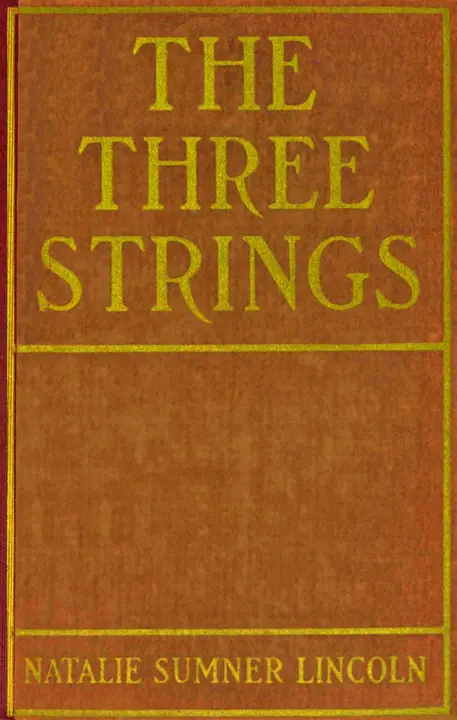
The three strings
Natalie Sumner Lincoln
THE CLASSIC COLLECTION · 1924
"The Thirteenth Letter" by Natalie Sumner Lincoln is a murder mystery novel written in the early 20th century. The narrative opens with an ominous atmosphere surrounding Paul Abbott, a sick man who has just returned home to his family's country lodge near Washington, D.C. The story unfolds as the focus shifts to his nurse, Miriam Ward, whose fateful night shift becomes intertwined with the shocking events that follow Abbott's apparent murder. At the start of the story, Paul Abbott is gravely ill, and his new nurse, Miriam Ward, is tasked with his care amid a raging snowstorm. As events transpire, a mysterious girl named Betty Carter arrives with a clergyman, ultimately revealing a complex web of relationships. Tension builds when Abbott is discovered dead, leading to chaos and intrigue. As the characters grapple with confusion and suspicions, Miriam's night takes a dark turn when she finds herself chloroformed, complicating her role in the unfolding mystery. This opening effectively sets the stage for a gripping tale of deception, love, and the quest for justice.
Introduction adapted from the source catalogue; source summaries may be automatically generated.
Free to read · English · 61,752 words · No account needed
MAKE TIME FOR A GOOD BOOK
On by default. Untick to stop anonymous reading totals. Each page counts after 10 seconds in view. How this works.
Anonymous counting is on unless you have switched it off.
"Here is a Canadian stamp of the same issue," he said. "Paul wrote me when he was last in Canada, and I kept the stamp. Let's see--"
Miriam waited with absorbed attention while he applied the gauge to the stamp. When he looked up his eyes were shining.
"The stamp has exactly fifty-two perforations," he announced. "Can it
be a coincidence or a--"
"A what?"
He looked at her without speaking for a moment. "The number is just twice that of the letters of the alphabet." Trenholm drew in his breath. "I have come to your way of thinking, Miss Ward. It must be a code, and it may be that two alphabets are registered on each stamp, the cuts corresponding to the letters according to the number of the particular perforation affected, counting from one corner of the stamp."
Miriam, who had been following his explanation with close attention,
nodded her head wisely.
"I see," she broke in. "That would explain any irregularity in the cuts, because for coding it would be sufficient to indicate the perforation intended to be cut, without making a mark of a definite character, and with this gauge of yours the number of the perforation which has been cut would be recognized at once."
"Exactly," he answered. "Without a gauge there would be great difficulty in determining the number of the perforation, because the cut might seem to create new indentations if carelessly made." Trenholm stopped and took up the envelope of the thirteenth letter and applied his gauge to the left-hand stamp, and Miriam, pencil in hand, assisted him.
Trenholm counted clockwise. "Five perforations are damaged," he declared, "numbers 8, 20, 23, 27, 30. Now, if the code is based on a double alphabet, these would become 8, 20, 23, 1, 3, or the letters H, T, W, A, C. How are the letters to be arranged, Miss Ward?"
She looked at her pad, where she had jotted down the letters as well as the figures. "There is only one vowel," she said. "It must be one word. Then why use two alphabets?"
"Possibly because of the accidental chance that the stamp perforations count up to fifty-two," replied Trenholm. "It would be convenient, in case of a word with many letters, to prevent destroying the appearance of the stamp by cutting too many indentations close to one another. Have you solved the first word?" as she checked an exclamation.
"Yes--'watch.'"
"Good!" Trenholm's eyes were bright with excitement. Looking again at the first stamp, he noticed that the first, third, and fifth letters of the words "watch" were indicated on the first alphabet, and the remaining letters on the second one.
Your reading position is saved on this browser. Take it to another device with a library code. Reading pages adapt to text, rather than matching a printed edition.
Natalie Sumner Lincoln
Natalie Sumner Lincoln
Natalie Sumner Lincoln
Natalie Sumner Lincoln
BEHIND THE BOOK
This eBook is for the use of anyone anywhere in the United States and most other parts of the world at no cost and with almost no restrictions whatsoever. You may copy it, give it away or re-use it under the terms of the Project Gutenberg License included with this eBook or online at www.gutenberg.org. If you are not located in the United States, you will have to check the laws of the country where you are located before using this eBook. Read the source licence.
The original source file, including credits and licence, is retained by this library. Request an original-format copy at no charge. Please include the book title and Project Gutenberg identifier #67890.
KEEP YOUR CURIOSITY GOING
Coulson Kernahan

Maurice Baring
Frances Wright
Cécile Tormay

Frederic Jesup Stimson

W. H. P. (William Henry Pope) Jarvis