
Letters to a Friend, Written to Mrs. Ezra S. Carr, 1866-1879
John Muir
THE CLASSIC COLLECTION · 1878
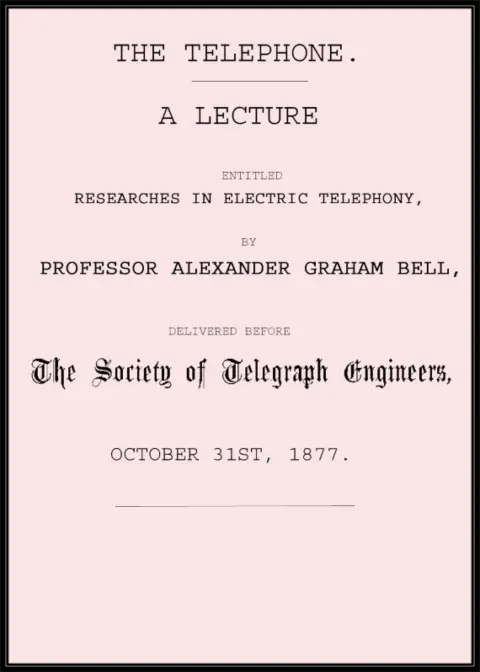
"The telephone: a lecture entitled Researches in electric telephony" by Alexander Graham Bell is a scientific publication delivered in the late 19th century. The book contains an account of Bell's experiments and discoveries related to electric telephony, focusing particularly on the principles and mechanisms behind sound production through electrical means. It reflects a period of significant scientific advancement and innovation in telecommunications. In this lecture, Bell discusses his extensive research into the mechanics of sound and speech, building on previous studies including those by his father and other scientists. He explains the various types of electrical currents that can produce sound and details his development of the telephone, including the use of tuning-forks and the invention of apparatus that captures and conveys articulate speech electrically. Bell recounts the experimental process that led to the first successful transmission of vocal sounds over a distance, highlighting both his successes and the challenges faced in perfecting the technology that would ultimately revolutionize communication.
Introduction adapted from the source catalogue; source summaries may be automatically generated.
Free to read · English · 9,341 words · No account needed
MAKE TIME FOR A GOOD BOOK
On by default. Untick to stop anonymous reading totals. Each page counts after 10 seconds in view. How this works.
Anonymous counting is on unless you have switched it off.
[2] C. G. Page. “The Production of Galvanic Music.” Silliman’s Journ. 1837, xxxii. p. 396; Silliman’s Journ. July, 1837, p. 354; Silliman’s Journ. 1838, xxxiii. p. 118; Bibl. Univ. (new series), 1839, ii. p. 398.
[3] J. P. Marrian. Phil. Mag. xxv. p. 382; Inst. 1845, p. 20; Arch.
de l’Électr. v. p. 195.
[4] W. Beatson. Arch. de l’Électr. v. p. 197; Arch. de Sc. Phys. et Nat. (2d series), ii. p. 113.
[5] Gassiot. See “Treatise on Electricity,” by De la Rive, i. p. 300.
[6] De la Rive. Treatise on Electricity, i. p. 300; Phil. Mag. xxxv. p. 422; Arch. de l’Électr. v. p. 200; Inst. 1846, p. 83; Comptes Rendus, xx. p. 1287; Comp. Rend. xxii. p. 432; Pogg. Ann. lxxvi. p. 637; Ann. de Chim. et de Phys. xxvi. p. 158.
[7] Matteucci. Inst. 1845, p. 315; Arch, de l’Électr. v. 389.
[8] Guillemin. Comp. Rend. xxii. p. 264; Inst. 1846, p. 30; Arch. d. Sc. Phys. (2d series), i. p. 191.
[9] G. Wertheim. Comp. Rend. xxii. pp. 336, 544; Inst. 1846, pp. 65, 100; Pogg. Ann. lxviii. p. 140; Comp. Rend. xxvi. p. 505; Inst. 1848, p. 142; Ann. de Chim. et de Phys., xxiii. p. 302; Arch. d. Sc. Phys. et Nat. viii. p. 206; Pogg. Ann. lxxvii. p. 43; Berl. Ber. iv. p. 121.
[10] Elie Wartmann. Comp. Rend. xxii. p. 544; Phil. Mag. (3d series), xxviii. p. 544; Arch. d. Sc. Phys. et Nat. (2d series), i. p. 419; Inst. 1846, p. 290; Monatscher. d. Berl. Akad. 1846, p. 111.
[11] Janniar. Comp. Rend, xxiii. p. 319; Inst. 1846, p. 269; Arch. d. Sc. Phys. et Nat. (2d. series), ii. p. 394.
[12] J. P. Joule. Phil. Mag. xxv. pp. 76, 225; Berl. Ber. iii. p. 489.
[13] Laborde. Comp. Rend. l. p. 692; Cosmos, xvii. p. 514.
[14] Legat. Brix. Z. S. ix. p. 125.
[15] Reis. “Téléphonie.” Polytechnic Journ. clxviii. p. 185; Böttger’s Notizbl. 1863, No. 6.
[16] J. C. Poggendorff. Pogg. Ann. xcviii. p. 192; Berliner Monatsber. 1856, p. 133; Cosmos, ix. p. 49; Berl. Ber. xii. p. 241; Pogg. Ann. lxxxvii. p. 139.
[17] Du Moncel. Exposé, ii. p. 125; also, iii. p. 83.
[18] Delezenne. “Sound produced by Magnetization,” Bibl. Univ. (new series), 1841, xvi. p. 406.
[19] See London Journ. xxxii. p. 402; Polytechnic Journ. ex. p. 16; Cosmos, iv. p. 43; Glösener—Traité général, &c. p. 350; Dove.-Repert. vi. p. 58; Pogg. Ann. xliii. p. 411; Berl. Ber. i. p. 144; Arch. d. Sc. Phys. et Nat. xvi. p. 406; Kuhn’s Encyclopædia der Physik, pp. 1014-1021.
[20] Gore. Proceedings of Royal Society, xii. p. 217.
[21] C. G. Page. “Vibration of Trevelyan’s bars by the galvanic current.” Silliman’s Journal, 1850, ix. pp. 105-108.
[22] Sullivan. “Currents of Electricity produced by the vibration of Metals,” Phil. Mag. 1845, p. 261; Arch. de l’Électr. x. p. 480.
[23] The full description of this figure will be found in Mr. Alexander J. Ellis’s translation of Helmholtz’s work, “Theory of Tone.”
[24] See Researches in Telephony.—Trans. of American Acad. of Arts and Sciences, vol. xii. p. 1.
[25] Elisha Gray. Eng. Pat. Spec. No. 2646, Aug. 1874.
USEFUL BOOKS ON TELEGRAPHY, &c.
Your reading position is saved on this browser. Take it to another device with a library code. Reading pages adapt to text, rather than matching a printed edition.
BEHIND THE BOOK
This eBook is for the use of anyone anywhere in the United States and most other parts of the world at no cost and with almost no restrictions whatsoever. You may copy it, give it away or re-use it under the terms of the Project Gutenberg License included with this eBook or online at www.gutenberg.org. If you are not located in the United States, you will have to check the laws of the country where you are located before using this eBook. Read the source licence.
The original source file, including credits and licence, is retained by this library. Request an original-format copy at no charge. Please include the book title and Project Gutenberg identifier #55787.
KEEP YOUR CURIOSITY GOING
John Muir

Asa Gray
Asa Gray

Florence Nightingale
Elizabeth Robins Pennell
Denison Olmsted