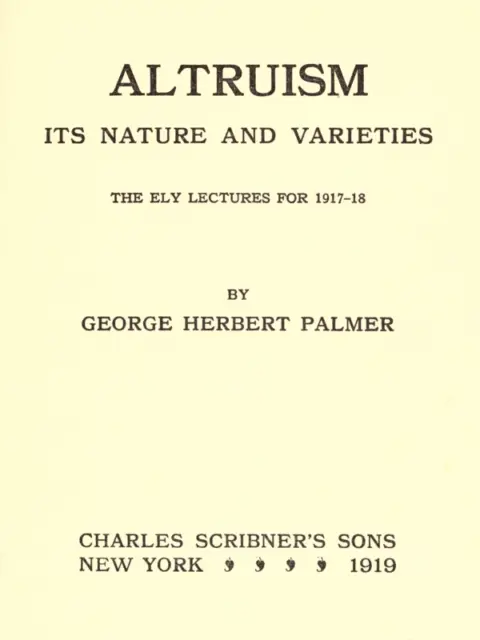
Altruism: Its Nature and Varieties
George Herbert Palmer
THE CLASSIC COLLECTION · 1908
"The Teacher: Essays and Addresses on Education" by George Herbert Palmer and Alice Freeman Palmer is a collection of insightful essays written in the early 20th century. The work delves into various philosophical aspects of education, examining the roles and ideals of teachers, the nature of ethical and moral instruction, and the broader implications of teaching within society. The authors address the significance of teaching as an art form that shapes character and influences the development of students. The opening of the book presents a preface that outlines the structure and core themes of the essays within. Palmer discusses the profound responsibility and influence teachers have over their students, emphasizing the importance of teaching as more than just a profession but an art intertwined with character development. He introduces the concept of "vicariousness" as a necessary quality for teachers, urging them to empathize deeply with their students' perspectives. Palmer's reflections establish the foundational ideas that the following essays will explore, setting the stage for a rich examination of education's role in shaping individuals and society at large.
Introduction adapted from the source catalogue; source summaries may be automatically generated.
Free to read · English · 91,433 words · No account needed
MAKE TIME FOR A GOOD BOOK
On by default. Untick to stop anonymous reading totals. Each page counts after 10 seconds in view. How this works.
Anonymous counting is on unless you have switched it off.
The truth is, Harvard has introduced the principle more slowly than other colleges. She was merely one of the earliest to begin. In 1825, on the recommendation of Judge Story, options were first allowed, in modern languages. Twenty years of experiment followed. In 1846 electives were finally established for seniors and juniors; in 1867 for sophomores; in 1884 for freshmen. But the old method was abandoned so slowly that as late as 1871 some prescribed study remained for seniors, till 1879 for juniors, and till 1884 for sophomores. During this long and unnoticed period, careful comparison was made between the new and old methods. A mass of facts was accumulated, which subsequently rendered possible an extremely rapid adoption of the system by other colleges. Public confidence was tested. Comparing the new Harvard with the old, it is plain enough that a revolution has taken place; but it is a revolution like that in the England of Victoria, wrought not by sudden shock, but quietly, considerately, conservatively, inevitably. Those who have watched the college have approved; the time of transition has been a time of unexampled prosperity. For the last fifteen years the gifts to the University have averaged $250,000 a year. The steady increase in students may be seen at a glance by dividing the last twenty-five years into five-year periods, and noting the average number of undergraduates in each: 1861-65, 423; 1866-70, 477; 1871-75, 657; 1876-80, 808; 1881-85, 873.
These facts are sufficient to show that Harvard has reached her present great prosperity by becoming the pioneer in a general educational movement. What made the movement general was the dread of flimsy study. Our world is larger than the one our grandfathers inhabited; it is more minutely subdivided, more finely related, more subtly and broadly known. The rise of physical science and the enlargement of humanistic interests oblige the college of to-day to teach elaborately many topics which formerly were not taught at all. Not so many years ago a liberal education prepared men almost exclusively for the four professions,--preaching, teaching, medicine, and law. In the first century of its existence one half the graduates of Harvard became ministers. Of the graduates of the last ten years a full third have entered none of the four professions. With a narrow field of knowledge, and with students who required no great variety of training, the task of a college was simple. A single programme decently covered the needs of all. But as the field of knowledge widened, and men began to notice a difference between its contents and those of the college curriculum, an effort was made to enlarge the latter by adding subjects from the former. Modern languages crept in, followed by sciences, political economy, new departments of history, literature, art, philosophy. For the most part, these were added to the studies already taught. But the length of college days is limited. The life of man has not extended with the extension of science. To multiply subjects was soon found equivalent to cheapening knowledge. Where three subjects are studied in place of one, each is pushed only one third as far. A crowded curriculum is a curriculum of superficialities, where men are forever occupied with alphabets and multiplication-tables,--elementary matters, containing little mental nutriment. Thoroughgoing discipline, the acquisition of habits of intellectual mastery, calls for acquaintance with knowledge in its higher ranges, and there is no way of reaching these remoter regions during the brief season of college life except by dividing the field and pressing along paths where personal friction is least. Accordingly, alternative options began to be allowed, at first between the new subjects introduced, then between these and the old ones. But in this inevitable admission of option a new principle was introduced whose germinal force could not afterwards be stayed. The old conception had been that there were certain matters a knowledge of which constituted a liberal education. Compared with the possession of these, the temper of the receiving mind was a secondary affair. This view became untenable. Under the new conditions, college faculties were forced to recognize personal aptitudes, and to stake intellectual gains upon them. In assessing the worth of studies, attention was thus withdrawn from their subject-matter and transferred to the response they called forth in the apprehender. Hence arose a new ideal of education, in which temper of mind had preeminence over quaesita, the guidance of the powers of knowing over the store of matters known. The new education has accordingly passed through two stages of development: first, in order to avoid superficiality when knowledge was coming in like a flood, it was found necessary to admit choice; secondly, in the very necessity of this admission was disclosed a more spiritual ideal of the relation of the mind of man to knowledge.
Your reading position is saved on this browser. Take it to another device with a library code. Reading pages adapt to text, rather than matching a printed edition.
George Herbert Palmer
George Herbert Palmer
BEHIND THE BOOK
This eBook is for the use of anyone anywhere in the United States and most other parts of the world at no cost and with almost no restrictions whatsoever. You may copy it, give it away or re-use it under the terms of the Project Gutenberg License included with this eBook or online at www.gutenberg.org. If you are not located in the United States, you will have to check the laws of the country where you are located before using this eBook. Read the source licence.
The original source file, including credits and licence, is retained by this library. Request an original-format copy at no charge. Please include the book title and Project Gutenberg identifier #36774.
KEEP YOUR CURIOSITY GOING

David Patterson (Spirit) Hatch

David Patterson (Spirit) Hatch

David Patterson (Spirit) Hatch
Coulson Kernahan

Ralph Waldo Emerson

Maurice Baring