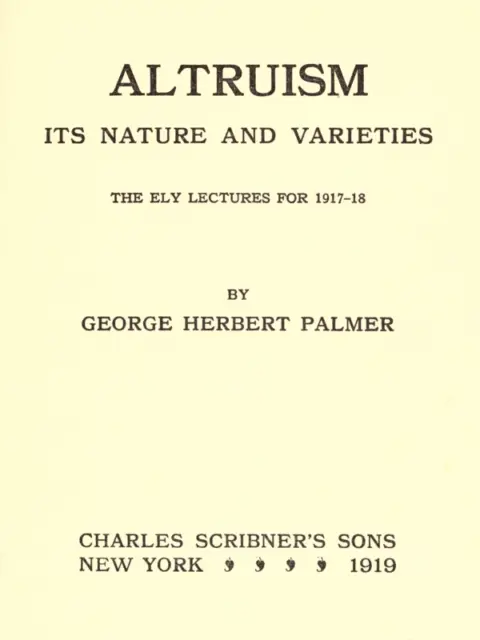
Altruism: Its Nature and Varieties
George Herbert Palmer
THE CLASSIC COLLECTION · 1908
"The Teacher: Essays and Addresses on Education" by George Herbert Palmer and Alice Freeman Palmer is a collection of insightful essays written in the early 20th century. The work delves into various philosophical aspects of education, examining the roles and ideals of teachers, the nature of ethical and moral instruction, and the broader implications of teaching within society. The authors address the significance of teaching as an art form that shapes character and influences the development of students. The opening of the book presents a preface that outlines the structure and core themes of the essays within. Palmer discusses the profound responsibility and influence teachers have over their students, emphasizing the importance of teaching as more than just a profession but an art intertwined with character development. He introduces the concept of "vicariousness" as a necessary quality for teachers, urging them to empathize deeply with their students' perspectives. Palmer's reflections establish the foundational ideas that the following essays will explore, setting the stage for a rich examination of education's role in shaping individuals and society at large.
Introduction adapted from the source catalogue; source summaries may be automatically generated.
Free to read · English · 91,433 words · No account needed
MAKE TIME FOR A GOOD BOOK
On by default. Untick to stop anonymous reading totals. Each page counts after 10 seconds in view. How this works.
Anonymous counting is on unless you have switched it off.
If then the modes of accepting the passion for perfection are so divergent as I have indicated, is it possible to suggest methods by which we may discipline ourselves in the nobler way of seeking the interests of life?--I mean by taking part with things in their beginnings, learning to reverence them there, and so attaining an interest which will continually be supported and carried forward. You may look with some anxiety upon the doctrine which I have laid down. You may say, "But beauty is seductive; beauty allures me. I know that the imperfect in its struggle toward perfection is the nobler matter. I know that America is, for him who can see all things, a more interesting land than Spain. Yes, I know this, but I find it hard to feel it. My strong temptation is to lie and dream in romance, in ideal perfection. By what means may I discipline myself out of this degraded habit and bring myself into the higher life, so that I shall always be interested in progress, in the future rather than in the past, in the on-going rather than in the completed life?" I cannot give an exact and final receipt for this better mind. A persistently studied experience must be the teacher. To-day you may understand what I say, you may resolve to live according to the methods I approve. But you may be sure that to-morrow you will need to learn it all over again. And yet I think I can mention several forms of discipline, as I may call them. I can direct your attention to certain modes by which you may instruct yourselves how to take an interest in the imperfect thing, and still keep that interest an honorable one.
In my judgment, then, your first care should be to learn to observe. A simple matter--one, I dare say, which it will seem to you difficult to avoid. You have a pair of eyes; how can you fail to observe? Ah! but eyes can only look, and that is not observing. We must not rest in looking, but must penetrate into things, if we would find out what is there. And to find this out is worth while, for everything when observed is of immense interest. There is no object so remote from human life that when we come to study it we may not detect within its narrow compass illuminating and therefore interesting matter. But it makes a great difference whether we do thus really observe, whether we hold attention to the thing in hand, and see what it contains. Once, after puzzling long over the charm of Homer, I applied to a learned friend and said to him, "Can you tell me why Homer is so interesting? Why can't you and I write as he wrote? Why is it that his art is lost, and that to-day it is impossible for us to awaken an interest at all comparable to his?"--"Well," said my friend, "I have often meditated on that, but it seems to come to about this: Homer looked long at a thing. Why," said he, "do you know that if you should hold up your thumb and look at it long enough, you would find it immensely interesting?" Homer looks a great while at his thumb. He sees precisely the thing he is dealing with. He does not confuse it with anything else. It is sharp to him; and because it is sharp to him it stands out sharply for us over thousands of years. Have you acquired this art, or do you hastily glance at insignificant objects? Do you see the thing exactly as it is? Do you strip away from it your own likings and dislikings, your own previous notions of what it ought to be? Do you come face to face with things? If you do, the hardest situation in life may well be to you a delight. For you will not regard hardships, but only opportunities. Possibly you may even feel, "Yes, here are just the difficulties I like to explore. How can one be interested in easy things? The hard things of life are the ones for which we ought to give thanks." So we may feel if we have made the cool and hardy temper of the observer our own, if we have learned to put ourselves into a situation and to understand it on all sides. Why, the things on which we have thus concentrated attention become our permanent interests. For example, unluckily when I was trained I was not disciplined in botany. I cannot, therefore, now observe the rose. Some of you can, for you have been studying botany here. I have to look stupidly on the total beauty of the lovely object; I can see it only as a whole, while you, fine observer, who have trained your powers to pierce it, can comprehend its very structure and see how marvellously the blooming thing is put together. My eyes were dulled to that long ago; I cannot observe it. Beware, do not let yourselves grow dull. Observe, observe, observe in every direction! Keep your eyes open. Go forward, understanding that the world was made for your knowledge, that you have the right to enter into and possess it.
Your reading position is saved on this browser. Take it to another device with a library code. Reading pages adapt to text, rather than matching a printed edition.
George Herbert Palmer
George Herbert Palmer
BEHIND THE BOOK
This eBook is for the use of anyone anywhere in the United States and most other parts of the world at no cost and with almost no restrictions whatsoever. You may copy it, give it away or re-use it under the terms of the Project Gutenberg License included with this eBook or online at www.gutenberg.org. If you are not located in the United States, you will have to check the laws of the country where you are located before using this eBook. Read the source licence.
The original source file, including credits and licence, is retained by this library. Request an original-format copy at no charge. Please include the book title and Project Gutenberg identifier #36774.
KEEP YOUR CURIOSITY GOING

David Patterson (Spirit) Hatch

David Patterson (Spirit) Hatch

David Patterson (Spirit) Hatch
Coulson Kernahan

Ralph Waldo Emerson

Maurice Baring